
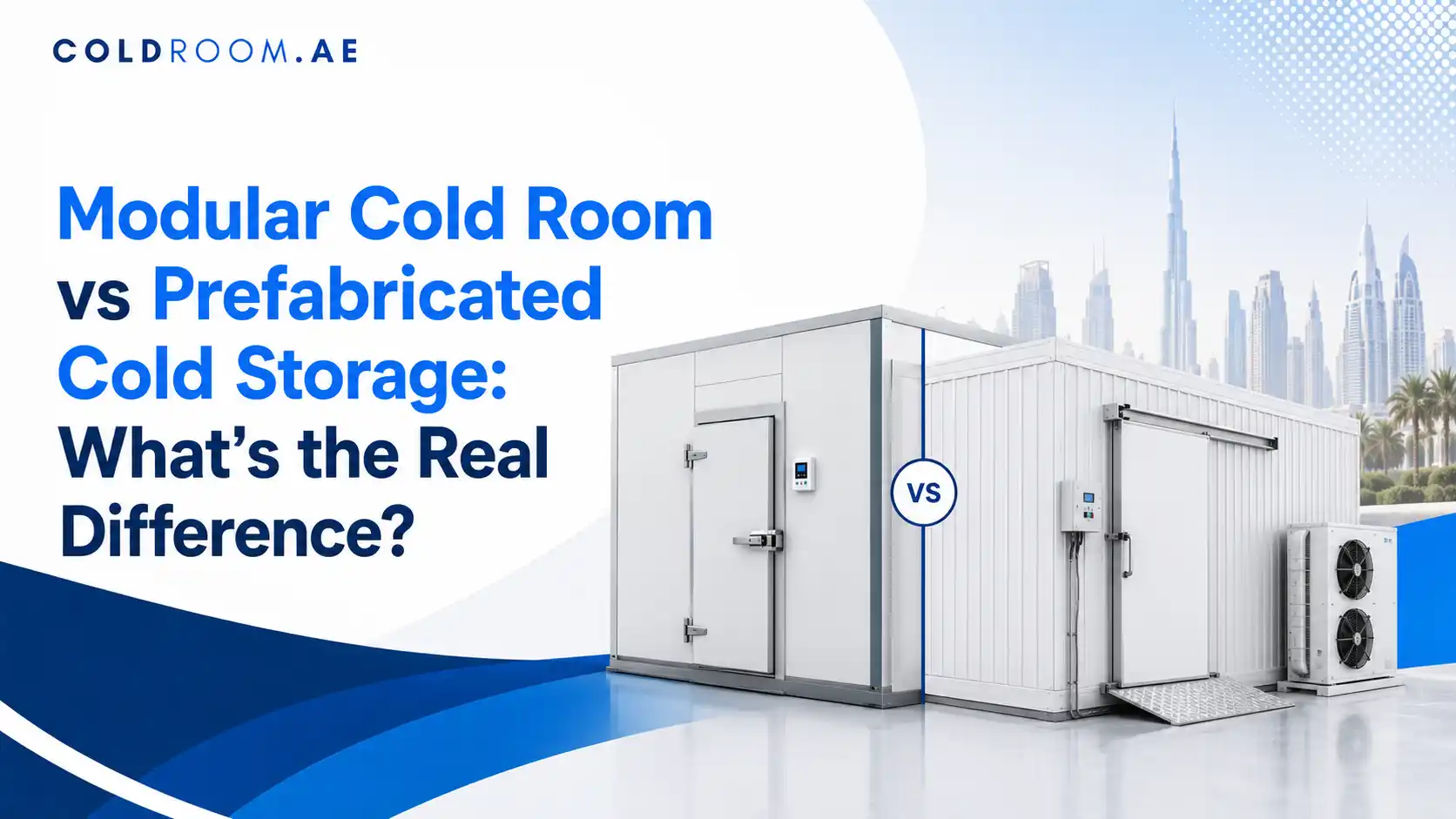
Collect a few quotes for a new cold room in Dubai, Abu Dhabi, or Sharjah, and you’ll hit something odd pretty fast. The prices don’t line up. Neither do the lead times — even when every supplier seems to be quoting the same job. Ask around and you’ll usually find out why: one company calls it “modular,” another calls it “prefabricated,” as if the two words mean the same thing.
They’re not. And the difference isn’t just vocabulary — it decides how fast your cold room can go up, whether you can ever move it again, and how tall you can build.
The Quick Answer
Here’s the actual distinction, in plain engineering terms: modular cold rooms are always prefabricated, but plenty of prefabricated cold rooms aren’t modular at all — even though most suppliers throw both words around like they mean the same thing. Prefabrication is really just about where the panels get made: a factory, not your site. Modularity means something more specific — the panels click together with cam-lock joints, so the whole room can come apart and go back up somewhere else without any damage. Large permanent cold storage facilities are also prefabricated, but they’re bolted to structural steel frames — take them down, and you’re not relocating a cold room; you’re demolishing one.
How They’re Actually Built
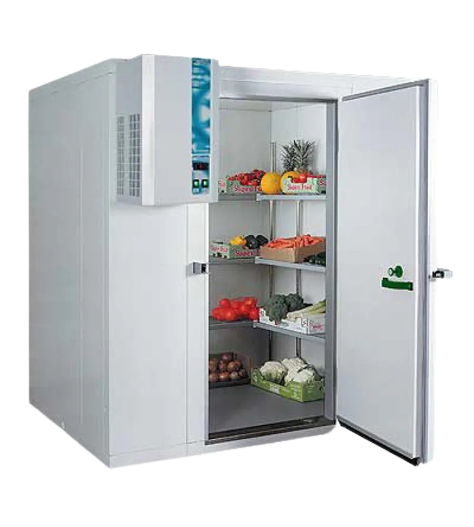
Modular cold rooms use insulated sandwich panels with tongue-and-groove edges and built-in cam-lock fasteners. A hex key pulls an internal hook over a pin, drawing two panels into a tight, sealed joint — no silicone, no welding, no structural steel needed for small-to-mid-sized rooms. The panels themselves carry the load, which is exactly what makes them fast to install and just as fast to dismantle.
Prefabricated cold storage, at the large-scale end, works differently. Panels are cut to length in continuous production runs and fixed onto an independent steel skeleton — columns, purlins, girts — using through-bolts and clips. The panels are just a thermal skin wrapped around that frame; they don’t bear any structural load themselves. Sealing relies on external flashing and butyl tape at every steel junction rather than an integrated lock.
That single design decision — panel-as-structure versus panel-on-steel — is what drives every other difference below.
Comparison at a Glance
| Factor | Modular Cold Room | Large-Scale Prefabricated Cold Storage |
|---|---|---|
| Joinery | Integrated cam-locks | Slip-joint panels bolted to steel |
| Structural frame | Panels are self-supporting | Requires a dedicated steel skeleton |
| Relocation | Fully reusable, non-destructive teardown | Permanent — dismantling damages the structure |
| Typical clear height | Usually up to 4–6 m before needing internal support | Can go well beyond that in high-bay, clad-rack designs |
| Best suited for | Small-to-mid volume, leased sites, seasonal needs | Large, fixed, long-term distribution or storage facilities |
| Lead time | Days to a couple of weeks | Weeks to months, including structural design and approvals |
| Typical clients | F&B outlets, pharmacies, labs, event/catering ops | Large distribution centers, cold chain logistics hubs |
When a Modular Cold Room Is the Right Call
- You’re on leased premises and don’t want to sink cost into a fixture you can’t take with you.
- You need to be operational fast — a modular room can be running in days, not weeks.
- Your volume needs might change — panels can be added or removed as your business grows or contracts.
- You want the option to relocate the entire unit if you move locations or open a new branch.
This covers most restaurants, cafes, supermarkets adding overflow storage, pharmacies, clinics, and small-to-mid distribution operations across the UAE.
When You Need Full Prefabricated Cold Storage
- You require very tall clear height for pallet racking or narrow-aisle forklifts — beyond what a self-supporting panel system can safely span.
- The facility is genuinely permanent and tied to a large, fixed footprint.
- You’re building a high-volume logistics or distribution hub, not a walk-in unit.
If that’s your situation, a structural steel-framed cold store — not a modular room — is the correct engineering approach, and any supplier proposing a pure cam-lock panel system for that scale is quietly setting you up for structural problems down the line.
Why This Distinction Matters More in the UAE
GCC ambient temperatures push insulation and refrigeration harder than almost anywhere else, so panel thickness and compressor sizing typically need to be more generous here than in temperate-climate spec sheets. Cold storage for food handling in the UAE also has to hold within the thresholds set by Dubai Municipality and equivalent authorities in Abu Dhabi and Sharjah — generally around 5°C for chillers and -18°C for freezers, tighter for certain pharmaceutical and lab applications. A modular room built for European or South Asian conditions without adjusting for Gulf heat load can struggle to hold temperature during peak summer months, regardless of how well the cam-locks seal.
This is also why the “just relocate it” advantage of modular systems matters so much locally — leased warehouse space, shifting free zone locations, and rapidly scaling F&B and pharma operations are the norm here, not the exception.
Quick Reference: Typical Modular Cold Room Specs
- Insulation: High-density PIR or PUF sandwich panels
- Panel thickness: Commonly ranges from 60mm to 150mm depending on target temperature and ambient load
- Temperature range: Chillers typically +2°C to +8°C; freezer configurations down to -20°C or lower
- Refrigeration: Either a self-contained monoblock unit or a remote split system depending on room size and layout
Exact figures vary by project and application — always confirm against the specific product datasheet for your intended use case rather than treating these as fixed specs.
Frequently Asked Questions
Usually, if we’re talking small-to-mid-sized rooms. You’re not paying for structural steel design or the civil works and approvals that come with a large prefab build. Once you’re talking high-bay, large-footprint facilities, though, it’s not really an apples-to-apples comparison anymore — you’re pricing two different jobs.
Genuinely, yes — that’s the whole point of the cam-lock system. No bolts, no silicone holding it together — just interlocking panels you can knock apart and rebuild somewhere else. If you change locations, the whole setup packs up and tags along, panels and all.
Honestly? Barely anything. In everyday industry talk, people tend to throw both phrases around to mean the same thing. Strictly speaking, “cold room” describes an isolated walk-in unit, while “cold storage” nods to a larger-scale operation, but almost no one actually enforces that boundary — us included half the time. Regardless of the label you choose, the underlying construction remains identical.
Yes — assuming it’s specified and installed properly. What actually determines compliance is the installation and ongoing monitoring: food-grade stainless or galvanized panels, temperature control that’s genuinely maintained, monitoring that’s actually checked, not just installed and forgotten. Get that right and HACCP and Dubai Municipality cold chain standards aren’t a problem for a modular room. The format itself was never really the issue.
Same cam-lock system, just insulated and refrigerated for sub-zero range instead of standard chiller temperatures. If a full freezer setup is what you’re after, our Freezer Room page covers the modular, walk-in, and portable options in more depth.
Questions to Ask Any Supplier Before You Sign
A lot of procurement headaches trace back to comparing quotes that were never actually for the same thing. Before you sign off on a cold room project, ask every supplier:
- Get clear on whether the panel system is actually self-supporting — a lot of quotes bury a structural steel frame in the fine print instead of the price.
- What’s the tallest this configuration can go before you need internal support columns?
- If you need to move this in a couple of years, will the panels survive the teardown, or is this really a permanent fixture dressed up as modular?
- Confirm the panel thickness and refrigeration capacity were actually sized for UAE summer heat — not just carried over from a cooler-climate spec sheet.
- Ask outright whether the quoted structure already meets Dubai Municipality (or your emirate’s) cold chain and hygiene requirements, or if that’s extra work you’ll be paying for later.
Straight answers to those five questions are usually enough to tell whether you’re looking at a genuine modular system or a prefab structure being marketed with looser terminology.
Why Coldroom.ae
With 7+ years of experience and 1000+ successful projects across the UAE, ColdRoom.ae specializes in modular cold rooms and cold storage solutions built for speed, flexibility, and the region’s demanding climate. If you’re not sure whether a modular system fits your space and business needs, tell us your temperature range, footprint, and whether the site is leased or owned — we’ll give you a straight answer, not just a quote.