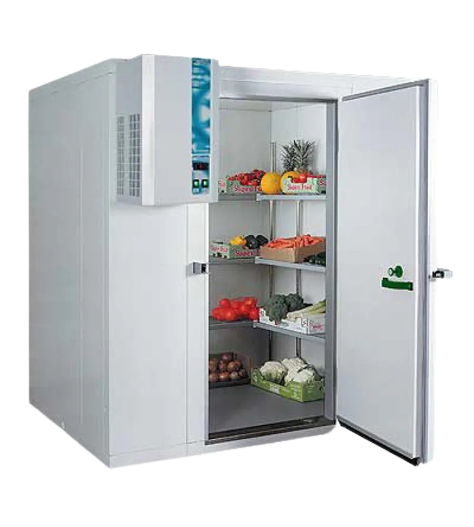

A cold room for food security is temperature-controlled storage infrastructure that protects a nation’s food reserves, locally manufactured perishables, and production-facility inventory from spoilage. In the UAE — where 70–90% of food is imported and summer temperatures exceed 45°C — industrial cold rooms have become the physical backbone of the National Food Security Strategy 2051.
That backbone is now under construction at unprecedented scale. At the recent Reset & Rise business panel in Dubai, organized by Ajman Free Zone with Gulf News, industry executives and free zone leaders identified local manufacturing and food security infrastructure as being among the highest-growth non-oil sectors in the UAE. Corporate investors are responding by building food production facilities, central kitchens, and localized distribution hubs — and every one of them starts with cold storage.
This guide explains how cold rooms support UAE food security, the temperature and compliance standards production facilities must meet, what industrial cold rooms cost to build or lease in 2026, and how ColdRoom.ae engineers cold storage for Gulf conditions.
Why Is Food Security Driving Cold Room Demand in the UAE?
The UAE’s food supply depends on maritime imports moving through vulnerable chokepoints. Recent Red Sea and Bab el-Mandeb disruptions forced container lines to reroute around the Cape of Good Hope, adding 10–14 days to transit times — a delay that perishable cargo simply cannot survive. For a nation importing the large majority of its food, that exposure turned supply chain resilience from a talking point into national policy.
The UAE’s response is engineered, not reactive:
- National Food Security Strategy 2051, overseen by the Emirates Council for Food Security, targets a 50% increase in domestic food production and a top position on the Global Food Security Index.
- Operation 300bn aims to grow the industrial sector’s GDP contribution from AED 133 billion to AED 300 billion by 2031, with food security named a priority sector.
- Emirates Development Bank (EDB) offers project finance covering up to 90% of contract value for food security and manufacturing facilities, alongside the AED 1 billion National Industrial Resilience Fund launched in April 2026.
Every strand of this strategy converges on the same requirement: locally produced food, strategic reserves, and central kitchen output all need cold rooms engineered to hold temperature in Gulf heat — continuously, and in compliance with UAE food safety law.
What Is a Cold Room for Food Security?
A cold room for food security is an insulated, refrigerated chamber built to keep food at the temperatures the law requires. Its job is simple: stop bacteria from multiplying, and keep supply flowing even when imports are disrupted. These are not the walk-in fridges you’d find behind a restaurant. Food security cold rooms operate at industrial scale, anywhere from a compact walk-in unit inside a central kitchen up to distribution hubs holding thousands of pallets at once.
Within the UAE’s food supply chain, cold rooms perform four distinct roles:
- Strategic reserves: Housing buffer stocks of essential food products so supply continues even if sea freight is disrupted.
- Production storage: Food factories and processing plants need somewhere to hold raw ingredients coming in and finished goods going out. Cold rooms cover both ends.
- Central kitchens: Hub-and-spoke F&B operations depend on separate chilled storage for raw and ready-to-eat items — the municipality won’t approve the kitchen without it.
- Distribution: Staging areas for grocery delivery, quick-commerce, and re-export, often running several temperature zones under one roof.
Food Security Cold Room Temperature Requirements in the UAE
UAE food safety regulation — enforced by the Dubai Municipality Food Safety Department, ADAFSA in Abu Dhabi, and Sharjah Municipality under Federal Law No. 10 of 2015 — sets rigid critical control limits that cold rooms must maintain and document:
| Storage Type | Required Temperature | Typical Products |
|---|---|---|
| Deep freeze | −18°C or below at all times | Frozen meat, poultry, seafood, ready meals |
| Chilled (high-risk) | 5°C or below (legal limit); 0°C to 4°C recommended for raw meat & poultry | Raw meat, poultry, dairy, prepared foods |
| Chilled (produce) | 0°C to 5°C | Fruits, vegetables, fresh herbs |
| Blast chilling | 60°C → 21°C within 2 hours, then to 5°C within a further 4 hours | Cooked food entering chilled storage |
Temperature monitoring must be documented at critical control points under HACCP, and continuous IoT data logging with automated alarms is rapidly becoming the audit standard. ColdRoom.ae fits every industrial installation with digital monitoring so facilities remain inspection-ready around the clock.
How Are Cold Rooms Engineered for 45°C Gulf Conditions?
A cold room spec that works fine in Rotterdam will not survive a Sharjah summer. The failure pattern is predictable. An exterior wall sits in direct sun for six or seven hours, the panel core can’t resist the heat load, and a compressor sized for European ambients runs flat out just to hold temperature. Energy bills climb first. Then the temperature breaches start. Gulf-specific engineering exists to break that chain at three points.
Insulated panel construction
Panel thickness in the UAE starts at 60mm and goes well past 100mm — how far depends on two things: how cold the room needs to be, and how much sun the walls take. The core material matters as much as the thickness. Most builders here have moved from standard polyurethane (PUF) to polyisocyanurate (PIR), partly for the better thermal resistance but mainly because PIR’s fire performance is what UAE Civil Defense codes want to see. On the inside, HACCP leaves little choice: food-grade stainless steel or polymer-coated galvanized steel, so surfaces stay non-absorbent and can be washed down properly.
Sealing and pressure management
Picture the door of a −18°C freezer room opening into 45°C air at Gulf humidity. That’s a 63-degree swing across a few centimetres of gasket, and it creates two problems at once: pressure imbalance and condensation. Heated pressure-relief vents handle the first — without them, the door can vacuum-lock shut. For the second, the gaskets themselves have to stay flexible at sub-zero temperatures; a stiffened gasket leaks warm, wet air into the room, and ice buildup follows.
Refrigeration and monitoring technology
Compressor staging is where under-specced installations get found out. Modern UAE facilities run staged compressors under PLC control, with IoT sensors feeding the data back, and some operators now layer AI-driven load prediction on top to trim energy use during peak afternoon hours. On refrigerants, the big industrial sites are moving off HFCs toward ammonia and CO₂ — higher upfront cost and stricter safety engineering, but the thermodynamic efficiency at scale justifies it.
How Much Does an Industrial Cold Room Cost in the UAE?
Cold storage is capital-intensive — typically two to three times the cost of dry warehousing — because of refrigeration plant, reinforced flooring, fire-rated panels, and dedicated power infrastructure. 2026 benchmark figures:
| Storage Type | Construction Cost (per m²) | Leasing (per pallet/month) |
|---|---|---|
| Dry / general warehouse | AED 1,200 – 1,700 | AED 50 – 90 |
| Chilled cold storage | AED 1,800 – 2,200+ | AED 80 – 150 |
| Deep-freeze / automated | AED 4,000 – 5,500 | AED 150 – 250+ |
Utility connections and power substations can add 15–25% to construction budgets, and climate-controlled leased space runs roughly 40–60% above non-AC warehousing. For food security and manufacturing projects, EDB financing and the National Industrial Resilience Fund can offset a substantial share of this capital cost — and a strong In-Country Value (ICV) score, including locally sourced insulated panels, improves both financing terms and government procurement eligibility.
For most production facilities and central kitchens, a modular walk-in cold room for food security delivers the required compliance at a fraction of mega-facility cost. ColdRoom.ae designs, supplies, and installs modular cold rooms sized to your production volume, with transparent quotations covering panels, refrigeration, monitoring, and Civil Defense compliance.
Compliance: What Do Production Facilities and Central Kitchens Need?
The shift toward centralized production kitchens — which can cut F&B operating costs by 30–40% through the hub-and-spoke model — has concentrated regulatory scrutiny on cold storage design. Key requirements for UAE approval:
- Unidirectional flow: Food moves one way through the facility — receiving, storage, prep, cooking, packaging — and never back. If the layout drawing shows raw ingredients crossing paths with cooked product, the municipality rejects it. This is among the most commonly failed inspection criteria.
- Physical segregation: Raw poultry in the same walk-in chiller as ready-to-eat food is an automatic violation. Each cold room needs its own designation and clear labeling, and inspectors check this on every visit, not just at approval.
- HACCP integration: Every cold room counts as a critical control point. That means documented monitoring, a defined alarm response, and a certified Person In-Charge on site — no PIC, no permit.
- Fire detection: Kitchens get heat detectors rather than smoke detectors (cooking fumes trigger too many false alarms), tied into an addressable panel that covers the whole premises.
- Dubai Civil Defense 2026 updates: Hassantuk smart-monitoring connection is now mandatory for all commercial premises — including existing businesses at trade license renewal — and DCD revised kitchen suppression agent quantities and nozzle positioning in Q1 2026. Non-compliance blocks license renewal.
- Hygiene infrastructure: Washable surfaces, food stored at least 15 cm off the floor, and correctly sized grease traps with documented disposal contracts.
With parallel submissions and correct drawings, municipality, Civil Defense, and free zone approvals typically take 3–8 weeks. Getting cold room specifications right in the mechanical drawings — before construction begins — is the single biggest factor in avoiding resubmission delays.
Where Is UAE Cold Storage for Food Security Heading?
The infrastructure pipeline confirms the trajectory. Start with Dubai. Food Tech Valley was designed to triple the city’s food production, and the anchor tenants have already committed: Spinneys is building a 500,000 sq ft processing facility there, due to be operational by 2027, and Al Ain Farms has signed for a 260,000 sq ft logistics hub. Abu Dhabi is moving on to an even bigger footprint. The Abu Dhabi Food Hub at KEZAD covers 3.3 square kilometres, and in May 2026 it added a dedicated 37,000 m² cold chain facility — this in a zone where KLP21 already runs the UAE’s largest mobile racking installation for deep-freeze rooms, 14,000 pallet positions held at −25°C. Then there’s Jebel Ali, where the Americold–RSA–DP World hub offers 40,000 multi-temperature pallet positions with bonded storage, built for GCC re-export.
None of this is speculative capacity. Dubai alone holds roughly a third of the domestic cold chain market, and the forecasts — Mordor Intelligence at the conservative end, Grand View Research at the aggressive end — put growth anywhere from about 6% to over 20% CAGR through 2030, depending on how you scope the market. Food security mandates, quick-commerce grocery, and pharmaceutical storage are doing the pulling.
For food producers, central kitchen operators, and distributors, the message is straightforward: cold storage capacity is now a competitive asset, and facilities that meet UAE compliance standards from day one will capture the demand this national strategy is creating.
Frequently Asked Questions
It’s industrial-scale refrigerated storage that keeps food reserves, locally produced perishables, and production inventory from spoiling. The UAE’s National Food Security Strategy 2051 leans heavily on this infrastructure — when imports get disrupted, cold rooms are what keep domestic supply on the shelves.
Freezer rooms must stay at −18°C or below, no exceptions. For chilled high-risk food, Dubai Municipality and ADAFSA set the legal ceiling at 5°C, though anyone storing raw meat or poultry should run colder — 0°C to 4°C is the accepted standard.
Purpose-built cold storage construction runs AED 1,800–2,200+ per square meter, rising to AED 4,000–5,500 for automated deep-freeze facilities. Modular walk-in cold rooms for production kitchens cost significantly less and are priced by size, temperature range, and refrigeration specification.
Yes — this one is non-negotiable. Dubai Municipality requires physical segregation between raw materials and ready-to-eat products, plus one-way food flow through the facility. Put raw poultry in the same walk-in chiller as cooked food and you’ve failed the inspection.
Securing municipality, Dubai Civil Defense, and free zone approvals typically takes 3 to 8 weeks when submissions run in parallel and mechanical drawings — including cold room specifications — are correct at first submission.
Fresh produce, dairy, and prepared foods require chilled storage between 0°C and 5°C. Meat, poultry, seafood, and long-term reserves require frozen storage at −18°C or lower. Facilities handling both need separate, individually monitored chambers.
Build a Cold Room for Food Security That Passes Inspection
ColdRoom.ae designs, manufactures, and installs industrial cold rooms and commercial walk-in freezers engineered for UAE conditions — PIR insulated panels, Gulf-rated refrigeration, IoT temperature monitoring, and full HACCP and Civil Defense compliance built into every project. Whether you are fitting out a central kitchen, a food production facility, or a distribution hub, our team delivers cold storage that passes inspection and holds temperature at 45°C ambient.