
Get the cold room temperature wrong, and the consequences show up fast — spoiled stock, a failed municipality inspection, or in the worst case, food or medicine that’s no longer safe to use. There’s no single “right” number, either. A setting that keeps beef fresh will destroy a crate of green bananas within hours, and a vaccine fridge needs something colder and far more precise than either one.
The UAE makes this harder than most places. Ambient summer heat pushes past 45°C, sometimes closer to 50°C, and that changes how thick your insulation needs to be, how your compressors are sized, and even which refrigerant you’re allowed to use going forward.
Below, you’ll find the actual figures organized around three things: the type of room, the product going into it, and the industry running it — plus the rules Dubai, Abu Dhabi, and the wider UAE actually enforce for anyone running a commercial or industrial cold room.
Quick Answer: Cold Room Temperature
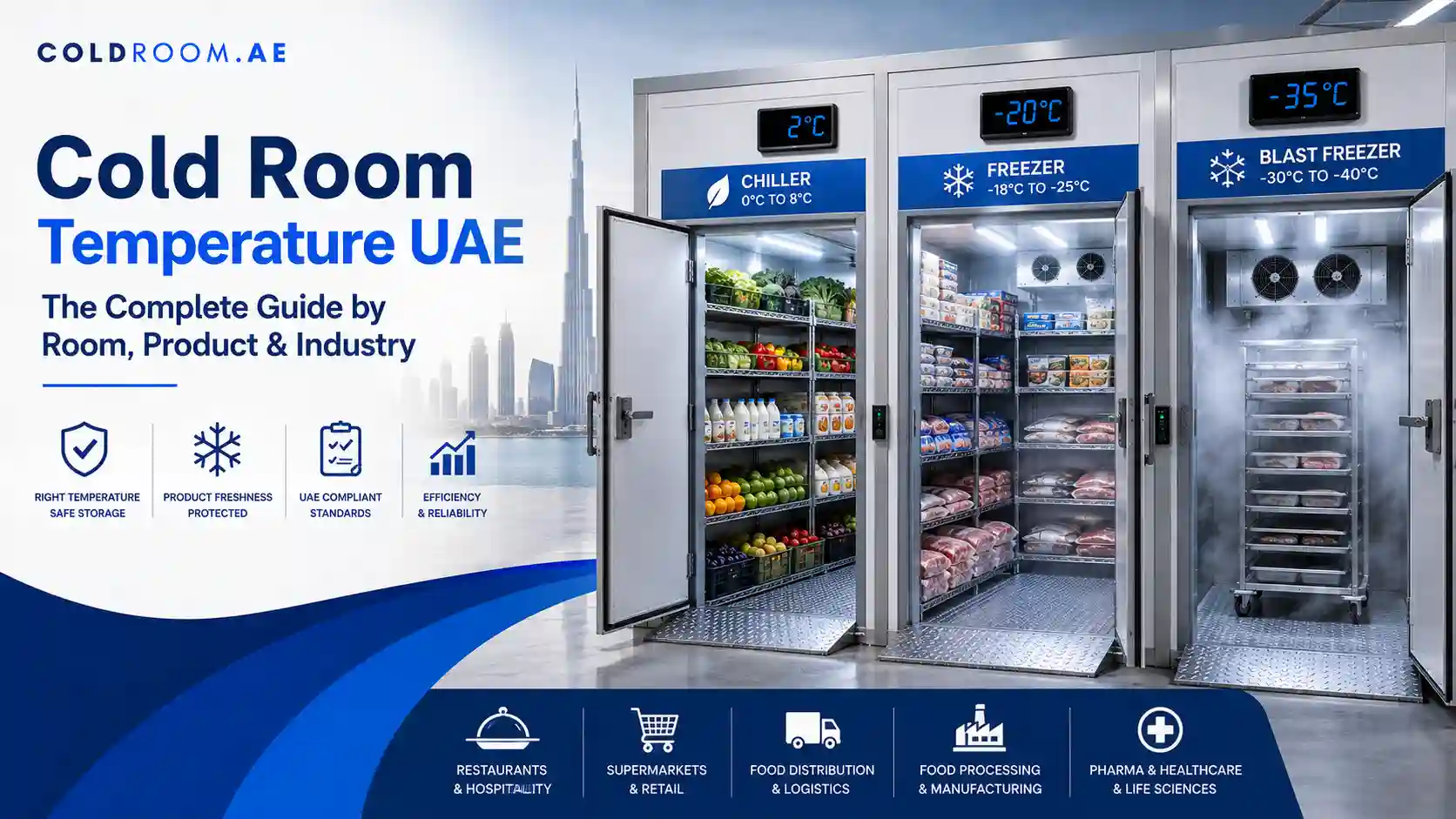
Cold room temperature typically falls into three ranges depending on what’s stored: 0°C to 8°C for chilled goods (dairy, produce, fresh meat), -18°C to -25°C for frozen goods, and -30°C to -40°C for blast freezing. In the UAE, regulated high-risk food must stay at or below 5°C, and pharmaceuticals require 2°C to 8°C under WHO Annex 9 standards.
- Chiller / cold storage: 0°C to 8°C
- Freezer: -18°C to -25°C
- Blast freezer: -30°C to -40°C
- Pharmaceutical cold chain: 2°C to 8°C
What Is Cold Room Temperature?
“Cold room temperature” sounds like a simple idea, but it’s really just shorthand for a range — the internal temperature a refrigerated space is built to hold steady so bacteria don’t take over and stock doesn’t spoil before it’s used.
That range breaks down into three rough bands, depending on what’s being stored and for how long:
- Chillers and cold storage generally run 0°C to 8°C. This covers fresh goods that haven’t been frozen — dairy, produce, most meat.
- Freezers drop to -18°C to -25°C, built for stock that needs to last months, not days.
- Blast freezers go colder still, -30°C to -40°C, and they’re not really for holding product long-term — they’re for pulling the temperature down fast.
Exactly where you land within any of these depends on the product itself: how much water it holds, how easily it’s damaged, and how long it needs to stay usable.
Normal Cold Room Temperature: Quick Reference Table
| Cold Room Type | Normal Temperature Range | Typical Use |
|---|---|---|
| Chiller / Cold Room | 0°C to 8°C (≤5°C required for regulated high-risk food) | Dairy, fresh meat, produce, beverages |
| Freezer Room | -18°C to -25°C | Frozen meat, seafood, ready meals |
| Blast Freezer | -30°C to -40°C | Rapid freezing, meat/seafood processing |
| Pharmaceutical Cold Room | 2°C to 8°C | Vaccines, insulin, biologics |
| Ultra-Cold Pharma Storage | -60°C to -90°C | mRNA vaccines, gene therapies |
Cold Room Temperature in Celsius (and Fahrenheit)
Since “cold room temperature in Celsius” is one of the most searched terms on this topic, here’s a quick conversion reference:
| Range | Celsius | Fahrenheit |
|---|---|---|
| Chiller (standard) | 0°C to 5°C | 32°F to 41°F |
| Freezer | -18°C to -25°C | 0°F to -13°F |
| Blast freezer | -30°C to -40°C | -22°F to -40°F |
| Pharma cold chain | 2°C to 8°C | 36°F to 46°F |
For reference, general classification bands used by WHO and the Council of Europe are: room temperature 15°C–25°C, “cool/cold” 8°C–15°C, refrigerator 2°C–8°C, and deep freeze -15°C to -20°C. These are broad definitional bands, not specific commercial cold room products.
Chiller Room Temperature Range
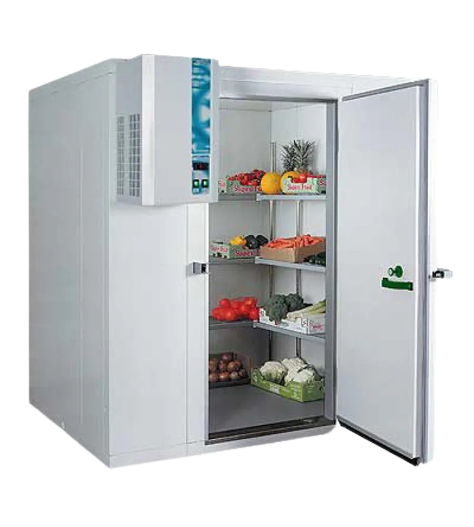
Chiller rooms (also called cold rooms or cool rooms) are the most common commercial refrigeration setup. The standard chiller room temperature range is 0°C to 8°C. Many UAE food operators aim for the tighter end of that range — closer to 2°C to 4°C — to build in a safety margin against door-opening heat spikes, though this is a general operating practice rather than a fixed regulatory figure.
- Meat & dairy: +2°C to +4°C
- Vegetables: +5°C to +7°C
- Beverages: +8°C to +10°C
Under Dubai Municipality’s Food Code, chilled high-risk food must not exceed 5°C, and this figure is treated as a Critical Control Point (CCP) during health inspections.
Freezer Cold Room Temperature
-18°C to -25°C is the standard freezer range, and -18°C specifically isn’t a made-up number — it’s the internationally recognized limit for frozen food, and GSO 150-1:2013 turns it into law across the region rather than leaving it as a guideline. Go colder for deep-freeze work like ice cream or long-term storage — usually -20°C to -25°C.
Blast freezers work on a different principle entirely. They run at -30°C to -40°C with high-velocity air, and the goal isn’t storage — it’s speed. Get a product’s core temperature down fast enough, and the ice crystals that form inside stay microscopic instead of growing large. Large crystals tear through cell walls as they form. Small ones don’t. That’s the whole reason blast-frozen product holds its texture and doesn’t weep liquid when it thaws, while slow-frozen product often does.
Walk-In Cold Room Temperature
A walk-in cold room (chiller) typically runs at 0°C to 4°C, while a walk-in freezer runs at -18°C to -25°C. The tighter 0–4°C band (rather than the full 0–8°C chiller range) is standard for walk-ins specifically because of their higher door-opening frequency — every entry lets in warm, humid UAE air that the compressor then has to remove.
Two design factors matter more for walk-ins than standalone units:
- Insulation is where suppliers actually disagree. Some manufacturers spec 60mm to 80mm PIR panels as their baseline, while others push closer to 80mm–100mm to handle the UAE’s extreme ambient load — there isn’t one industry-wide number. The right call comes down to your specific heat-load calculation, not a figure pulled off a spec sheet.
- Door protection: strip curtains or air curtains to cut infiltration losses significantly, with vestibule/airlock setups offering the strongest protection in high-traffic facilities.
Cold Room Temperature Controllers
A cold room temperature controller is the digital or electromechanical thermostat that regulates compressor cycling to hold the room within its set band. In UAE commercial installations, controllers typically manage:
- Set point — the target temperature (e.g., 4°C for a chiller)
- Differential — how far the temperature can drift before the compressor re-engages
- Defrost cycles — electric or hot-gas defrost timing, critical in freezer rooms where UAE humidity accelerates evaporator icing
- Alarm thresholds — a pre-alarm buffer zone (e.g., 6°C on a 4°C chiller) and a critical limit (e.g., 8°C) that triggers a HACCP deviation protocol
Modern UAE cold rooms increasingly pair controllers with IoT data loggers and remote SMS/email alarms, since manual clipboard checks are no longer considered defensible during a municipality audit.
Cold Storage Temperature for Medicine & Pharmaceuticals
Cold storage temperature for medicine follows some of the strictest bands in cold chain logistics:
| Category | Temperature Range | Notes |
|---|---|---|
| Standard vaccines, insulin, biologics | 2°C to 8°C | WHO Annex 9 TTSPP standard; MoHAP/DoH/DHA enforced |
| Frozen biologics / plasma products | -15°C to -25°C | Specific biologic compounds |
| mRNA vaccines / gene therapies | -60°C to -90°C | Ultra-cold storage only |
| General medication (non-biologic) | 15°C to 25°C | Room-temperature stable products |
Unlike food storage, where a brief temperature excursion shortens shelf life, a deviation in a pharmaceutical cold room can render medication biologically inactive — resulting in mandatory product condemnation. UAE pharma cold rooms must be validated through Installation, Operational, and Performance Qualification (IQ/OQ/PQ) protocols and simulate UAE summer ambient stress conditions as part of that validation.
Cold Room Temperature in Commercial Kitchens
In a commercial kitchen, cold room temperature obligations differ slightly from bulk storage because of the two-stage cooling rule enforced under the Dubai Municipality Food Code:
- Hot cooked food must drop from 60°C to 21°C within 2 hours
- From there, it has another 4 hours to reach 5°C — regulators check both legs of that drop separately, not just the final number
This is precisely why standard walk-in chillers can’t be used to cool hot food — they’re built to hold pre-chilled stock at a steady state, not absorb the sensible heat load of a fresh batch of cooked rice or curry. Kitchens handling this cooling step need a dedicated blast chiller, not just a walk-in cold room.
Cold Storage Temperature for Vegetables
Vegetables aren’t interchangeable when it comes to cold storage. A leafy green pulled from 0°C into a warmer room starts wilting almost immediately. A potato held at that same 0°C, on the other hand, can end up damaged by the cold itself.
| Vegetable | Ideal Temperature | Humidity | Notes |
|---|---|---|---|
| Leafy greens | 0°C to 1°C | 90–100% | Very perishable, keep moist |
| Root vegetables (general) | 2°C to 4°C | 60–70% | |
| Potato (retail/table use) | 3°C to 6°C | 85–95% | Short-term storage before sale |
| Potato (frying/processing) | 7°C to 10°C | 85–95% | Avoids cold-induced sweetening that darkens fries |
| Tomato (ripe) | 10°C to 15°C | 85–90% | Below 10°C causes chilling injury, mealy texture |
Potato is the clearest example of this. You’ll see it listed at 3°C–6°C in some places and 7°C–10°C in others, and both numbers are correct — they’re just solving different problems. Potatoes cooled too far trigger a chemical shift called cold-induced sweetening, where starch converts to sugar inside the tuber. For a potato headed straight to a shop shelf, that’s barely noticeable. For one headed into a fryer, it means the finished product comes out darker and tastes off. So retailers moving stock quickly can get away with the colder end, 3°C–6°C, while anyone frying or processing potatoes long-term needs to stay up around 7°C–10°C to protect the finished product.
Cold Storage Temperature for Fruits
Fruit cold storage temperature splits sharply between temperate fruits (which tolerate near-freezing storage) and tropical fruits (which suffer chilling injury below roughly 10–14°C — a critical distinction for UAE importers handling both categories).
| Fruit | Ideal Temperature | Notes |
|---|---|---|
| Apples | 0°C to 2°C | Store away from ethylene-sensitive produce |
| Grapes | 0°C to 1°C | High humidity needed (90–95%) |
| Lemon / Orange (citrus, general) | 4°C to 7°C | Both sources only give a general citrus figure — no distinct lemon vs. orange data available |
| Banana (green, unripe) | 12°C to 14°C | Chilling injury below 12°C — never refrigerate green bananas |
Cold Storage Temperature: Onion, Ginger, Mango & Dry Fruits
These four don’t appear in the UAE-specific research used elsewhere in this guide, so the figures below are drawn from established postharvest research instead — cited individually rather than folded in as if they came from the same source base.
| Product | Recommended Temperature | Source |
|---|---|---|
| Onion (dry storage) | 0°C, 65–70% RH — pungent varieties can hold 6–9 months at this temperature | UC Davis Postharvest Research & Extension Center |
| Ginger | Above 12°C — chilling injury (skin pitting, discoloration) develops below this threshold | University of Hawaii CTAHR Postharvest Quality-Maintenance Guidelines |
| Mango | Around 13°C for extended storage (2–4 weeks postharvest life) | UC Davis Postharvest Research & Extension Center |
| Dry fruits & nuts (raw) | 0°C to 10°C, 55–70% RH | UC Davis Postharvest Research & Extension Center |
UAE-Specific Considerations: Dubai, Abu Dhabi, Sharjah & Beyond
Cold room temperature standards on paper are the same whether you’re in London or Dubai — but achieving them is a fundamentally different engineering problem in the Gulf.
- UAE engineers don’t design around the “average” hot day — they design around the worst one. ASHRAE’s statistical peak for the region sits at 43.3°C, but that number is drawn from typical yearly extremes. Real UAE summers push past that, hitting 45°C to 50°C during genuine heatwaves, and a cold room engineered only for the textbook figure risks failing exactly when it’s needed most.
- Insulation is another place the climate forces a different spec sheet. Suppliers don’t all agree on exact numbers, but UAE cold rooms generally run thicker PIR panels than you’d see in a temperate climate — somewhere in the 80mm to 150mm range depending on whether it’s a chiller or a deep freezer.
- Each Emirate runs its own food safety authority, and while the names differ, the numbers line up. Dubai Municipality’s Food Code 2020 and Abu Dhabi’s ADAFSA (Code of Practice No. 13) both draw the same hard line — 5°C or below for chilled goods, -18°C or below for frozen. The national ZAD system ties it together, tracking food product accreditation across every Emirate, Sharjah included.
- There’s a bigger shift underway too, and it has nothing to do with degrees. The UAE ratified the Kigali Amendment in 2024, which is slowly pushing commercial cold rooms off R-404A — a refrigerant with a heavy environmental footprint — toward lower-impact alternatives like R-448A, R-449A, or natural refrigerants such as CO₂, ammonia, and propane. The 2028 HFC freeze is what’s driving the timeline.
- Getting it wrong here isn’t just a quality problem, it’s a legal one. Federal Law No. 10 of 2015 sets fines starting at AED 10,000 for documentation issues and climbing as high as AED 2,000,000 for trading in temperature-abused food, with jail time on the table in serious cases.
Industrial & Commercial Applications
Cold room temperature control isn’t a niche concern — it touches nearly every industry operating in the UAE, just in different ways.
A Dubai Municipality inspector doesn’t need to find much to shut a kitchen down — a chiller running a few degrees on the wrong side of 5°C is often enough. Hotels, catering operations, and central kitchens run on their chiller and freezer setup the same way a car runs on its engine; if it fails, nothing else in the business functions. Retail carries a version of the same risk at a larger scale: every supermarket and hypermarket across Dubai and Abu Dhabi is effectively running a continuous cold chain that can’t tolerate even a brief interruption. Logistics operations feel this at an even bigger scale — one temperature lapse inside a 3PL warehouse or cross-docking hub rarely stays contained to a single pallet, and it’s the whole shipment that ends up written off before it ever reaches a customer.
Healthcare carries the highest stakes of all. Hospitals, clinics, and pharmacies handling vaccine distribution work within margins measured in single degrees, not ranges. Food processors and manufacturers — meat and seafood plants, dairy operations, bakeries — need it for both quality and legal compliance. And on the trading side, fruit and vegetable importers and wholesalers across Dubai, Abu Dhabi, and Sharjah depend on precise, product-specific temperature zones just to keep imported produce sellable by the time it reaches a shelf.
Frequently Asked Questions
Most chilled cold rooms sit somewhere between 0°C and 8°C. In practice though, a lot of operators don’t run anywhere near the top of that range — they keep it closer to 2°C to 4°C, just to have room for error if a door gets left open too long. Freezers are a separate story: -18°C to -25°C.
There isn’t really a hard floor for chilled storage — the main rule is just don’t let it freeze. Fresh produce and dairy get damaged by ice crystals the same way meat does, so staying above 0°C matters. Frozen storage works differently; -18°C is treated as the baseline for anything meant to last.
Depends entirely on what you’re storing. Leafy greens want it cold, close to 0°C to 1°C. Root vegetables have more wiggle room, anywhere from 2°C up to 10°C depending on the vegetable and what it’s being used for. Then there are the chill-sensitive ones — tomatoes included — that actually do worse the colder you go, and need something closer to 10°C to 15°C.
A walk-in chiller should sit at 0°C to 4°C. If it’s a walk-in freezer, drop that down to -18°C to -25°C.
For most vaccines, insulin, and biologics, MoHAP and WHO Annex 9 both call for 2°C to 8°C — that’s the standard. mRNA vaccines and similar advanced therapies need a lot more, down to around -60°C to -90°C, which is a completely different category of ultra-cold storage.
Mainly because of the heat. UAE summers regularly push past 45°C outside, and a cold room built for a European or American climate just isn’t designed to fight that. It needs thicker insulation, bigger condensers than you’d expect, and extra protection at the doors — air curtains, sometimes a full vestibule — to stop hot air from flooding in every time someone walks through. None of that is really necessary in a temperate climate.
Get the Right Cold Room Temperature for Your Business
Choosing between a chiller, freezer, or blast freezer setup — and getting the insulation, controller, and monitoring specifications right for UAE conditions — is easiest with an engineer who designs specifically for this climate. ColdRoom.ae has delivered 1,000+ cold storage projects across the UAE over 7+ years, from single-room chillers to full industrial cold chain facilities.