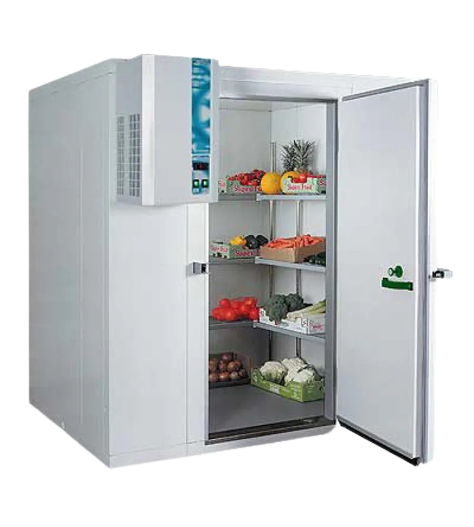

Cold Warehousing Storage Solutions UAE
Coldroom.ae builds cold warehousing storage facilities designed around the UAE’s climate — they aren’t adapted from a spec meant for somewhere cooler. That’s everything from a single chilled room to a full multi-temperature warehouse. We’ve built for food distributors moving fresh produce, pharmaceutical importers who can’t afford a degree of drift, and 3PL operators setting up new sites — and it holds up the same way across Dubai, Abu Dhabi, Sharjah, Ajman, and the rest of the UAE.

What Is Cold Warehousing Storage?
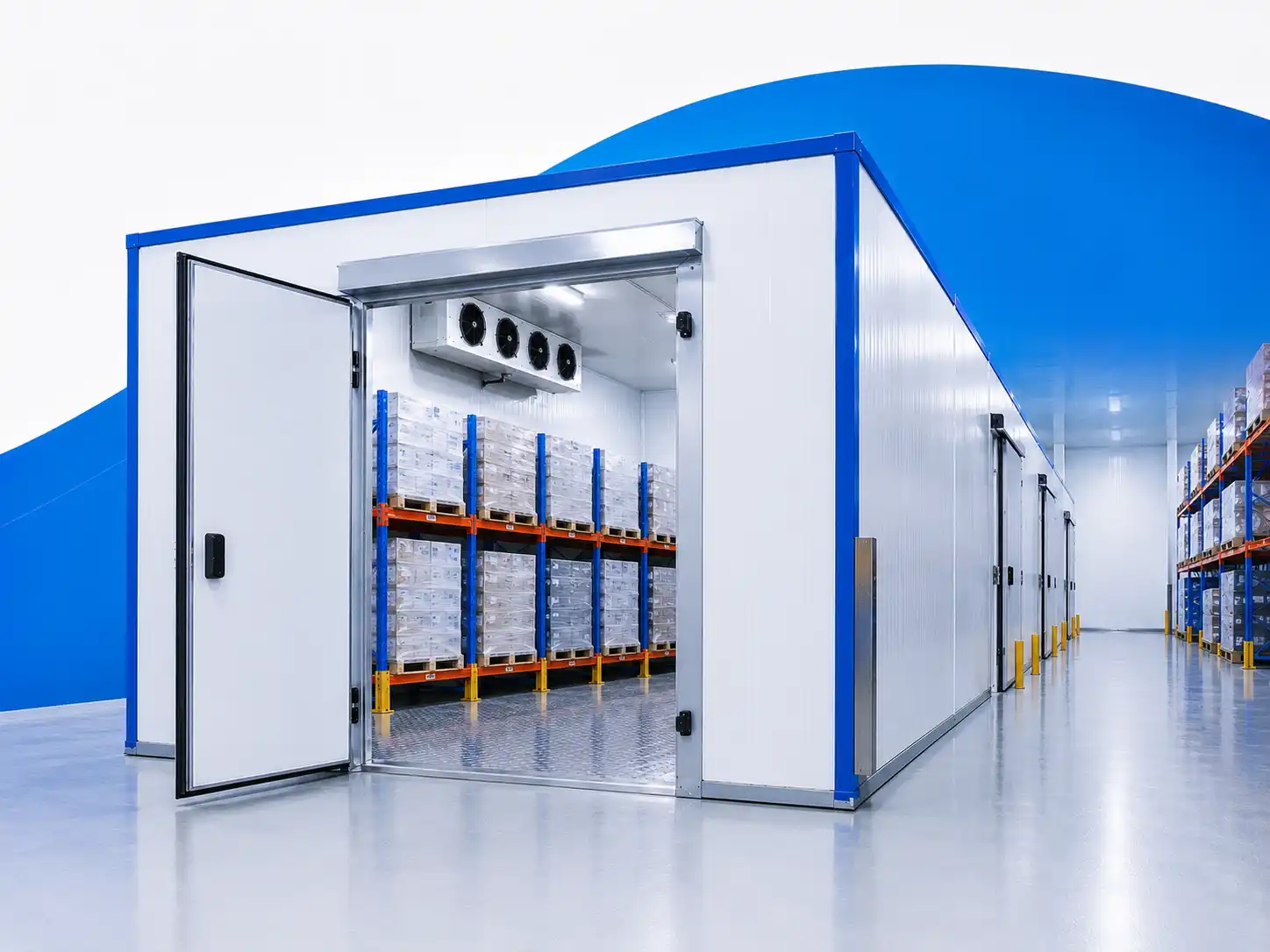
Cold warehousing storage is a large, insulated, refrigerated facility that holds perishable or temperature-sensitive goods at a set temperature for as long as they’re in storage. It’s not the same thing as a standalone cold room. At this scale, you’re usually looking at multiple temperature zones, racking built for pallet volume, loading docks, and round-the-clock monitoring — because the goal isn’t just keeping something cold, it’s keeping the whole chain intact from the moment goods arrive to the moment they leave.
The difference from a standard dry warehouse comes down to the build itself. The walls, ceiling, and floor are insulated panels rather than ordinary cladding. The mechanical side runs on industrial refrigeration instead of basic ventilation. And day-to-day, you’re logging temperature continuously and keeping compliance records, not just tracking inventory the way a dry warehouse would.
Why UAE Businesses Need Cold Warehousing Storage
The UAE imports a large share of its food supply and enforces strict cold-chain regulations under the National Food Security Strategy 2051 and the Dubai Municipality Food Code, which means reliable cold warehousing storage isn’t optional for F&B, pharma, or retail businesses — it’s a regulatory and commercial necessity.
Three factors drive demand specifically in the UAE:
- Extreme ambient heat. UAE ambient conditions push refrigeration systems harder than most climates are designed for, and the safety margin engineers build in is substantial — see Climate under UAE-Specific Considerations below for the exact figures. Poorly insulated storage simply doesn’t hold up long-term here.
- Regulatory enforcement. Cold storage in the UAE has to meet documented, auditable standards across food safety and pharma — more on exactly which bodies apply below. Facilities without proper insulation and monitoring risk non-compliance.
- Growing trade volume. The UAE’s position as a re-export and transshipment hub (JAFZA, Dubai South, KIZAD) continues to drive new cold storage development. Industry-wide investment at this scale — independent of Coldroom.ae — includes projects like Toll Group’s 25,000 sqm Dubai South cold warehouse. Industry estimates put the UAE cold storage market in the billions of dollars with double-digit annual growth, though exact figures vary by source and should be treated as directional rather than fixed.
Who Uses Cold Warehousing Storage? Industries & Applications
Food & Beverage Distributors. If you’re importing fresh produce, dairy, meat, or seafood, chilled and frozen storage isn’t optional — it’s what keeps shelf life where it needs to be and keeps you on the right side of the Dubai Municipality Food Code.
Pharmaceutical & Healthcare Logistics. This is where the margin for error gets thin. Vaccines, biologics, and temperature-sensitive medicines need GDP-compliant storage — 3D temperature mapping, calibrated data logging, the works — all of it under MoHAP’s watch.
Third-Party Logistics (3PL) & Cold Chain Logistics Companies. Cold storage logistics companies and 3PL operators leasing pallet space to multiple clients need flexible, multi-zone cold storage warehouses with high-density racking and warehouse management system (WMS) integration for their own operations. ColdRoom.ae designs and builds this infrastructure for logistics providers expanding or upgrading their cold chain warehousing capacity — including cold storage 3PL operations that need both chilled and frozen zones under one roof.
Retail & E-Commerce. Grocery and online retail fulfilment depends on centralized cold warehousing storage to support last-mile chilled and frozen delivery.
Chemicals & Specialty Materials. Temperature-sensitive industrial and specialty chemical storage requires the same rigorous insulation and monitoring standards as food and pharma cold rooms.
Types of Cold Warehousing Storage We Build
| Storage Type | Temperature Range | Typical Products Stored | Common UAE Use Case |
| Controlled Ambient / Cool Room Warehouse | +15°C to +25°C | Dry goods, oral solid pharmaceuticals | Grain, general trade goods |
| Chilled / Cold Room Warehouse | +2°C to +8°C | Fresh produce, dairy, vaccines, short-shelf-life meat | F&B distribution, pharma cold chain |
| Frozen Storage Warehouse | -18°C to -25°C | Frozen meat, seafood, ice cream, packaged frozen food | Long-term F&B storage, freezer warehouse operations |
| Deep-Freeze / Blast Freezer Warehouse | -30°C to -45°C | Rapid freezing, specialized biologics | Industrial processing, specialty pharma |
| Multi-Temperature / Multi-Zone Warehouse | Ambient to deep-freeze, zoned | Mixed inventory across categories | 3PL and cold chain logistics companies handling diverse cargo |
| Modular Cold Room (within existing warehouse) | Configurable | Any of the above at smaller scale | Retrofitting dry warehouses into cold stores & warehouse space |
Technical Specifications & Engineering
| Component | Typical Specification | Why It Matters |
| Insulated Panels | PIR, roughly 80–150mm (chilled) / 120–200mm (frozen), exact thickness confirmed per project | Achieves the target U-value for the zone; PIR’s B1 fire rating supports Dubai Civil Defense compliance |
| Refrigeration System | Rack powerpack (multi-compressor) or ammonia (R717) for industrial scale | Provides redundancy and handles the heat load from high ambient conditions |
| Doors & Docking | Insulated sliding doors, high-speed rapid-roll doors, air curtains | Minimizes thermal ingress during forklift and dock traffic |
| Flooring | High-density PU with vapour barrier; frost-heave protection for freezer zones | Prevents moisture migration and slab damage in sub-zero rooms |
| Racking | Selective, drive-in, or Very Narrow Aisle (VNA) systems | Maximizes pallet density within the cooled volume |
| Monitoring | 24/7 temperature and humidity logging; WMS integration for 3PL/multi-client operations | Continuous logging supports food safety and GDP pharma compliance audits; WMS integration is an operational feature for logistics providers, not itself a compliance requirement |
| Backup Systems | Dual compressors, emergency generators | Maintains cold chain integrity during power disruptions |
Note: exact panel thickness, U-values, and equipment specification vary by project and supplier, and are confirmed during site assessment — figures above represent typical ranges used in UAE cold warehousing storage construction, not a fixed Coldroom.ae build spec.
Cold Warehousing Storage vs. Standard Warehousing
| Feature | Standard Dry Warehouse | Cold Warehousing Storage Facility |
| Wall/Ceiling Construction | Standard cladding | Insulated PIR sandwich panels |
| Temperature Control | None (ambient only) | Active refrigeration, zoned control |
| Monitoring | Basic inventory tracking | Continuous temperature/humidity logging with alarms |
| Regulatory Requirements | General building code | DCD FM 4880 fire rating, Dubai Municipality/ADAFSA food code, MoHAP GDP (where applicable) |
| Typical Use | Dry goods, general cargo | F&B, pharma, chemicals, cold chain logistics |
UAE-Specific Considerations
Cold warehousing storage in the UAE has to be engineered around three local realities that don’t apply in temperate climates:
Climate. ASHRAE design conditions for the UAE run around 43°C to 46°C, with engineers commonly designing for 45°C to 50°C ambient as a margin against recorded extremes. This means insulation thickness and refrigeration capacity need to be sized well above standard international baselines, particularly for frozen and deep-freeze zones.
Compliance. Compliance here isn’t one checklist — it’s several, stacked depending on what you’re building. Panels need to meet Dubai Civil Defense’s FM 4880 fire rating, and food storage has to sit within the Dubai Municipality Food Code’s temperature thresholds. Building in Abu Dhabi adds ADAFSA Code of Practice No. 34/2020 into the mix, and if pharmaceuticals are involved anywhere in the facility, MoHAP’s GDP standards apply too.
Location. We build across Dubai, Abu Dhabi, Sharjah, Ajman, and the rest of the UAE — not just the emirate Coldroom.ae happens to be based in. That includes logistics-zone work near JAFZA, Dubai South, KIZAD, and DIP, where warehouse projects tend to cluster anyway.
Manufacturing, Installation & Turnkey Process
Like most established cold storage contractors in the UAE, Coldroom.ae’s project process typically follows these stages, adapted to each site’s specific requirements:
- Site Assessment & Load Calculation — evaluating ambient conditions, product entry temperature, and throughput to size the refrigeration system correctly.
- Design & Engineering — CAD layout, panel specification, and racking configuration matched to your operation.
- Manufacturing & Sourcing — panel fabrication and refrigeration equipment sourced to meet UAE fire and safety standards.
- Installation & Commissioning — on-site construction, system testing, and temperature validation before handover.
- Ongoing Support — maintenance and monitoring support to keep the facility compliant and energy-efficient.
Frequently Asked Questions
It’s cold storage scaled up — not one room, but a full facility built to hold temperature-sensitive stock, whether that’s food headed to a distributor or medicine that can’t handle a swing in temperature, from the day it arrives to the day it ships.
Chilled stays above freezing, +2°C up to +8°C — fine for produce and dairy. Frozen goes well below that, -18°C down to -25°C, which is the range for meat, seafood, or anything meant to last months rather than days.
Yes — this is actually one of our more common project types. 3PL operators usually need chilled, frozen, and ambient zones all under one roof so they can serve several clients out of a single site, and that’s exactly what we design for.
Coldroom.ae uses PIR insulated panels engineered to meet Dubai Civil Defense FM 4880 fire-rating requirements for UAE commercial and industrial cold storage facilities. Speak with our team to confirm certification details for your specific project.
There’s no single setting — it’s set by whatever’s being stored, and by how sensitive that product is to even small temperature swings. Blast-freezing and specialty pharma storage push furthest, sometimes down to -30°C or -45°C, where a couple of degrees of drift can ruin a batch outright.
Yes, and it’s not an occasional thing — Dubai, Abu Dhabi, Sharjah, Ajman, and the rest of the UAE are all regular territory for us.
One site, several sealed zones — ambient on one side, deep-freeze on the other, everything in between as needed. It’s how a single facility ends up handling completely different product categories at once, which is why cold chain logistics companies and 3PL operators lean on this setup so much.
Get Started
Planning a cold warehousing storage project in Dubai, Abu Dhabi, Sharjah, or Ajman? ColdRoom.ae’s engineering team can assess your site and product requirements and provide a detailed proposal.