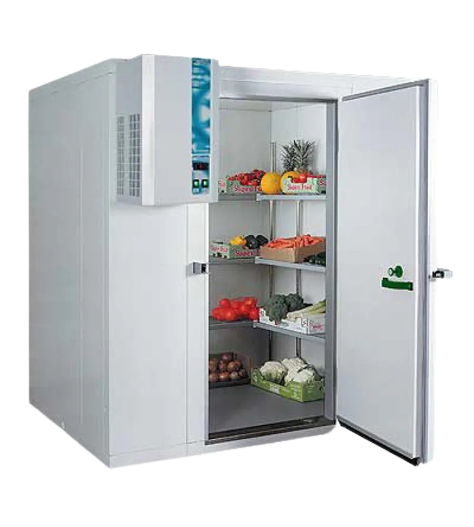

Customized Cold Room Manufacturers UAE
Coldroom.ae designs and builds customized cold rooms for commercial and industrial clients throughout the UAE, in Dubai, Abu Dhabi, Sharjah, Ajman and beyond. Few projects look the same once you get past the brief. One might be a compact chiller wedged into a corridor for a cloud kitchen; another, a combi-room shaped around a supermarket’s display floor; a seafood processor further down the list needs something else again, flooring and drainage built to take a daily washdown without breaking down within the year. What doesn’t change is how we get there. We survey the site first, work out the load and layout it actually needs, then fabricate and install around that, not a standard catalog size.


What Is a Customized Cold Room?
A customized cold room isn’t built to a catalog spec. It’s designed around whatever the facility actually needs: the space available, the thermal load of what’s going inside it, and how the operation runs day to day. A standard cold room, by comparison, ships in fixed sizes, 2m x 2m or 3m x 3m being typical.
Custom builds work the other way around. The room gets designed to fit the building, not the other way round: around a load-bearing column here, under a sloped ceiling there, sometimes splitting into two or three temperature zones inside one continuous footprint. Coldroom.ae builds these across Dubai, Abu Dhabi, Sharjah, Ajman and the rest of the UAE, acting as both the manufacturer and the installer on each job, from panel fabrication through to final commissioning on site.
Temperature-wise, most builds fall somewhere in one of three bands. Positive chillers sit between 0°C and +15°C and cover fruits, vegetables, and flowers. Freezers run colder, -18°C down to -25°C, for meat and other frozen stock. At the extremes, some builds need to go as low as -40°C for blast freezing, or hold as tight as +2°C to +8°C for pharmaceutical storage.
Why a Customized Cold Room Is Needed
A standard, off-the-shelf cold room works fine for average, generalized storage. It starts to fall short once a business runs into any of the following:
- Irregular or restricted space. Fixed-size modular units leave unusable dead zones in irregularly shaped rooms, or simply won’t fit around columns, low ducting, or narrow corridors. This is a common problem in Dubai and Abu Dhabi’s premium retail and hospitality real estate.
- Extreme UAE ambient conditions. Equipment that isn’t built for this climate risks compressor failure, spoiled stock, and unplanned downtime. In a market where summer heat regularly pushes refrigeration systems to their limits, that’s a business cost, not just a technical inconvenience.
- Specific product or hygiene requirements. Seafood processing, pharmaceuticals, and multi-temperature retail each call for different flooring, panel facings, and redundancy levels than a generic chiller can offer.
- Regulatory compliance. UAE Civil Defence fire codes, Dubai Municipality Food Code temperature thresholds, and noise restrictions on outdoor equipment all shape what a compliant cold room needs to look like on a given site.
A customized cold room is designed to work through each of these constraints from the start, rather than being adapted to them after the fact.
Industries & Applications
| Industry | Typical Temperature Range | Why Customization Matters |
| Restaurants & Hospitality | 0°C to +5°C (chiller), -18°C to -25°C (freezer) | Must fit complex kitchen layouts; needs racking that separates raw and cooked goods and flooring that withstands constant foot traffic |
| Supermarkets & Grocery | Multi-zone | Glass display panels for consumer visibility; combi-rooms and high-speed doors for frequent restocking |
| Meat & Seafood Processing | 0°C to +2°C (fresh), -18°C to -25°C (frozen) | Seamless polyurea flooring, stainless steel facings, and drainage systems built to withstand chemical washdowns |
| Pharmaceuticals & Healthcare | +2°C to +8°C (standard), down to -60°C to -90°C (ultra-low) | Dual-compressor redundancy and IoT temperature mapping for MoHAP/WHO audit compliance |
| Fruits & Vegetables | Product-specific (e.g. leafy greens 0-1°C, bananas 12-14°C) | High humidity control (up to 95% RH) and specific airflow to prevent chilling injury and dehydration |
| Cloud Kitchens, Cafes & Florists | 0°C to +8°C, high-humidity zones for flowers | Compact, space-efficient footprints; low-velocity evaporator fans for florists to avoid petal damage |
| Logistics & Distribution | +15°C to +25°C (ambient) to -18°C (frozen) | Large-span insulated roof panels, structural steel integration, custom loading bay dock seals |
Types of Customized Cold Room Solutions
Commercial customized cold rooms are sized for restaurants, cafes, supermarkets, and retail pharmacies, and typically combine chiller and freezer zones within a single structure.
Industrial customized cold rooms cover larger-volume installations for meat and seafood processing, logistics hubs, and distribution centers, built around semi-hermetic reciprocating compressors and heavy-duty flooring.
Small and compact customized cold rooms are engineered specifically for tight urban footprints. This is a distinct category, not simply a smaller version of a standard room. They’re built for cloud kitchens, specialty cafes, independent florists, and retail pharmacies operating in premium, space-constrained real estate, using slimline evaporators and remote condensing units to reduce indoor heat rejection. Panel dimensions are cut to fit alcoves and narrow back-of-house corridors that a standard unit couldn’t use.
Because a compact room holds less total air volume, every door opening causes a near-complete air exchange and a temperature spike. That’s why these rooms typically need thicker insulation, 80mm to 100mm, and oversized refrigeration capacity relative to their size rather than less.
Technical Specifications
| Component | Customization Range |
| Panel thickness | 60mm to 200mm |
| Insulation core | PIR (Polyisocyanurate) or PUR (Polyurethane), selected largely on fire-rating requirements |
| Facings | Pre-painted galvanized steel, stainless steel (hygienic zones), or glass (retail display) |
| Flooring | Marine plywood or aluminum chequered plate (pedestrian use); reinforced concrete with polyurea coating or stainless steel dimple plate (forklift traffic, washdown environments) |
| Doors | Hinged, sliding, glass display, or high-speed roll-up PVC |
| Compressors | Scroll compressors (medium loads) to semi-hermetic reciprocating compressors (heavy industrial freezing) |
| Defrost systems | Electric resistive (simpler, higher energy use) or hot-gas defrost (more efficient, preferred for large freezers) |
| Monitoring | Digital thermostats; IoT-enabled temperature and humidity tracking with automated alarms |
| Refrigerants | Lower-GWP alternatives such as R448A or R449A, in line with MOCCAE and the Kigali Amendment phase-down of R404A |
Refrigeration capacity isn’t estimated; it’s calculated. Coldroom.ae’s design process follows cooling load principles consistent with the ASHRAE Heat Balance Method, factoring in:
- Product load: the heat that must be removed from incoming goods. Cooling fresh product down from ambient temperature demands significantly more capacity than simply holding pre-chilled stock.
- Transmission load: heat gain through walls, ceiling, and floor, governed by panel thickness and U-value.
- Infiltration load: heat and humidity entering through door openings, addressed with air curtains or high-speed doors.
- Internal heat sources: lighting, fan motors, forklifts, and personnel.
- Ambient temperature: peak UAE design temperatures of 45°C to 50°C.
Customized vs. Standard Cold Rooms
| Evaluation Metric | Standard Cold Room | Customized Cold Room |
| Dimensions | Fixed increments (e.g. 2m x 2m, 3m x 3m) | Engineered to the exact millimeter |
| Space utilization | Often leaves dead zones in irregular rooms | Wraps around pillars, sloped ceilings, and other obstructions |
| Refrigeration system | Packaged “plug-and-play” monoblock units | Engineered split systems calculated for specific loads |
| Flexibility | Limited; hard to modify post-installation | High; supports combi-zones, specialized doors, and flooring |
| Best suited for | General ambient storage, light retail, temporary setups | Industrial processing, pharmaceutical compliance, architecturally constrained urban sites |
| Cost & installation | Lower upfront cost, faster install | Higher upfront engineering investment, site-specific installation |
UAE-Specific Considerations
Fire and Life Safety Code (Civil Defence). UAE fire regulations place strict limits on building envelope materials for commercial and industrial cold storage. PIR insulated panels are the commonly favored choice over standard EPS or basic PUR, since PIR forms a protective char layer under extreme heat that slows flame spread and reduces smoke generation. Coldroom.ae designs its customized cold rooms to align with these fire-rating requirements.
Food safety regulation. The Dubai Municipality Food Code sets a maximum of 5°C for chilled high-risk foods, treated as a Critical Control Point in inspections. ADAFSA applies equivalent standards for Abu Dhabi, requiring unbroken cold chain integrity from receipt to dispatch. Automated IoT temperature logging is increasingly expected in place of manual paper logs, with integration into platforms such as Dubai Municipality’s Foodwatch system.
Noise regulation. Dubai Municipality caps outdoor equipment noise at 40-50 dBA in residential and mixed-use zones during the day, 7am to 8pm, dropping to 30-40 dBA at night. That’s tighter than it sounds in practice. Where the condensing unit sits, whether an acoustic enclosure is worth the cost, how long a pipe run to a remote condenser needs to be, it all comes back to hitting that number.
Refrigerant compliance. Refrigerant choice isn’t purely a performance decision anymore. MOCCAE has been phasing out high-GWP options like R404A as part of the UAE’s commitment under the Kigali Amendment, pushing new installations toward lower-impact alternatives such as R448A and R449A.
Climate-driven engineering. Ambient temperatures across Dubai, Abu Dhabi, Sharjah, and Ajman regularly climb to 45-50°C in summer, and condensing units built for cooler climates just aren’t rated for that kind of heat load. That’s why oversized, heat-tolerant units and properly sealed panels matter here. The sealing does double duty, too, keeping out the condensation that builds up once summer humidity gets into the mix.
What We Need to Quote Your Cold Room Accurately
- Space dimensions, length, width, height, and anything already in the room that could affect the layout: a column, low ducting, whatever’s there
- Product type and expected storage volume
- Required internal temperature range
- How the room gets used day to day: daily throughput, the temperature product arrives at, roughly how often the door opens
- What’s available on site: power supply, single-phase or three-phase, where drainage runs, and where the outdoor condensing unit could actually go
A site survey is worth doing before the design gets finalized. Floor load capacity, ventilation space for the condensing unit, room to get the insulated panels in the door, none of that comes through clearly on a floor plan alone.
Frequently Asked Questions
It’s a cold room built around your specific site and business, not selected from a catalog. In practice, Coldroom.ae surveys your space first and designs the panels, refrigeration system, and layout afterward, the reverse of picking a standard unit and fitting your space around it.
Yes, and it’s one of the more common requests we get. Cafes and bakeries, for example, often need combi-room designs in spaces smaller than 10 square meters, combining chiller and freezer zones in one compact footprint instead of running separate units.
It’s a calculation, not a guess, and getting it wrong in either direction causes real problems. An undersized system risks spoilage and can’t recover after door openings; an oversized one short-cycles and drives up energy costs unnecessarily. The load calculation accounts for every contributing factor before equipment is selected.
The structural dimensions, yes. Panels are cut to the exact space you have. What isn’t up for customization are certain safety features required regardless of size or shape, such as internal emergency release handles and heated door frames, which stay standard on every build.
Total cost depends primarily on cubic volume, panel thickness and insulation core (PIR panels typically cost more than standard PUR), compressor capacity, any specialized flooring or high-speed doors, and the complexity of the site-specific installation. Get in touch with our team for a quote tailored to your space and requirements.
PIR is generally the safer choice for UAE Civil Defence compliance, but the final specification should always be confirmed against your building consultant’s directives, since requirements can vary depending on occupancy type and the approval pathway for your site.
No, it works the other way. With less total air volume, every door opening exchanges a larger share of the room’s air, causing a bigger temperature swing. Combined with the slimline evaporators and remote condensing units common in compact designs, oversized insulation and refrigeration capacity are what keep recovery times fast.
Get a Customized Cold Room Quote
Coldroom.ae designs, supplies, and installs customized and compact cold rooms for commercial and industrial clients across Dubai, Abu Dhabi, Sharjah, Ajman, and the wider UAE. Contact our team at sales@coldroom.ae, call +971 50 175 2255, or message us on WhatsApp to arrange a site survey and get a tailored quote.