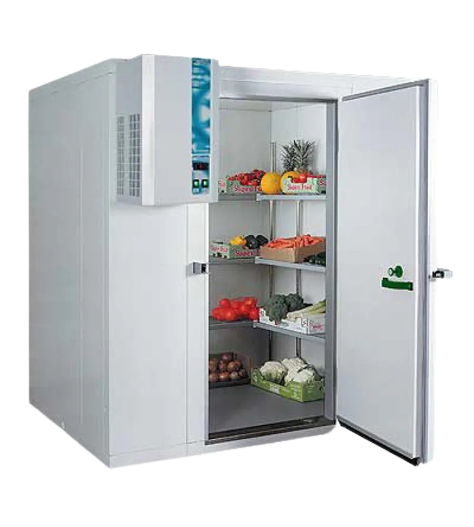

Outdoor Cold Room Manufacturers UAE
Running out of indoor space in Dubai, Abu Dhabi, Sharjah, or Ajman? Go outdoor. An outdoor cold room is usually where businesses turn next. We’re Coldroom.ae — we manufacture and supply outdoor walk-in coolers and freezers built for exactly that. And these aren’t indoor units pushed outside and hoped for the best. UAE heat, sand, and humidity play by their own rules, so we design for them from the ground up.

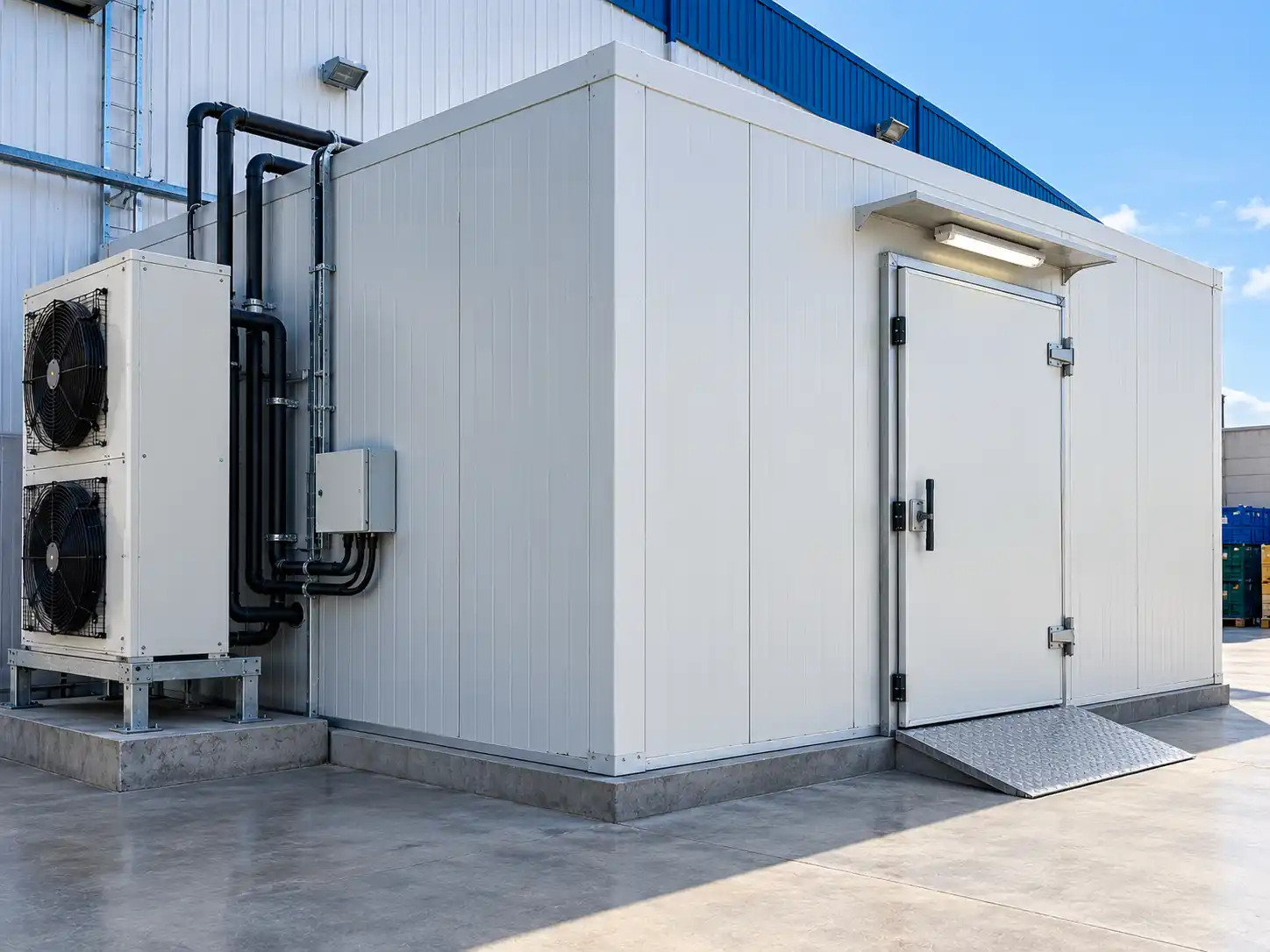
What Is an Outdoor Cold Room?
So what actually counts as an outdoor cold room? A refrigerated structure built to sit outside the building instead of inside it — fully insulated, mechanically cooled, holding a steady internal temperature no matter what the weather’s doing. Nothing more complicated than that. Indoor cold rooms have it easy, tucked into a shaded, climate-controlled space where the elements never really reach them. An outdoor one doesn’t get that luxury. Direct sun, blowing dust, coastal humidity — all of it lands straight on the exterior cladding, which means the insulation, weatherproofing, and refrigeration all have to work harder just to match what an indoor unit does with ease.
Commercially, it usually comes down to one of two builds:
Go with an outdoor walk-in cooler — sometimes called a chiller room — and you’re looking at 0°C to +8°C, the right zone for fresh produce, dairy, beverages, anything that only needs short-to-medium-term holding.
Need it colder? An outdoor walk-in freezer runs sub-zero, typically -18°C to -25°C, with heavy-duty builds dropping as low as -29°C — built for meat, seafood, ice cream, and anything else headed for long-term frozen storage.
Why UAE Businesses Choose Outdoor Cold Rooms
Space isn’t cheap in Dubai or Abu Dhabi. Not even close. Every metre tied up in storage is a metre you can’t use for prep, retail, production — whatever actually pays the bills. So skip the internal squeeze. Push the cold storage out to the courtyard, the loading bay, the service yard, and the building itself stays exactly the size it always was.
Beyond space, three practical drivers push UAE businesses toward outdoor installations:
- Scalability. Modular, cam-lock panel construction means a small outdoor cold room can be expanded into a large outdoor cold room later, as volume grows, without demolishing and rebuilding.
- Loading logistics. Positioning the room next to a loading dock or service road lets delivery trucks offload straight into storage, cutting down on indoor handling.
- Regulatory exposure. This one isn’t optional, either. UAE food safety rules — enforced by the Dubai Municipality, and by ADAFSA in Abu Dhabi — treat temperature control as a legal requirement. There’s real science behind the 5°C to 60°C “Danger Zone,” the range where bacteria multiply fastest, and it’s exactly why inspectors expect documented proof that stock never sat in it.
An outdoor cold room built to handle UAE ambient conditions is what keeps that proof consistent.
Industries and Applications
Restaurants, hotels, and commercial kitchens. Kitchen space is for cooking, not stacks of frozen meat boxes — so that’s what goes out back. An outdoor cold room in the yard or the alley clears the floor for prep and covers, right where it’s actually needed. High-frequency door access and fast temperature recovery matter most here, since staff are in and out constantly during service.
Supermarkets and hypermarkets. Before stock ever reaches the display chillers, it usually sits in bulk outdoor holding first. That separation solves a compliance problem too: raw meat, dairy, and produce stay in their own thermal zones, so cross-contamination risk stays low.
Food processing and logistics (3PL). Warehouse yards mostly sit empty — until an outdoor cold room with drive-in forklift access and reinforced flooring turns that dead space into usable pallet storage. That’s the model larger sites build around.
Farms, agriculture, and fisheries. Outdoor cold rooms — sometimes paired with solar power — remove field heat from freshly harvested produce immediately after picking, and hold catch at coastal offloading points before it moves into the wider cold chain.
Pharmaceutical and temperature-sensitive storage. Biologics and vaccines don’t forgive a couple of degrees of drift. That’s why outdoor pharma cold rooms hold the tighter 2°C to 8°C range with backup power and round-the-clock data logging — the baseline for Good Distribution Practice compliance.
Events and temporary sites. Desert camps, festivals, catering setups — none of them come with a building to plug into. Portable, skid-mounted outdoor cold rooms run on generator power instead, so refrigeration shows up wherever the event does.
Types of Outdoor Cold Rooms We Build
Small outdoor cold room (1 m³ to 15 m³). Think florists, cafés, small kitchens, low-volume retail — anywhere that just needs a compact walk-in or a cabinet unit outside the door. Single-phase power is all it takes, and most go up in 1-3 days with barely any civil work involved.
Medium commercial outdoor cold room. This is the 15 m³ to 50 m³ range most restaurant chains, supermarkets, and catering operations land in. It needs more than the small tier — reinforced flooring, three-phase power, a proper concrete plinth, secondary roofing overhead. Budget 4-7 days on site once all that’s factored in.
Large industrial outdoor cold rooms run anywhere from 50 m³ up past 500 m³, built as drive-in facilities for cold chain logistics, food processing, and bulk agricultural distribution. Multi-compressor systems, dedicated electrical substations, civil works that stretch into several weeks before commissioning even starts.
Engineering an Outdoor Cold Room for UAE Conditions
Fitting a standard indoor-rated cold room outside in Dubai or Abu Dhabi doesn’t work — it will fail. Three environmental factors drive every design decision:
Extreme heat and solar load. Ambient temperatures pass 45°C most summers, and that’s before you factor in a metal panel sitting in direct sun — surface temps on that panel can climb to around 70°C. The compressor feels every bit of that heat gain, working harder just to hold a temperature an indoor unit would maintain without breaking a sweat.
Sand and dust. It settles on condenser coils and chokes off airflow, plain and simple. Across the region, that’s one of the most common reasons outdoor units strain the compressor or shut down without warning.
Coastal humidity does its own damage. Exposed metal and electrical contacts corrode faster in high humidity, and every time a door opens, moisture-laden air gets in, condenses, and freezes onto the evaporator coils — which means more defrost cycles, and harsher ones.
So what actually holds up against all that? An outdoor cold room engineered for UAE conditions generally comes with:
- PIR insulation panels — 75mm to 100mm for coolers, 120mm to 150mm or thicker for freezers — picked over standard PUF because it holds up better thermally and resists fire more effectively.
- Cam-lock or tongue-and-groove panel joints, closing off the cold bridges that would otherwise cause condensation and corrosion right where panels meet.
- Oversized, tropicalized condensing units built to reject heat effectively even when ambient air nears 50°C, paired with high-throw evaporator fans for even, rapid cooling.
- A secondary sloped roof above the insulated ceiling, creating a shaded, ventilated air gap that cuts solar heat gain and manages seasonal rain.
- Insulated floor panels on freezers, preventing “frost heave” — the ground-freezing effect that can crack a concrete foundation over time.
- Heated door frames on freezers, stopping gaskets from freezing solid against the frame in humid conditions.
Technical Specifications
| Attribute | Outdoor Walk-In Cooler | Outdoor Walk-In Freezer |
| Temperature range | 0°C to +8°C | -18°C to -25°C (heavy-duty specs to -29°C) |
| Panel insulation | PIR, 75mm-100mm | PIR, 120mm-150mm (up to 200mm for extreme industrial exposure) |
| Floor | Insulated recommended; can sit on a sealed, vapor-barrier concrete slab | Insulated floor mandatory to prevent frost heave |
| Door | Standard insulated door, gasket seal | Heated door frame and gasket, pressure relief valve |
| Defrost | Off-cycle or light electric | Demand-based electric or hot-gas defrost, heated drain lines |
| Typical power | 220V-240V single-phase (small units) | 380V-415V three-phase (medium/large units) |
| Common compressor brands | Bitzer, Copeland, Danfoss | Bitzer, Copeland, Danfoss |
| Controls & monitoring | Digital thermostats and data loggers (e.g. Carel-type controllers) | Digital thermostats and data loggers (e.g. Carel-type controllers) |
Standard Indoor Spec vs. UAE Outdoor Spec
| Component | Standard Indoor Specification | UAE Outdoor High-Ambient Specification |
| Condenser coil | Standard fin spacing, matched capacity | Oversized capacity, wider fin spacing to resist sand clogging, anti-corrosion coating |
| Compressor | Standard hermetic/semi-hermetic | Heavy-duty semi-hermetic or scroll, often inverter-driven, high-pressure safety cutoffs |
| Evaporator fans | Standard throw distance | High-velocity throw to overcome warm-air infiltration from frequent door openings |
| Defrost mechanism | Off-cycle or timed electric | Demand-based smart electric or hot-gas defrost for coastal humidity icing |
Installation Process
- Site and foundation preparation. A perfectly level concrete pad is essential — an uneven base misaligns panels and breaks the vapor barrier. Freezer installations add a sub-floor vapor barrier and, where needed, heating mats before the floor panels go down.
- Panel and door assembly. Floor panels first, then interlocking wall and ceiling panels secured with cam-locks, followed by the insulated door with heated frame (for freezers).
- Secondary roof installation. A corrugated weather roof goes up above the ceiling panels to handle solar exposure and rain.
- Refrigeration and electrical work. The evaporator is mounted inside, copper piping routed to the external condensing unit, and all electrical connections run through weatherproof conduit.
- Testing and commissioning. Nothing gets handed over untested. Refrigerant lines go through pressure testing and vacuum dehydration before charging, then the room gets thermally mapped to make sure temperature holds even across every corner — that’s what confirms it’s actually ready.
Timelines vary by size. Small units are usually done in 1-3 days, medium commercial rooms take 4-7, and large industrial jobs can run several weeks — and that’s just the on-site portion. Factor in off-site panel fabrication and site prep beforehand, and the full project timeline stretches further.
UAE Regulatory Considerations
Two frameworks govern cold storage here: the Dubai Municipality Food Code, and in Abu Dhabi, ADAFSA’s Code of Practice No. 13. Neither leaves much wiggle room — chilled and high-risk foods have to stay at 5°C or below, frozen goods at -18°C or below, and inspectors expect to see HACCP records and calibrated digital temperature logs on demand. Falling short can mean fines or, in serious cases, facility closure.
UAE Civil Defence fire and life safety requirements generally favour fire-retardant insulation such as PIR over standard EPS foam. Outdoor cold room panels are typically specified with this in mind — we’d recommend confirming exact certification requirements for your specific site and use case with your project team.
Energy Efficiency
Outdoor cold rooms in the UAE inevitably use more power than an identical room placed in an air-conditioned building, simply because of the heat load they’re fighting. That said, a few design choices genuinely move the needle:
- Higher-density PIR insulation instead of standard-thickness panels simply means less compressor run-time.
- Inverter-driven compressors don’t cycle at full power all the time — they track the real-time load and draw only what’s needed.
- Cold air stops leaking out during loading once PVC strip curtains or fast roll-up doors are in place.
- And the condenser gets an easier time too, once a shaded, ventilated secondary roof takes solar heat gain off its plate entirely.
Frequently Asked Questions
Yes, provided it’s engineered for high-ambient conditions specifically — heavy-duty PIR insulation, a weatherproof secondary roof, and an oversized condensing unit rated for temperatures well above 45°C. A standard indoor-spec room will not hold up.
You can, but only if it’s a unit actually rated for outdoor use — not an indoor model relocated and hoped for the best. That means a weatherproof roof, an insulated floor to keep ground frost out, heated door frames so the gaskets don’t freeze shut, and a condenser built for extreme ambient heat.
Temperature, mostly, but not only that. A cooler sits at 0°C to +8°C, holding fresh goods with fairly simple defrost needs. A freezer goes much lower — -18°C to -25°C, sometimes colder — and that drop brings thicker insulation, an insulated floor to head off frost heave, heated door frames, and a more aggressive defrost setup along with it.
Polyisocyanurate, or PIR. It beats standard polyurethane foam on two fronts that matter here: better thermal resistance, and better fire-retardant performance.
Depends — size, target temperature, and how well it’s insulated and shaded all play a part. What’s consistent is that freezers pull noticeably more power than coolers, and pairing higher-density insulation with inverter compressors can cut consumption meaningfully versus a system that wasn’t specified properly in the first place.
It does. A level, load-bearing concrete pad isn’t optional — it’s what keeps the structure stable and the panel joints properly sealed. Freezers need one more thing on top of that: a vapor barrier and insulation built right into the floor.
Yes, and that’s actually one of the advantages of the cam-lock panel system — more panels go on as storage needs grow. The catch is the refrigeration unit usually needs upgrading alongside it, so it can actually handle the bigger volume.
With a sloped secondary roof, sitting above the insulated ceiling panels. That gap underneath it stays shaded and ventilated, which knocks down the surface temperature the refrigeration system would otherwise be fighting.
Routine maintenance includes pressure-washing sand and dust off the condenser coils, checking door gaskets for wear, clearing defrost drain lines, and verifying refrigerant pressure and sensor calibration — all more frequent priorities outdoors than indoors given the environment.
Related Services
Outdoor cold rooms are one part of a broader range of cold storage solutions we design and install across the UAE, including cold warehousing storage, pharmaceutical cold rooms, dates cold storage, flower chillers, fruit ripening rooms, and garbage cold rooms — as well as installations across Abu Dhabi and the other emirates.
Get a Quote
Whether you need a small outdoor cold room for a single kitchen or a large industrial installation for a logistics site, our team can help you specify the right size, insulation, and refrigeration capacity for your location and budget.