
Introduction
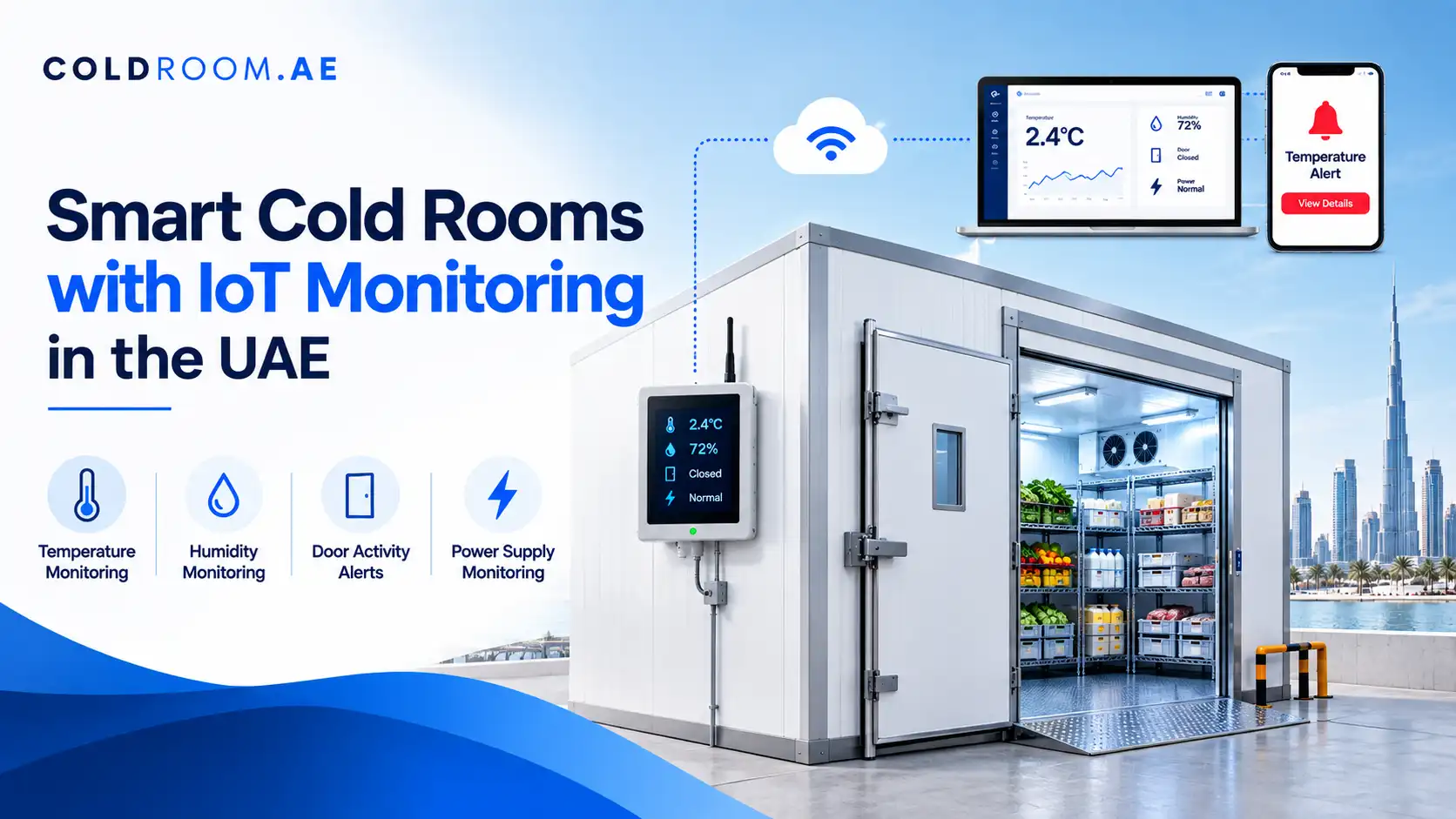
Cold rooms with IoT monitoring keep a running record of conditions inside the room. Sensors track temperature, humidity, door activity, and power supply, and pass the readings through a gateway to a cloud platform. If a value moves outside its safe range, the system notifies the person responsible, whether or not anyone is on site. Food, pharmaceutical, and logistics operators in Dubai, Abu Dhabi, Sharjah, Ajman, and elsewhere in the UAE use this to add a continuous, time-stamped log to the manual checks they already carry out.
The need is practical. In summer, outdoor temperatures in parts of the UAE can come close to 50°C, and insulated panels and compressors work under heavy load for months at a time. In those conditions, a compressor fault or an open door overnight or over a weekend can go unnoticed until the stock has already been affected. An IoT monitoring system shortens that delay by detecting the fault as it happens and notifying the responsible person.
This guide explains how IoT in cold storage works, which parameters to monitor, how monitoring relates to UAE food and pharmaceutical requirements, and how to choose an IoT remote monitoring solution from a cold room manufacturer or supplier.
What Is IoT Monitoring in Cold Storage?
IoT monitoring in cold storage is a remote monitoring system for cold rooms. Sensors inside the room measure conditions such as temperature and humidity, a gateway sends those readings online, and software raises an alert when a value drifts outside the range set for the stock.
A typical IoT device monitoring setup has five layers:
- Sensors measure temperature, humidity, door status, power, and equipment current.
- A gateway collects sensor data and forwards it to the network.
- Connectivity carries the data by LoRaWAN, other low-power radio, cellular, or Ethernet.
- A cloud platform stores readings, draws trend graphs, and produces reports.
- An alerting system notifies staff by push notification, SMS, email, or phone call.
From Reactive Checks to Predictive Asset Protection
A manual check records the temperature at one moment, and whatever happens between one round and the next goes unrecorded. IoT monitoring fills that gap with a continuous record, and it shows the trend as well as the current figure. It can also follow equipment behaviour, for example compressor current or the time a door stays open. A compressor that is struggling can show up there first, sometimes before the room itself gets warmer.
The three terms are easy to blur together, so it helps to separate them. Monitoring is the constant collection of readings. An alert is the notification sent when a reading crosses a threshold. The response is what a person or system does next, such as moving stock, restarting a unit, or calling a technician.
How the Components Relate
| Component | Function | Sends data to | Depends on |
|---|---|---|---|
| Sensor | Measures conditions | Gateway | Correct placement and calibration |
| Gateway | Collects and buffers data | Cloud platform | Signal path and power backup |
| Cloud platform | Stores, analyses, reports | Alerting system and users | Network connection |
| Alerting system | Notifies responsible staff | Facility manager | Correct thresholds and contact lists |
| Staff or automated response | Corrects the fault | Cold room equipment | Fast, clear alerts |
Why Cold Rooms in the UAE Need IoT Monitoring
Heat and Compressor Stress
The gap between outdoor and indoor temperature is large for much of the year. Polyurethane (PUF) and polyisocyanurate (PIR) insulated panels work under constant thermal load, and compressors run at high capacity for long periods. This raises the likelihood of mechanical failure and makes early warning valuable.
Power Transfers and Compressor Restart
After a grid interruption, there is a short delay while the automatic transfer switch and generator bring backup power online. Every compressor start draws several times its normal running current, and the compressor’s Locked Rotor Amps (LRA) rating gives the upper end of that surge. Soft starters and variable frequency drives reduce it.
In industrial areas such as JAFZA and Dubai Industrial City, several compressors may try to restart together once the generator takes the load. That can cause voltage sags, trip protection relays, or leave a compressor stopped.
Systems with Current Transformer (CT) clamps on the compressor phases can detect this. If a compressor is not drawing current when it should be, the facility manager is alerted before a temperature alarm would trigger. This is the main difference between simple temperature logging and equipment health monitoring.
How IoT Monitoring Works Inside a Cold Room
Radio Signals and the Faraday Cage Effect
Most cold rooms are built from insulated sandwich panels with a skin of galvanised steel or aluminium on both faces. That metal skin behaves much like a Faraday cage: radio waves are reflected or absorbed instead of passing through. Wi-Fi suffers most. Its 2.4 GHz and 5 GHz signals often fade badly inside the room, and a network that works well outside may not reach a sensor on the other side of the panel.
Lower-frequency, long-range radio such as LoRaWAN usually copes better, and its sensors can run on a battery for years. Freezers add a second constraint. Standard batteries lose capacity in the cold, so sensors there need cold-rated lithium cells. Even so, metal panels weaken any radio signal, which is why the position of the gateway and its antenna matters as much as the protocol. Many installations mount the gateway, or at least its antenna, outside the insulated envelope and send the data to the cloud over cellular or Ethernet. Other designs are also in use, including wired probes and Bluetooth or Wi-Fi sensors with external antennas. Whichever is chosen, radio devices sold for use in the UAE should carry the required regulatory approval, and the supplier should be able to confirm it.
Gateways, Data Buffering, and Cloud Analytics
The gateway bridges the cold room and the wider network. Its most important feature is local data buffering. If the internet connection drops, the gateway keeps recording and uploads the stored data when the link returns, so the log has no gaps. An internal battery lets it continue through a power cut.
The cloud platform turns raw readings into dashboards, trend graphs, maintenance indicators, and exportable reports, available on web and mobile.
Critical Parameters: What Should a Cold Room IoT Monitoring System Track?
A complete IoT remote monitoring system tracks temperature, humidity, door status, power, compressor current, energy use, and equipment alarms.
| Parameter | What Is Monitored | Why It Matters |
|---|---|---|
| Temperature | Air, product core, and evaporator coil temperature | Keeps stock within required limits and limits spoilage and microbial growth |
| Humidity | Relative humidity inside the room | Reduces condensation and frost; protects produce from dehydration and moisture-sensitive products and packaging from damage |
| Door status | Open or closed state and duration, via magnetic contacts | Prolonged openings let in warm, moist air, raising energy use and causing temperature spikes and ice |
| Power status | Voltage and phase continuity | Detects grid failure at once and confirms the backup generator has taken over |
| Compressor status | Current draw via CT clamps | Reveals failed restarts, short cycling, and developing motor faults early |
| Energy consumption | kWh used by the refrigeration cycle | Highlights inefficiency; refrigeration is typically a large share of a cold store’s electricity use |
| Alarm status | Defrost errors, sensor faults, fan failures | Separates an external cause, such as an open door, from an internal mechanical fault |
Key Facts at a Glance
| Entity | Attribute | Typical Value |
|---|---|---|
| Chilled food cold room | Required temperature | 5°C or below |
| Frozen food cold room | Required temperature | -18°C or below |
| Temperature danger zone | Range of rapid bacterial growth | 5°C to 60°C |
| Vaccines and many biologics | Storage range | 2°C to 8°C (some products require frozen storage; follow the product label; blood products vary by component) |
| Food storage sensor | Typical accuracy | About ±1.0°C |
| Pharmaceutical sensor | Commonly specified accuracy | ±0.5°C |
| Sensor calibration | Typical interval | At least annually, or as the manufacturer or authority requires |
IoT Cold Room Monitoring Across UAE Industries
Restaurants, Hotels, and Commercial Kitchens
Kitchens monitor chilled preparation rooms, blast chillers, and walk-in freezers to keep food out of the danger zone and to keep records ready for inspections. Logging the cooling rate of cooked batches requires product probes in addition to room sensors. Operators of commercial walk-in cold rooms benefit most from door alerts and automatic logs.
Supermarkets and Hypermarkets
Retail sites have many refrigeration zones, from dairy coolers to frozen aisles and back-of-house storage. Central monitoring can reveal defrost failures, refrigerant leaks, and compressor short cycling before customers see the effect.
Pharmaceutical and Healthcare Storage
Vaccines and other temperature-sensitive medicines require tight control and documented evidence. Systems for this sector use calibrated sensors with traceable certificates, protected audit trails, and validated software. Requirements such as the U.S. FDA’s 21 CFR Part 11 are not UAE law, but many pharmaceutical operators use them as an international benchmark for electronic records. Rooms should also be thermally mapped before use to find hot and cold spots.
Multi-Commodity Logistics and 3PL Warehouses
Warehouses in hubs such as JAFZA and Dubai South often hold frozen seafood alongside fresh flowers at a different temperature. Zone-level monitoring gives each area its own alarm limits and reports. Operators of large cold storage warehouses also use the data to manage cooling loads and to prepare export and certification documents.
Types of IoT Monitoring Solutions
| Solution Type | Best Suited To | Main Consideration |
|---|---|---|
| Standalone wireless sensors with cloud alerts | Small walk-in rooms and single sites | Simple to install; limited equipment insight |
| Gateway-based multi-sensor systems | Kitchens, supermarkets, mid-size industrial sites | Balanced cost and coverage; gateway placement matters |
| Integrated monitoring with CT clamps and power sensing | Industrial cold rooms and warehouses | Supports predictive maintenance |
| Validated systems | Healthcare and pharmaceutical distribution | Documentation and validation requirements |
| Integration with a Building Management System (BMS) | Large facilities that need automated control | Higher cost and complexity; allows direct control |
Calculating the ROI of IoT Cold Room Monitoring
The financial case rests on three areas.
Loss prevention. A single undetected excursion, such as a tripped breaker over a weekend, can destroy stock worth tens of thousands of dirhams. Some vendors report payback within roughly four to ten months, often through one avoided loss. These figures depend on stock value and site conditions, so estimate your own exposure before relying on them.
Energy optimisation. Continuous data can show over-cooling, excessive defrost cycles, and heat gain through worn door seals. Some vendors report facility energy savings of 10 to 25 percent when operators act on the findings. The saving only occurs after someone replaces the seal, services the evaporator, or adjusts the defrost schedule.
Labour and record-keeping. Automatic logging removes repeated manual readings, shortens the time spent preparing records for inspections, and reduces transcription errors.
Manual Monitoring vs IoT Monitoring
| Factor | Manual Monitoring | IoT Monitoring |
|---|---|---|
| Frequency | Periodic checks, for example every few hours during shifts | Continuous; readings often every few minutes |
| Overnight and holiday cover | Gaps when unstaffed | 24/7 |
| Remote access | None; paper or local files | Web and mobile dashboards |
| Alerts | Found at the next check | Instant SMS, email, or push |
| Records | Depend on staff accuracy and consistency | Time-stamped digital logs |
| Multiple cold rooms | Staff visit each unit | Central view of all rooms |
| Response | Reactive | Proactive |
Manual checks remain part of many procedures. In pharmaceutical settings they help verify electronic records and act as a fallback if a sensor fails.
How to Choose an IoT Remote Monitoring Device or Solution
Sensor Accuracy and Calibration
Match accuracy to the application. Pharmaceutical storage commonly specifies a tighter tolerance than general food storage. Sensors can drift over time in conditions of thermal cycling and condensation, producing false alarms or hiding a real excursion. Choose devices that are easy to remove for calibration, and use an ISO/IEC 17025-accredited laboratory for certificates traceable to recognised standards.
Connectivity and Resilience
Ask how the sensors reach the gateway through the metal-clad panels and where the gateway will sit. The gateway should have a battery backup and enough local storage to keep recording through an outage.
Scalability and Software
The platform should support one walk-in room today and many sites later, with mobile access, tiered alert escalation, exportable reports, and user permissions.
Sensor Placement
One sensor is rarely enough. Airflow creates warm zones near doors and cooler zones near evaporators, so larger rooms need several sensors positioned after a thermal mapping exercise.
Questions to Ask a Cold Room Manufacturer or IoT Supplier
- Which calibration certificates are supplied?
- What happens to data if the internet or power fails?
- What regulatory approvals do the radio devices hold for use in the UAE?
- What reports are available for inspections and audits?
- Who receives alerts, and how are they escalated?
UAE Regulations and Standards for Cold Room Monitoring
Authorities expect temperature control to be maintained and documented. Continuous IoT logs are one dependable way to do this, especially for sites with several rooms or out-of-hours periods. Requirements change, so confirm current rules with the relevant authority before relying on this summary.
Dubai. The Dubai Municipality Food Code sets required storage temperatures for chilled and frozen food, listed in the table above. Food establishments use Foodwatch, Dubai Municipality’s food safety platform, for permit applications and daily reporting by the Person in Charge, and the platform digitises records including temperature monitoring records. Registration is widely described as mandatory.
Abu Dhabi. The Abu Dhabi Agriculture and Food Safety Authority (ADAFSA) inspects food businesses under Abu Dhabi Food Law No. 2 of 2008 and its supporting regulations. Check ADAFSA’s current requirements for cold storage records.
Sharjah and Ajman. Municipal food safety departments in these emirates set their own inspection and record-keeping expectations.
Pharmaceutical and healthcare storage. The Emirates Drug Establishment (EDE) is taking over pharmaceutical facility licensing and related functions from MOHAP, which retains control of narcotics and controlled drugs. Confirm which body handles your licence. Emirate health authorities, such as the Department of Health in Abu Dhabi, also set standards. Good Distribution Practice (GDP) calls for temperature mapping and documented monitoring of storage areas, and WHO guidance on temperature mapping is a common reference.
International standards. The WHO Performance, Quality and Safety (PQS) E006 specification covers temperature monitoring devices for vaccine storage and is widely used as a reference. Facilities working under HACCP and ISO 22000 use continuous records to support the monitoring of Critical Control Points (CCPs).
Common Misconceptions About IoT in Refrigeration
| Misconception | Reality |
|---|---|
| IoT automatically controls the refrigeration system | Most IoT systems monitor and alert. Direct control needs a BMS or controller integration |
| IoT monitoring guarantees product safety | It gives visibility. Alerts must be acted on, and backup power must be adequate |
| One sensor is enough for any cold room | Airflow creates temperature differences; larger rooms need several sensors |
| Standard Wi-Fi works well inside a cold room | Metal panels weaken Wi-Fi, so other radio designs or external antennas are usually needed |
| Any IoT sensor suits pharmaceutical storage | Pharmaceutical use needs sensors and software that meet documented requirements |
Frequently Asked Questions
It is the use of connected sensors, a gateway, and cloud software to record temperature, humidity, door status, and power in real time and to alert staff when values go outside set limits.
Sensors send readings to a gateway using a radio design or wiring suited to metal-clad panels. The gateway, often placed outside the insulated envelope, forwards the data to the cloud.
The platform sends an alert. A short deviation, such as a door opened during loading, may raise a dashboard flag. A prolonged excursion, power loss, or compressor fault escalates to SMS, phone call, and email for the responsible managers.
Yes, if the system includes CT clamps and power sensing. It can flag a failed restart after a generator transfer, short cycling, and abnormal current draw.
It depends on the stock value at risk, energy costs, and how quickly staff respond to alerts. Some vendors report payback within months, mainly by avoiding a single major loss.
Dubai food establishments use Foodwatch for permits and daily reporting, and the platform includes temperature monitoring records. Check Dubai Municipality’s current guidance for the exact records your permit requires.
Drift can cause false alarms or hide a real temperature change. Regular calibration with traceable certificates keeps readings reliable and defensible during audits.
Yes. Cloud platforms can show cold rooms and warehouses in different emirates on one dashboard, with alerts sent to the person responsible for each site.
Look for calibrated sensors with traceable certificates, a protected audit trail, and support for thermal mapping records. Confirm requirements with EDE, MOHAP, or the relevant emirate health authority.
In many cases, yes. Wireless sensors, door contacts, and CT clamps can often be added without major changes. A site assessment confirms sensor positions and gateway location.
Get IoT Monitoring for Your Cold Room in the UAE
Coldroom.ae supplies industrial and commercial cold rooms in the UAE. To discuss a cold room with remote monitoring for your facility, request a quotation.