

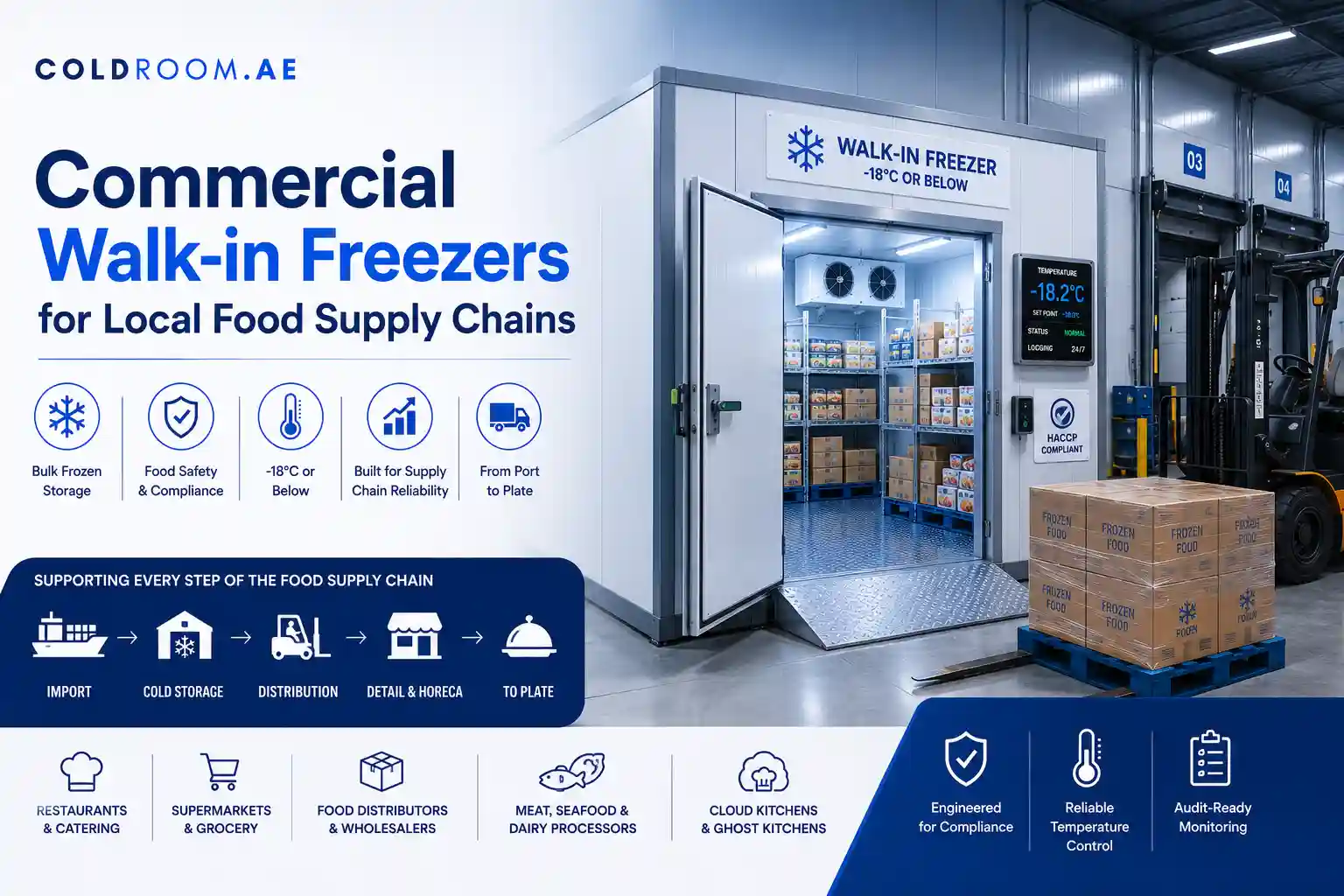
A commercial walk-in freezer is exactly what it sounds like: a room, not a cabinet, kept at −18°C or colder. That size difference matters more than it sounds like it should. A restaurant, a supermarket, a food distributor — none of them can run serious volume out of a standalone freezer unit forever. At some point the freezer has to become part of the building itself. Insulated panels. A dedicated refrigeration plant. Flooring that can actually take a pallet jack or a forklift without buckling. That’s the difference between a big appliance and a room, and it’s also why these things end up sitting right in the middle of how frozen food moves through the UAE, from the port all the way to whatever plate it lands on.
In a country that imports the vast majority of what it eats, that room is not just kitchen equipment. It’s supply chain infrastructure — and commercial walk-in freezers for food supply chains across the UAE are increasingly being specified with that role in mind.
Why Walk-in Freezers Matter for Food Supply Chains in the UAE
The UAE isn’t just a consumer of frozen food — it’s a regional trading hub for it. The country facilitates over 18% of the Middle East’s total food trade and contributes more than 26% of the region’s food exports (Logic Consulting, 2024), which means local cold storage capacity doesn’t only serve residents; it underpins re-export and distribution across the wider Gulf.
That role has come under real pressure. Shipping disruptions through the Red Sea and Black Sea corridors since 2023 have pushed vessels onto longer routes, stretched transit times, and left refrigerated containers sitting on UAE tarmacs and ports in ambient heat that regularly exceeds 45°C. The practical effect has been a shift away from strict just-in-time inventory. Distributors, supermarket chains, and third-party logistics providers are now holding more stock on-site rather than trusting tightly scheduled deliveries — and every extra pallet of buffer stock needs a compliant freezer room to sit in.
This shift lines up with the UAE’s National Food Security Strategy 2051, the federal policy framework that treats cold storage capacity as national infrastructure rather than a private operational cost. Frozen storage — the −18°C to −25°C band specifically — has become the fastest-growing segment of the country’s cold chain sector, driven by rising frozen meat and seafood consumption and the growth of hyper-local grocery delivery in dense Dubai neighborhoods like Business Bay, Jumeirah, and Al Barsha, where operators are turning to smaller, hyper-local cold units to hit one-to-three-hour delivery windows.
Put simply: every commercial walk-in freezer installed across Dubai, Abu Dhabi, and Sharjah adds a buffer against the exact kind of shipping volatility the region has faced over the past two years.
Where Walk-in Freezers Fit Across the UAE Food Supply Chain
Not every business needs the same freezer. The right specification depends heavily on where a facility sits in the supply chain.
Restaurants and catering businesses typically work with tight kitchen footprints, especially in premium real estate across Downtown Dubai or Dubai Marina. A restaurant walk-in freezer is often built as a combi unit — a single insulated structure partitioned into a chiller zone and a freezer zone — to make the most of limited space. Because commercial kitchens move raw proteins and prepared food in and out constantly, air curtains or PVC strip doors are standard, preventing the temperature spike that comes from staff opening the door dozens of times during service.
Supermarkets and grocery retailers need cold storage that customers can see into without opening. Retail-facing freezer rooms commonly use insulated glass doors — double or triple-glazed, with anti-fog heating built into the frame — so shoppers get full product visibility while the compressor isn’t fighting constant warm-air infiltration every time a door opens.
Food distributors and wholesalers operate at a different scale entirely, and they’re the segment most directly tied to ISO 22000 compliance and integration into the UAE’s national food security infrastructure. These facilities need panels rated for heavy mechanical traffic, reinforced flooring that can take pallet jacks and forklifts without compromising the insulation underneath, and — for larger builds — protection against frost heave (more on that below). Full digital data logging and remote monitoring aren’t optional here; they’re what keeps a wholesale operation auditable under UAE food safety law.
Meat, seafood, and dairy processors rely on a different category of equipment altogether: the blast freezer, used alongside GCC drip-percentage standards that govern how much moisture loss is acceptable during freezing. Rather than simply holding food at −18°C, a blast freezer drives air temperatures down to around −35°C to −40°C to pull a product’s core temperature down to −18°C rapidly — freezing times vary by unit capacity, air velocity, and product size, but typically fall somewhere between one and four hours. This rapid freezing — known as Individual Quick Freezing, or IQF — limits the size of ice crystals that form inside the product, which is what protects texture and cell structure in fresh seafood and meat.
Cloud kitchens and ghost kitchens, a fast-growing segment across the UAE’s industrial and commercial food zones, add another layer of complexity: multiple food brands often operate out of one facility, each needing to satisfy both municipal health codes and the compliance standards of delivery aggregator platforms. These operations typically pair a blast chiller directly next to freezer storage, so high-volume batch cooking can be cooled safely before it goes into deep freeze.
Types of Commercial Walk-in Freezers
| Type | Best Suited For | Typical Temperature | Key Feature |
|---|---|---|---|
| Standard commercial walk-in freezer room | Restaurants, hotel kitchens, small-to-mid retail | −18°C to −23°C | Cam-lock modular panels, single-compressor systems |
| Industrial walk-in freezer | Large distribution hubs, 3PL warehouses, food manufacturing | −18°C to −25°C | Forklift-rated flooring, high-ceiling racking, reinforced panels |
| Blast freezer | Meat, seafood, dairy processing | −35°C to −40°C (rapid core freeze to −18°C) | High-velocity air circulation, IQF-capable |
| Portable walk-in freezer | Remote catering, temporary sites, leased retail units | −18°C to −23°C | Skid-mounted or cam-lock knock-down build, relocatable |
| Custom walk-in freezer | Purpose-built warehouses, unusual footprints or throughput needs | Project-specific | Continuously joined panels, structural steel framing |
Portable and modular walk-in freezers use cam-lock panel systems that assemble without structural framing, which makes them the practical choice for restaurant operators, franchisees, or anyone leasing a commercial unit who might need to relocate the equipment when the lease ends. The same portable, skid-mounted approach is common for remote catering operations and temporary logistics staging.
Custom-built walk-in freezers, by contrast, are constructed in place using continuously joined, high-density panels mounted to structural steel. This approach is standard for large-scale wholesale and 3PL warehousing, where the freezer needs to be engineered around specific heat load calculations, forklift traffic, and volumetric capacity that a knock-down panel system can’t support.
Technical Specifications: What a Walk-in Freezer Room Needs in UAE Conditions
Summer in the UAE isn’t kind to refrigeration. Ambient heat regularly climbs past 45°C, and on a rooftop plant room it can get worse — 50°C isn’t unusual. Now put a freezer interior of −18°C or colder next to that. Few commercial refrigeration systems anywhere have to bridge a gap that wide, and almost every design choice that follows exists because of it.
Insulation panel thickness. Chiller rooms holding produce or dairy at 0°C to +5°C generally use 60mm to 100mm PUF or PIR panels. Freezer rooms need considerably more: 120mm to 150mm is standard for a commercial walk-in freezer, and blast freezers running at −35°C to −40°C typically require 150mm to 200mm panels. Installing a freezer with chiller-rated panels is one of the more common and costly mistakes in this market — it leaves the compressor running almost continuously against heat infiltration it was never sized to handle, which shows up as condensation on the walls, ice buildup on the evaporator, and early equipment failure.
Refrigeration sizing for local ambient conditions. Refrigeration equipment built to standard European ambient ratings (32°C–35°C) is routinely under-specified for the UAE. When outdoor and rooftop temperatures climb into the high 40s, an under-rated condenser simply loses the capacity to reject heat, and the whole refrigeration cycle can collapse right when it’s needed most. Equipment for a UAE freezer room needs to be desert-rated — oversized condenser coils and compressors built for 48°C to 50°C ambient conditions, not catalogue specs pulled from a cooler climate.
Defrost systems. A freezer sits below the freezing point of water, so every time the door opens, moisture in the air coming in has nowhere to go but the evaporator coil, where it turns to frost. Left alone, that frost builds up and starts choking airflow. There are two ways to deal with it. Electric defrost runs resistance heating elements on a timer to melt it off periodically. Hot gas defrost does the job differently — it reverses the refrigerant flow so hot gas comes back through the coil and melts the frost from the inside out. It’s the faster of the two, and generally the more energy-efficient one as well.
Flooring and frost heave. Floor requirements scale with the size of the room. A smaller freezer usually gets by with heavy-duty insulated or reinforced floor panels — nothing especially complicated. Large warehouse freezers are a different story, and this is a risk a lot of people don’t think about until it’s too late: keep a big room running at −20°C for long enough, and the cold works its way down through the slab and into the groundwater sitting in the soil beneath it. That water freezes too. And ice, as it freezes, expands — with enough force to crack a concrete foundation. The fix is underfloor heating mats or pipe ventilation systems built into the floor design from the start — not something to retrofit after cracks appear.
Sizing a Commercial Walk-in Freezer
| Business Scale | Typical Application | Volume / Footprint | Key Design Requirements |
|---|---|---|---|
| Small restaurant / café | Daily operational inventory | 15m³–30m³ (approx. 2.4m × 3.0m) | Modular cam-lock panels, single split system, electric defrost |
| Mid-size distributor / supermarket | High-turnover retail, regional staging | 50m³–150m³ | Insulated glass display doors, air curtains, dual-compressor redundancy |
| Large warehouse / 3PL hub | Bulk palletized storage, national reserves | 500m³–10,000m³+ | Forklift racking clearance, 150mm+ panels, frost heave protection |
These are starting benchmarks, not fixed rules — actual sizing depends on throughput, product mix, and how the room fits into the wider facility layout. A proper heat load calculation is the only way to size a freezer accurately for a specific site.
UAE Regulatory and Compliance Requirements
This is the part of the process most easily underestimated, and it’s where a non-compliant installation becomes a licensing problem rather than just an engineering one.
Temperature threshold. Every major regulatory framework applicable in the UAE — Dubai Municipality’s Food Code, ADAFSA in Abu Dhabi, the GCC Standardization Organization’s GSO CAC/RCP 8:2015, and Codex Alimentarius — sets frozen food storage at or below −18°C. Under the GSO and Codex Alimentarius standards specifically, that threshold applies at the thermal center of the product — the coldest point takes longer to freeze than the surface, so that’s the point that has to clear −18°C, not just the outside of the item. Dubai Municipality’s code also prohibits letting the room drift and stay drifted; if temperature rises to around −15°C during door openings, it has to be brought back down to −18°C promptly, not left to recover on its own schedule.
The two-stage cooling rule. This one trips up a lot of first-time freezer buyers. Dubai Municipality requires cooked food to pass through two defined cooling stages before it goes into frozen storage: from 60°C down to 21°C within 2 hours, then from 21°C down to 5°C within a further 4 hours — 6 hours total. A standard walk-in freezer isn’t designed to pull hot food down through that curve; trying to use one for it violates the Food Code, raises the ambient temperature of the whole room, and puts existing inventory at risk. That job belongs to a dedicated blast chiller or blast freezer, installed alongside the storage freezer rather than instead of it.
Fire safety for insulation panels. PUF and PIR foam cores are combustible, which puts freezer panel selection under the UAE’s Fire and Life Safety Code of Practice, enforced by the Directorate General of Civil Defense. Panels need to be FM Approved or Dubai Central Laboratory certified, with fire-retardant cores rated Class A2 (DIN 4102 / EN 13501-1) or Class A (ASTM E84). Using panels without this certification isn’t a minor compliance gap — it can mean a denied operating license and an uninsurable facility.
HACCP and digital traceability. Hazard Analysis Critical Control Points procedures are mandatory for commercial food operations under UAE federal law, and thermal control is the primary control point for any freezer room. Handwritten temperature logs taped to a freezer door don’t pass audits anymore. Facilities need digital data loggers with active alarms that flag any deviation from the −18°C setpoint, records retained for a minimum of 12 months (up to 5 years in some Abu Dhabi jurisdictions), and stock managed on a strict FIFO or FEFO basis.
| Standard | Frozen Storage Threshold |
|---|---|
| Dubai Municipality Food Code | ≤ −18°C |
| ADAFSA (Abu Dhabi) | ≤ −18°C, with digital cold chain traceability |
| GSO CAC/RCP 8:2015 | ≤ −18°C at thermal center; blast freezing to −35°C to −40°C |
| Codex Alimentarius (CXS 320/322) | ≤ −18°C at thermal center |
What Affects the Cost of a Commercial Walk-in Freezer in the UAE
Pricing for a commercial walk-in freezer varies significantly based on a handful of factors, which is why quotes need a proper site assessment rather than a flat number:
- Size and volume — a small café-sized unit and a 3PL warehouse freezer aren’t remotely comparable projects.
- Panel thickness and insulation rating — 120mm freezer-grade panels cost more than 100mm chiller-grade ones, and blast freezer panels (150mm–200mm) more again.
- Refrigeration capacity — desert-rated compressors and oversized condensers, built for 48–50°C ambient conditions, cost more than catalogue equipment but avoid the compressor failures that under-specified systems run into in UAE summers.
- Flooring and structural work — reinforced, forklift-rated flooring and frost heave protection add cost for larger installations.
- Doors and access — insulated glass display doors, air curtains, and multi-door configurations all affect the final price.
- Digital monitoring and controls — HACCP-compliant data logging and alarm systems are now a standard line item, not an optional extra.
Because these variables compound, industrial and custom warehouse installations can scale well beyond standard commercial pricing once rack refrigeration systems, civil works, and frost heave mitigation are factored in. The most reliable way to get an accurate figure is a site survey and heat load calculation — contact ColdRoom.ae for a quote based on your actual facility and requirements.
Choosing a Walk-in Freezer Manufacturer in the UAE
Freezer room performance in this climate comes down to whether the build accounts for local conditions — desert-rated refrigeration, correct panel thickness for the temperature band, and Civil Defense–compliant materials — rather than specifications pulled from a catalogue designed for a cooler market. That’s the single biggest differentiator between UAE walk-in freezer manufacturers: whether the engineering was actually designed for 45–50°C ambient heat, or just adapted from equipment built for somewhere else.
ColdRoom.ae has delivered modular cold storage projects across the UAE for over seven years, with 1,000+ completed installations spanning restaurants, supermarkets, and industrial cold storage across Dubai, Abu Dhabi, and Sharjah. For a closer look at what to check when comparing walk-in freezer manufacturers, see our dedicated guide: Walk-in Freezer Manufacturers in the UAE.
Frequently Asked Questions
−18°C or below. That’s the number every UAE authority agrees on — Dubai Municipality, ADAFSA, and GSO standards across the GCC all land on the same threshold. Some operators run it a couple of degrees colder, closer to −23°C, just to build in a margin of error.
Once a freezer sits consistently above −18°C, that’s a problem — it usually means the refrigeration system is struggling, not just having an off day. And if the food itself climbs above 4°C for more than two hours, don’t refreeze it. At that point it’s not safe to use.
Temperature range, mainly. A walk-in chiller stays above freezing, usually somewhere between 0°C and 10°C, just enough to slow spoilage down. A walk-in freezer drops well below that — −18°C or colder — which is cold enough to stop bacterial and enzymatic activity almost entirely. There’s more nuance to which businesses actually need which one; we cover that in our guide: Difference Between Walk-in Chiller and Walk-in Freezer.
For most small restaurants and cafés, something in the 15m³–30m³ range does the job — think roughly 2.4m by 3.0m. But that’s a starting point, not a rule. How much you actually need comes down to menu volume, how often deliveries come in, and how much kitchen space you can spare in the first place.
Yes. HACCP compliance requires digital temperature monitoring with active alarms for any deviation from setpoint, and records need to be retained for at least 12 months for food safety audits.
Standard commercial walk-in freezers typically use 120mm–150mm PUF or PIR panels, rated Class A2 or Class A for fire safety under UAE Civil Defense requirements. Blast freezers running colder need 150mm–200mm.
Related Reading
- Difference Between Walk-in Chiller and Walk-in Freezer
- Walk-in Freezer Manufacturers in the UAE
- Walk-in Chiller Manufacturer in the UAE
Get a Walk-in Freezer Quote
Whether you’re specifying a compact freezer for a Dubai restaurant kitchen, a retail-ready unit for a Sharjah supermarket, or an industrial installation for a distribution hub in Abu Dhabi, ColdRoom.ae designs commercial walk-in freezers engineered for UAE ambient conditions and built to Dubai Municipality, ADAFSA, and Civil Defense compliance standards from day one. Contact our team for a site assessment and quote.
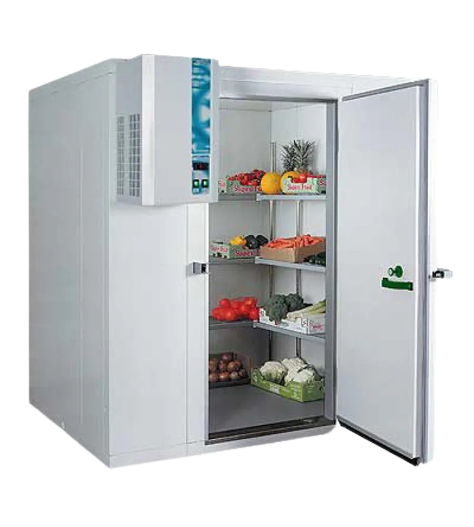
The article provides a clear overview of how commercial walk-in freezers support UAE food supply chains, especially through proper temperature control, insulation, monitoring, and regulatory compliance.
Thank you for the thoughtful comment. We’re glad the article gave a clear picture of how temperature control, insulation, and monitoring come together to keep UAE food supply chains compliant and reliable.
Commercial walk-in freezers are frozen storage facilities maintained at temperatures of ≤−18°C that serve as a vital component of the UAE’s food supply chain utilized by entities ranging from restaurants to distributors and must be designed to withstand extreme heat while complying with strict regulations to ensure efficiency, safety, and support for food security.
Thanks for the summary — you’ve captured the core of it well. The heat-tolerance and compliance piece is honestly the part most people overlook until it becomes a problem.