

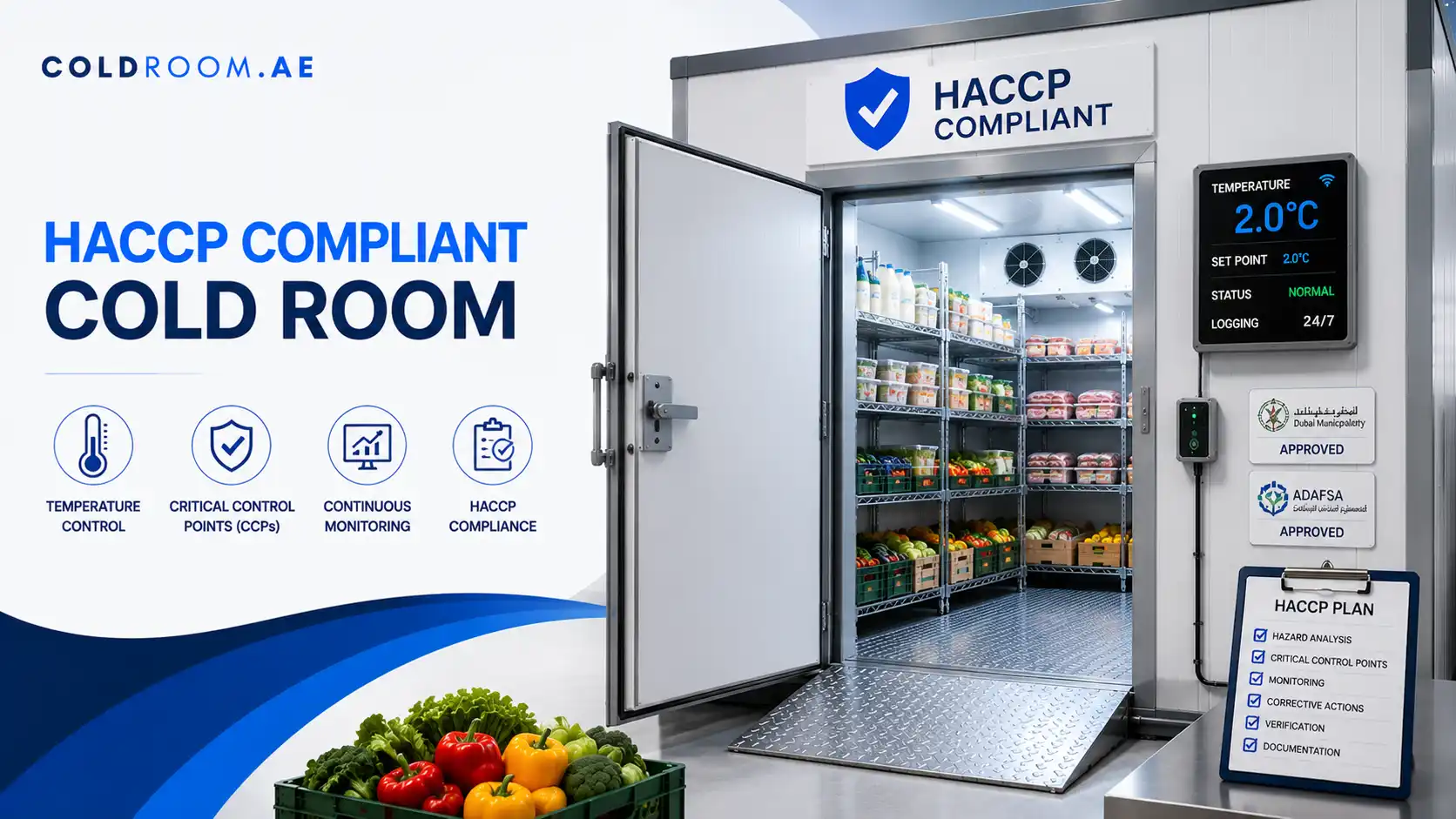
What Is a HACCP Compliant Cold Room?
A HACCP compliant cold room is a temperature-controlled storage facility engineered to satisfy the Critical Control Points (CCPs) required under a Hazard Analysis and Critical Control Point food safety plan — specifically the thermal, structural, and monitoring requirements enforced by Dubai Municipality, ADAFSA, and the UAE’s federal food safety law.
It is not simply a chiller or freezer that happens to run cold. It is a system built around three things at once: a temperature band that never drifts into the danger zone, continuous digital monitoring that can survive an inspector’s audit, and construction materials that hold up in a country where the outside air can be 45°C warmer than the inside of the room.
That distinction matters, because it’s the one most buyers get wrong.
Why a HACCP Compliant Cold Room Matters for Your UAE Business
Every high-risk food business in the UAE — restaurants, catering kitchens, hotels, food manufacturers, cold storage and logistics operators — is legally required to run an active HACCP-based food safety and compliance system, not a certificate on the wall. The equipment you store food in is the foundation that system is built on.
The regulatory structure behind this is layered:
| Level | Authority | Role |
|---|---|---|
| Federal | Ministry of Climate Change and Environment (MOCCAE) / Ministry of Industry and Advanced Technology (MoIAT) | Sets the national legal baseline under Federal Law No. 10 of 2015 on Food Safety; runs the ZAD registration platform and National Rapid Alert System |
| Dubai | Dubai Municipality (DM) Food Safety Department | Enforces the Dubai Municipality Food Code, the Foodwatch digital reporting platform, and the Person-in-Charge (PIC) requirement |
| Abu Dhabi | Abu Dhabi Agriculture and Food Safety Authority (ADAFSA) | Enforces its own technical regulations, the Essential Food Safety Training (EFST) programme, and the public Zadna Rating system |
| Sharjah & Northern Emirates | Sharjah Municipality and equivalent local bodies | Enforce food safety locally, referencing shared GCC standards such as GSO 323 for chilled and frozen food storage and transport |
| Pharmaceutical sector | Ministry of Health and Prevention (MOHAP) | Enforces Good Storage and Distribution Practices (GSDP) for temperature-sensitive medicines, typically 2°C–8°C with calibrated data loggers |
Federal law sets the mandate. Each emirate’s municipality decides how it’s inspected, graded, and penalised. A cold room built for Dubai compliance and a cold room built for Abu Dhabi compliance are working toward the same CCPs, but through two different enforcement bodies — which is why “compliant” has to mean something specific, not generic.
Note: the Dubai Municipality Food Code has had multiple published versions. Confirm you’re referencing the current active version on dm.gov.ae before citing specific section numbers or clause language in client-facing material.
Who Actually Needs a HACCP Compliant Cold Room?
HACCP implementation is mandatory, not optional, for any UAE business handling perishable or high-risk food. That covers a wide commercial and industrial base:
- Restaurants, cafés, and cloud kitchens handling meat, poultry, seafood, or dairy
- Hotels and catering companies running high-volume commissary kitchens
- Food manufacturers and processors — bakeries, ready-meal producers, meat processors
- Cold storage and logistics providers operating multi-client warehousing
- Supermarkets and retail grocery chains with backend chilled/frozen storage
- Institutional canteens — schools, hospitals, government facilities
- Industrial cold storage operators in food-adjacent sectors — seafood export, frozen food distribution, commercial cold storage warehousing
Lower-risk operators — businesses handling only ambient-stable, commercially packaged dry goods such as flour or pasta — face lighter prerequisite hygiene requirements and generally sit outside full CCP monitoring. If your operation touches anything chilled or frozen, it doesn’t.
HACCP vs. ISO 22000: Which One Does Your Cold Room Need to Support?
This is one of the most common points of confusion for UAE food businesses evaluating cold storage. They’re related, not interchangeable.
| HACCP | ISO 22000 | |
|---|---|---|
| What it is | A hazard-focused system identifying and controlling biological, chemical, and physical risks at defined Critical Control Points | A full Food Safety Management System (FSMS) that includes all HACCP principles plus leadership commitment, external communication, and a continuous-improvement (PDCA) cycle |
| Best fit for | Standalone restaurants, independent cafés, catering businesses, single-site cold storage operations | Large multi-site operations, food exporters, industrial manufacturers, businesses pursuing international trade recognition |
| Typical timeline | 4–14 weeks | 3–6 months |
| Typical UAE cost | AED 5,000–16,000 | AED 15,000–35,000+ |
Cost and timeline figures reflect ranges published by UAE HACCP certification providers as of this writing and can vary by facility size and complexity. Confirm current pricing directly with an EIAC-accredited certification body before quoting a client.
You cannot get ISO 22000 without a functioning HACCP plan underneath it — HACCP is the floor, not an alternative. For most independent restaurants and mid-sized cold storage operators, HACCP is the municipal baseline that determines whether you’re allowed to operate at all. ISO 22000 becomes relevant when a corporate buyer — an airline caterer, an international hotel chain, a government tender — demands it as a procurement condition.
Cold Room Critical Control Points: The Temperature Danger Zone
Every HACCP plan for cold storage centres on one CCP above all others: thermal control. Food held between 5°C and 60°C — the temperature danger zone — is in the exact range where pathogenic bacteria multiply fastest. A cold room’s entire job, from a compliance standpoint, is keeping product outside that window at every stage.
| Storage category | Mandated temperature | Why it matters |
|---|---|---|
| Chilled storage | 1°C–4°C (max 5°C) | Perishables — fresh meat, dairy, prepared meals — must stay below 5°C to arrest microbial proliferation |
| Frozen storage | -18°C or colder | Halts bacterial multiplication entirely; blast freezing may drop to -35°C, but standard holding must not exceed -18°C |
| Receiving dock | Max 5°C chilled / -18°C frozen | Chilled or frozen goods delivered above threshold should be rejected, and accepted product should be moved into cold storage as quickly as possible to limit exposure to ambient heat |
| Thawing (under refrigeration) | Max 10°C ambient air | Core product temperature must stay under 5°C during thaw; cooking must follow within 72 hours |
| Cold store corridors | Max 10°C ambient | Corridors between chiller and freezer zones should not be used as storage space |
This is the technical spine of a HACCP compliant cold room — every other engineering decision (insulation, door seals, panel density) exists to hold these numbers steady in a climate that fights against them.
HACCP Temperature Monitoring: What Compliance Actually Looks Like
HACCP Principle 4 requires documented monitoring — not just checking the temperature, but recording when, how, and by whom. Historically, twice-daily manual checks were acceptable. That’s no longer where the bar sits.
Manual logs fail audits for a predictable reason: transcription errors, missed shifts, and what inspectors call “pencil whipping” — writing down a number without actually reading the thermometer. Dubai Municipality’s food safety framework pushes facilities toward continuous digital monitoring through its Foodwatch platform, and inspectors increasingly cross-reference manual logs against the cold room’s own digital data logger. A mismatch between what staff wrote and what the sensor recorded is an immediate red flag.
A note on the “90-day myth”: A figure that circulates constantly in UAE cold storage marketing is a supposed 90-day statutory limit on temperature record retention. It doesn’t hold up under scrutiny of the actual regulatory text. GSO 323 only requires records be kept for a “sufficient period” — deliberately vague. In practice, the safer benchmark comes from adjacent standards: major hospitality HACCP programmes require three years of audit and deviation records, and general UAE business records fall under a seven-year corporate retention requirement. The practical takeaway for cold storage operators: don’t design around 90 days. Design around indefinite, cloud-based digital logging that can produce records on demand, however far back an auditor wants to look.
Calibration Requirements for a HACCP Compliant Cold Room
A monitoring system is only as trustworthy as the sensor feeding it. Under Dubai Municipality’s food safety framework, temperature-measuring devices — display units and thermometer probes alike — must be calibrated before first use and re-calibrated at intervals not exceeding one year. This calibration must come from an external provider accredited by the Emirates International Accreditation Centre (EIAC) — it cannot be done in-house with an uncertified reference. Any probe found out of calibration must be pulled from service immediately until it’s repaired and re-certified.
Corrective Action Protocols: What Happens When a CCP Is Breached
HACCP Principle 5 requires a predefined response the moment a compressor failure or door seal breach pushes a cold room out of range. One widely used corrective-action methodology in commercial food safety works like this:
- Set an alert threshold above your storage target — a common approach flags a check once ambient air rises meaningfully above the storage range (for example, well above the 5°C chilled ceiling), rather than waiting until the target itself is breached
- Check core product temperature, not just ambient air, using a calibrated probe once that alert threshold is crossed
- Assess how long the product was exposed and at what core temperature — the shorter the exposure and the closer to the safe range, the more likely the product can be rapidly re-chilled and kept; extended exposure well into the danger zone should result in disposal
- Document every step — the nature of the deviation, root cause, product disposition, and remedial action taken
- Sign-off by an authorised food safety representative before the log is closed
The specific numeric thresholds used for step 1–3 (exact alert temperature and time windows) vary by facility risk profile and food safety consultant. Rather than presenting one fixed number as universal, your facility’s HACCP plan should define its own thresholds in consultation with an accredited food safety advisor — this is one of the specific deliverables a HACCP consultant produces during plan development.
Inspectors don’t just want to see that a CCP was breached and resolved. They want to see the paper trail proving it was handled correctly, in order, every time.
What Inspectors Actually Check On-Site
Municipal inspections in Dubai, Abu Dhabi, and Sharjah are unannounced and physically thorough — not a paperwork skim. Expect inspectors to:
- Cross-check manual temperature logs against the cold room’s automated data logger
- Inspect door seal integrity and check for condensation or ice buildup on evaporator coils
- Confirm food is stored at least 15 cm off the floor and 20 cm clear of walls
- Demand EIAC-accredited calibration certificates for temperature sensors
- Verify staff food safety training records — Occupational Health Cards and Person-in-Charge (PIC) certification in Dubai, or ADAFSA Essential Food Safety Training (EFST) completion in Abu Dhabi
The gap that trips up most businesses isn’t a missing HACCP binder — it’s a HACCP binder that looks perfect and a cold room that tells a different story.
Consequences of Non-Compliance
The figures below reflect currently published guidance on UAE food safety enforcement. Penalty schedules can be amended, so confirm exact current figures against Federal Law No. 10 of 2015 and any related Cabinet Decisions before citing specific amounts to a client.
| Violation type | Examples | Consequence |
|---|---|---|
| Administrative breach | Missing/incomplete temperature logs, minor technical gaps | Fines, escalating for repeat violations |
| Severe breach | Gross negligence, contaminated food handling | Substantially higher fines, potential imprisonment |
| Critical failure | Falsified HACCP records, freezer running in the danger zone, systemic pest issues | Immediate facility closure, permit suspension, possible criminal referral |
In Abu Dhabi specifically, ADAFSA publishes closed establishments on its public Zadna Rating platform — turning a mechanical failure into a visible reputational hit, not just a fine.
Engineering Features That Actually Support HACCP Compliance
This is where the cold room stops being a legal requirement on paper and becomes physical infrastructure that helps a business stay in control of its hazards.
Insulation panels. Compliant cold rooms typically use high-density polyisocyanurate (PIR) or polyurethane (PU) sandwich panels between polyester-coated galvanized steel sheets. Panel density and thickness vary by application and manufacturer — thickness generally runs from 60 mm for standard chiller applications up to 200 mm for deep-freeze. Panel density and thickness aren’t themselves a fixed legal requirement; they’re an engineering specification that needs to be sufficient to hold your specific CCP temperature reliably under UAE ambient conditions. Panels interlock via a locking mechanism designed for an airtight seal — the seal is what prevents the CCP breach, not the refrigeration unit alone.
Fire safety. Fire-rated panel requirements are set by each emirate’s Civil Defence authority and generally reference EI-rated (integrity/insulation, e.g. EI60–EI120) core materials rather than a single universal standard. Rockwool or mineral-wool cores are commonly specified where fire rating is the priority; PIR and PU cores are chosen primarily for thermal performance. If Civil Defence fire approval is a requirement for a specific project, confirm the exact core material and rating your local Civil Defence authority requires — this varies by project type and emirate, and shouldn’t be assumed from panel type alone.
Spatial layout. Dubai’s food safety framework calls for food stored at a minimum 15 cm off the floor and shelving positioned at least 20 cm from interior walls — clearances that exist to allow airflow, prevent condensation buildup against cold surfaces, and make pest inspection possible.
Surface material. Interior panel surfaces need to be smooth, non-absorbent, and easily cleanable — painted steel or stainless steel are standard compliant finishes, chosen specifically to prevent bacterial adherence.
Digital monitoring and alarms. Regional cold chain standards call for continuous-recording temperature devices. Modern compliant cold rooms achieve this with IoT sensors streaming to a cloud dashboard, with automated SMS/phone alerts firing before a compressor failure pushes the room anywhere near the danger zone threshold — the difference between catching a fault in minutes versus finding out at the next manual check.
UAE-Specific Engineering: Why Climate Isn’t Optional Context
Ambient summer temperatures across Dubai, Abu Dhabi, and Sharjah routinely exceed 45°C with high coastal humidity. That’s not background detail — it’s the primary threat to CCP compliance.
When door gaskets degrade or panel joints are poorly sealed, hot humid exterior air meets a -18°C interior. The result is near-instant ice formation on evaporator coils and condensation on interior walls — which creates exactly the moisture conditions that fail a hygiene inspection outright. Airtight locking mechanisms, continuous vapour barriers, and well-maintained door gaskets aren’t efficiency upgrades in this climate. They’re the physical mechanism keeping a facility inside its CCP thresholds during a Dubai Municipality or ADAFSA audit.
Building a Food Safety and Compliance System Around Your Cold Room
Here’s the part that trips up a lot of buyers: a compliant cold room is not the same thing as HACCP certification.
Your cold room — its panels, its locking mechanism, its IoT telemetry — satisfies what’s called a Prerequisite Program (PRP). It’s the audit-ready hardware foundation. But HACCP certification is awarded to your operational system, not your equipment. Auditors evaluate how your staff actually use the room: monitoring frequency, FIFO stock rotation discipline, and how corrective actions get executed when something goes wrong. You cannot pass a HACCP audit without a properly engineered cold room. But owning one doesn’t hand you the certificate — the certificate belongs to the management system running on top of it.
The certification path, in order:
- Prerequisite setup — compliant cold storage, pest control, sanitation protocols, verified suppliers
- Hazard analysis and plan development — defining CCPs specific to your facility (e.g., “Cold Room 1 must maintain 2°C”)
- Staff training — ADAFSA EFST in Abu Dhabi, PIC certification in Dubai
- Internal audit — self-assessment before the external review
- External certification audit — conducted by an EIAC-accredited Certification Body
- Certificate issuance — typically valid three years, with mandatory annual surveillance audits
ColdRoom.ae supplies the compliant infrastructure your HACCP plan is built around — the certification itself is issued by an independent EIAC-accredited body, and we’re happy to point you toward that step once your cold room is in place.
HACCP Cold Room Compliance by Emirate
Dubai — Governed by Dubai Municipality’s food safety framework, with mandatory use of the Foodwatch digital platform for high-risk establishments and a designated Person-in-Charge (PIC) overseeing food safety systems.
Abu Dhabi — Governed by ADAFSA, operating independently of Dubai Municipality standards. Requires Essential Food Safety Training (EFST) certification for all food handlers and publishes facility ratings through the public Zadna Rating system.
Sharjah — Enforced through Sharjah Municipality, referencing shared GCC frameworks like GSO 323 for chilled and frozen storage. Sharjah-specific technical circulars (particularly around fire safety and panel specification) are less publicly documented than Dubai’s or Abu Dhabi’s — confirm current local requirements directly with Sharjah Municipality or Sharjah Civil Defence for any project-specific detail.
Whether you’re specifying a commercial cold room for a Dubai restaurant, an industrial cold storage facility for an Abu Dhabi distributor, or a cold room for a Sharjah food processor, the underlying CCP engineering is the same — the inspection and enforcement path is what differs by emirate.
Frequently Asked Questions
Chilled storage should stay between 1°C and 4°C, never exceeding 5°C. Frozen storage must hold at -18°C or colder. These thresholds keep food out of the 5°C–60°C temperature danger zone where bacterial growth accelerates.
No. A compliant cold room satisfies the prerequisite hardware requirements of a HACCP plan, but certification is awarded to your operational food safety system by an EIAC-accredited Certification Body, following an external audit of your processes.
At least once every 12 months, by an external provider accredited by the Emirates International Accreditation Centre (EIAC). Any sensor found out of calibration must be taken out of service immediately.
Your facility’s HACCP plan should define a specific corrective-action procedure — typically checking core product temperature (not just ambient air) once a deviation is detected, assessing exposure time and temperature, and either rapidly re-chilling or discarding the product depending on how far and how long it was out of range. These exact thresholds should be set with an accredited food safety consultant rather than assumed from generic guidance.
Yes. Any facility handling perishable or high-risk food — including standalone cold storage and logistics warehouses — is required to run an active, documented HACCP system under UAE federal law and local municipal enforcement.
HACCP is a hazard-control system focused on Critical Control Points and is the mandatory municipal baseline. ISO 22000 is a broader food safety management system that includes HACCP plus organisational requirements — usually pursued when a corporate buyer or export market requires it, not as a standalone municipal obligation.
There’s no confirmed uniform statutory figure — a commonly cited “90-day rule” isn’t substantiated in the actual regulatory text. Given related standards call for three to seven years of retention, the safer approach is continuous digital logging with indefinite, cloud-based storage rather than designing around a short retention window.
Related Reading
- Combi Cold Room: When One Unit Covers Chiller and Freezer Storage
- Modular vs. Prefabricated Cold Rooms: Which Fits Your HACCP Setup
- Cold Room for Food Security: Storage Infrastructure for UAE Supply Chains
Get a HACCP-Ready Cold Room Built for Your Facility
Whether you’re specifying a new commercial cold room in Dubai, upgrading industrial cold storage in Abu Dhabi, or fixing a facility that’s already failed an inspection in Sharjah, ColdRoom.ae designs cold rooms around the Critical Control Points your HACCP plan depends on — not a generic catalogue unit. Speak to our team about your storage requirements, temperature bands, and site conditions.
This guide clearly explains how cold room design, temperature monitoring, calibration, and corrective actions support HACCP compliance in the UAE. The distinction between a HACCP-ready cold room and actual HACCP certification is especially useful for businesses planning compliant food storage facilities.
Thank you for the kind words and for engaging with our content again. We’re glad the distinction between a HACCP-ready cold room and full HACCP certification came through clearly — it’s a point businesses often overlook when planning their storage facilities, so we’re pleased it added value.