

Blast Freezer Room Manufacturers UAE

Coldroom.ae manufactures and supplies industrial and commercial blast freezer rooms for businesses in Dubai, Abu Dhabi, Sharjah, Ajman and the rest of the UAE. No two projects are alike, so we design each blast freezer cold room around the product being frozen, the weight of each batch and the time available to freeze it. Every room is built to handle UAE summer temperatures of up to +50°C.

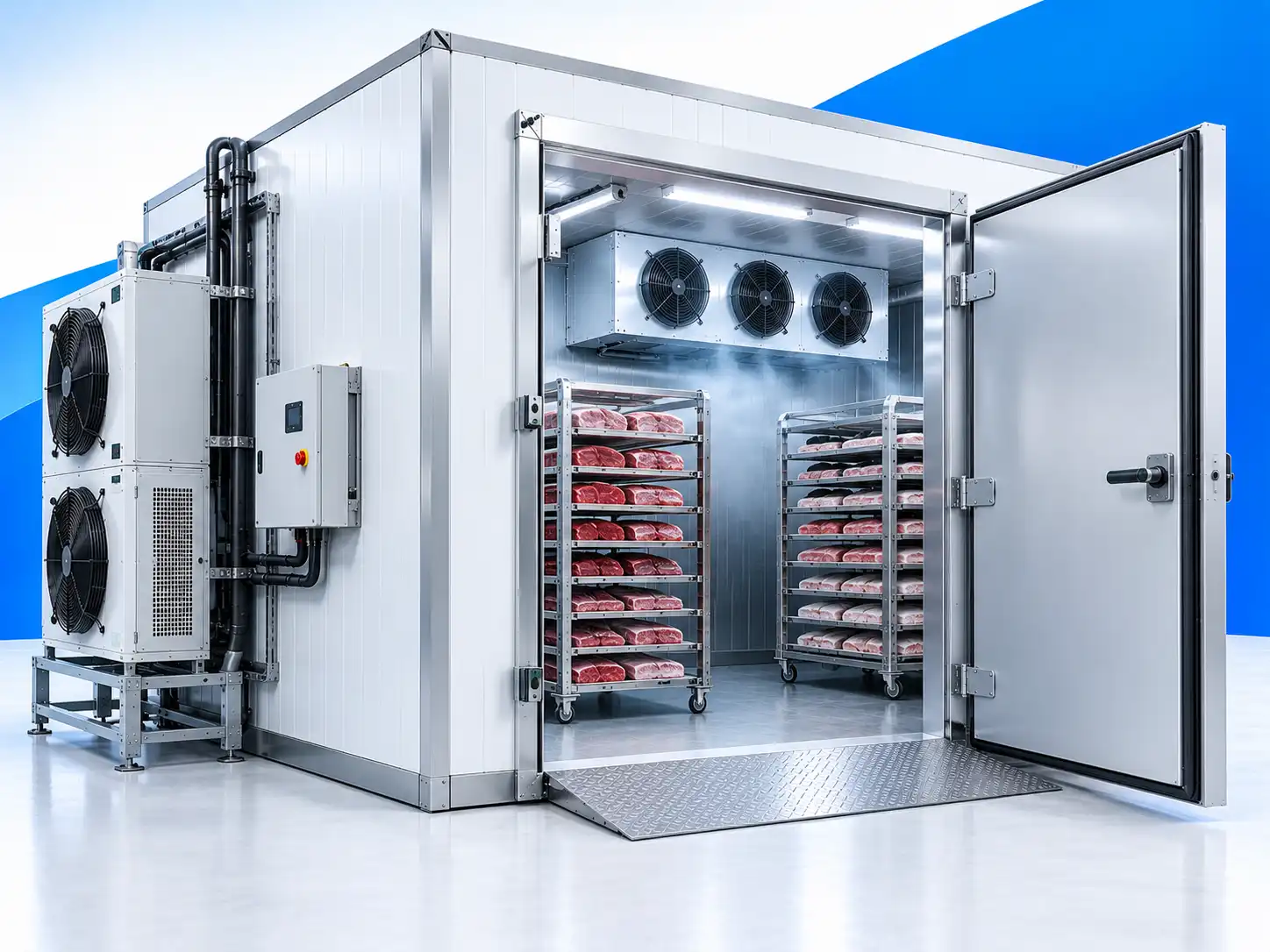
Walk-in blast freezer room with open insulated door, blast evaporator fans, meat on roll-in trolleys and external condensing units

What Is a Blast Freezer Room?

A blast freezer room is an insulated walk-in or trolley-in chamber used to freeze fresh or cooked food within a few hours. It is also known as a blast cold room or a blast freezer cold room. Fans push air at -30°C to -40°C across the product at high speed, and the process continues until the centre of the food reaches -18°C or lower.

A standard freezer room has a different job, which is to keep food that is already frozen. A blast freezer room is a production tool. It has to remove a large amount of heat from each batch within a fixed time.

Speed also decides how the food freezes. When freezing is fast, the water inside the food forms very small ice crystals that leave the cell walls largely intact. Slow freezing produces larger crystals that damage the cells. The result is less liquid lost when the product thaws, and better texture and weight retention.

Reach-in blast freezers and blast chillers are cabinets, and most hold about 5 to 25 kg per cycle. For larger volumes, Coldroom.ae supplies room-scale systems that handle batches from several hundred kilograms up to many tonnes.
Why Do Businesses Need a Blast Freezer Room?

Most buyers come to us because of quality losses. Food that freezes slowly forms large ice crystals, and these crystals tear the cell walls. After thawing, the product leaks fluid, turns softer and weighs less than it did when it went in. In a plant that sells by weight, that shrinkage is a direct loss of revenue. A blast freezer room cuts the freezing window, so far fewer cells are damaged.

Safety is the other concern. Bacteria grow fastest between +5°C and +60°C, and Dubai Municipality sets -18°C as the standard for frozen food. Each batch spends the least time in that range when it moves through it within a few hours, not a day or more.

Output matters as well. A kitchen or factory that can finish several batches per shift is not waiting on the freezer, and the energy and labour cost per kilogram falls.

Then there is the stock already in your cold store. Put a warm batch into an ordinary freezer and the room temperature climbs for hours. Ice builds on the evaporator coil, and the products stored nearby can begin to soften. The new batch is hurt too, because it cools so slowly that it develops the same large crystals you were trying to avoid.

What Is the Difference Between a Blast Freezer and a Blast Chiller?

The difference is where each one stops. A blast chiller brings hot cooked food from about +70°C to a core of +3°C in around 90 minutes. The food is cold but not frozen, and it goes into chilled storage for short-term use. A blast freezer keeps going until the core reaches -18°C or lower, which makes months of storage possible.

Plenty of kitchens end up needing both. In that case we can design one dual-mode room that chills and freezes, or pair a blast freezer with a holding freezer. With the second layout, a finished batch can be moved straight into storage, and nobody has to find space for it in the meantime.

Where Are Blast Freezer Rooms Used in the UAE?

IndustryTypical productsPurpose
Meat and poultry processingHalal carcasses, boxed cuts, poultry filletsReduce drip loss and weight shrinkage
Seafood and fisheryTuna, hammour, shrimp, filletsDeep freezing at -35°C to -45°C air for export quality
Central kitchens, hotels and cateringCooked meals, sauces, banquet dishesCook-freeze cycles on Gastronorm (GN 1/1) trolleys
Bakeries and pastryLaminated dough, par-baked breadStop fermentation, protect structure
Ice cream and dairyTubs, novelties, gelatoHardening to a -23°C to -25°C core
Food manufacturingReady meals, patties, vegetablesFreezing at the end of cooking or forming lines
Supermarkets and distributionCommissary meat, bakery, bulk stockFreezing overstock before van distribution
3PL and port logisticsImported frozen cargoPull-down for cargo that warmed in transit
Dates and pharmaceuticalsFresh dates, biological samplesRapid freezing before long-term storage

Blast Freezer Room Solutions We Manufacture and Supply

• Walk-in blast freezer rooms for industrial and commercial use

• Trolley-in rooms sized for GN 1/1 or 600×400 mm bakery racks

• Pallet-loaded rooms for boxed meat, poultry and seafood

• Dual-mode blast chiller and blast freezer rooms

• Modular and custom rooms built to site dimensions

• Multi-chamber systems with a blast room next to a holding freezer

How Does a Blast Freezer Room Work?

Each batch goes through three heat-removal stages:

  1. Sensible heat above freezing: the product cools from its entry temperature, for example +70°C after cooking, to its freezing point.
  2. Latent heat: water inside the food turns to ice at a near-constant temperature. This is the most energy-intensive stage.
  3. Sensible heat below freezing: the frozen core drops to -18°C or lower.

What Temperature Does a Blast Freezer Room Operate At?

Air temperature is typically -30°C to -40°C, and down to -45°C for heavy seafood duty. The target product core temperature is -18°C or lower, or -23°C to -30°C for ice cream and sashimi-grade fish.

These are two different readings. Room air cools within minutes, but dense cartons conduct heat slowly. An insertable core probe confirms the actual product temperature, so the cycle does not end while the centre is still above -18°C.

How Long Does a Blast Freezer Take to Freeze Food?

Freezing time depends on product thickness, moisture, packaging, entry temperature, air velocity and loading arrangement. As a general guide:

• Shallow trays with exposed food: about 4 hours from +70°C to a -18°C core

• Boxed meat, poultry or palletized fish: commonly 6 to 24 hours

We specify cycle time for each project from your batch data. Shorter cycles need substantially more refrigeration capacity.

Blast Freezer Room Technical Specifications

The values below are typical design ranges for UAE conditions. The final specification is set for each project during the load calculation.

AttributeTypical specification
Air temperature-30°C to -40°C (to -45°C for heavy seafood)
Product core target-18°C or lower
Insulated panelsPIR or PUR, typically 150–200 mm
Foam densityAbout 42 kg/m³
Panel jointsCam-lock with continuous vapor barrier
Interior finishGalvanized steel or AISI 304 stainless steel
Air velocityAbout 3.0–3.5+ m/s across the product
Airflow controlOverhead baffles, plenums, pallet spacers
CompressorsTwo-stage reciprocating or semi-hermetic screw
EvaporatorsLow-temperature blast units with wide fin spacing
Condensing unitsTropicalized, selected for +50°C ambient
DefrostHot-gas or electric resistance
FloorInsulated, non-slip, rated for trolleys and pallet jacks
Frost heave protectionHeating mats, glycol loops or ventilated sub-slab
DoorsHeavy-duty with frame heaters
Pressure reliefHeated pressure relief valve
ControlsPLC with core probes, alarms and HACCP data logging
Power supplyThree-phase, 400 V / 50 Hz

Can an air conditioning unit be used as a blast freezer? No. Air conditioning compressors and coils are designed for evaporating temperatures around +5°C to +7°C. At blast conditions they ice up, lose oil return and fail. A blast freezer needs an industrial low-temperature refrigeration plant.

Why does a blast freezer room need a pressure relief valve? When warm air trapped inside cools from about +35°C to -35°C, its pressure drops sharply. Without a heated relief port, the vacuum can lock the door shut and damage the panels.

Blast Freezer Room vs Blast Chiller vs Freezer Room vs Chiller Room

ParameterBlast Freezer RoomBlast Chiller RoomStandard Freezer RoomChiller Room
FunctionRapid freezingRapid cooling of cooked foodHolding frozen stockHolding chilled stock
Air temperature-30°C to -40°C-2°C to +2°C-18°C to -25°C0°C to +8°C
Core target-18°C or lower+3°C to +5°CMaintain -18°C or lowerMaintain +1°C to +5°C
AirflowVery highHighModerateGentle
Typical panel thickness150–200 mm80–100 mm100–150 mm60–100 mm
DefrostHot-gas or electricElectric, hot-gas or timedElectric or hot-gasOff-cycle or light electric

How Is a Blast Freezer Room Sized, and What Affects the Price?

A blast freezer room cannot be sized from floor area alone. The batch load, the heat removed during freezing and the required pull-down time account for most of the refrigeration capacity. Price follows the same factors, so we quote after a load calculation instead of using a fixed rate.

Information we need for a quote:

  1. Product type, moisture level and packaging
  2. Batch weight per cycle and number of cycles per day
  3. Entry temperature and required core temperature
  4. Required freezing time
  5. Loading method (trays on trolleys or boxed pallets) and available floor area
  6. Site conditions, including ambient heat and where the plant will sit

How these affect the design:

  • Higher entry temperatures, such as +70°C after cooking, add a larger heat load than pre-chilled product.
  • Deeper core targets need lower evaporating temperatures.
  • Open trays freeze faster than boxed pallets, which need spacers and slotted cartons.
  • A tight room layout, with overhead baffles, stops cold air bypassing the product.
  • Frequent door opening causes coil icing, so batch loading schedules matter.
  • Panel thickness, floor design and compressor type also move the project cost.

UAE-Specific Engineering Considerations

Ambient heat. In Dubai, Abu Dhabi, Sharjah and Al Ain, peak summer temperatures reach +45°C to +50°C. Many catalogue ratings, however, are published for +32°C to +35°C, and a unit chosen from those figures can struggle in the afternoon. The load is heavy because a room held at -35°C to -40°C is rejecting heat into +50°C air, a gap of 85 to 90°C. For this reason we recommend tropicalized condensing units selected for +50°C. They should sit in a shaded, ventilated plant room, or be paired with oversized condensers.

Humidity and coil icing. Along the coast, summer humidity stays between 70% and 90% RH. Each time the door opens, some of that moist air enters the room and freezes onto the evaporator fins, which restricts airflow when the batch needs it most. Wide fin spacing and scheduled defrost cycles address this, as does limiting door openings to loading and unloading. A dehumidified loading area helps further. The salt in coastal air also attacks condenser coils over time, so an anti-corrosion coating is worth specifying.

Fire safety. Insulated rooms in commercial and industrial buildings fall under the UAE Fire and Life Safety Code of Practice, which sets requirements for the fire performance of sandwich panel cores. Fire-rated PIR panel options are available, and the applicable approval is confirmed for each project.

UAE Food Safety Requirements

  • Dubai Municipality Food Code: frozen food must be held at -18°C or below, and temperature records are kept through the Foodwatch platform. For cooked food, the code requires cooling from +60°C to +20°C within 2 hours and then to +5°C within a further 4 hours. Blast chilling is usually how kitchens meet that window, while blast freezing provides rapid pull-down to the frozen standard.
  • ADAFSA (Abu Dhabi): frozen food at -18°C or below, with freezer room design requirements in Guideline No. (6) of 2019.
  • Sharjah Municipality: inspections of post-cook cooling, frozen storage and temperature logging.
  • MoIAT and GSO: federal technical regulations for frozen and chilled food stores and for frozen meat and fish.

Rooms are designed to support these requirements, including calibrated core probes and logged temperature records.

Installation and Maintenance

  1. Site survey and load calculation: we collect product, batch and site data.
  2. 3D design and quotation: room layout, equipment selection and scope.
  3. Fabrication and installation: panels, refrigeration plant, doors, floor and controls.
  4. Commissioning: pull-down testing and core probe calibration.
  5. Maintenance support: preventive maintenance before summer includes condenser coil washing, superheat and subcooling checks, door gasket and heater testing, drain line clearing and sensor calibration every six months.

We serve industrial and commercial clients in Dubai, Abu Dhabi, Sharjah, Ajman and across the UAE.

Frequently Asked Questions

What is the difference between a blast freezer room and a standard walk-in freezer?

The difference is the job each one does. A blast freezer room is built to freeze fresh or cooked product, so it runs air at -30°C to -40°C through high-velocity fans and brings the core down to -18°C within hours. A standard walk-in freezer has far less cooling capacity and gentler airflow. It is meant to keep frozen stock cold, not to freeze a warm batch.

Can one room work as both a blast chiller and a blast freezer?

Yes. A dual-mode room can first cool cooked food to +3°C and, when needed, freeze it to -18°C. The two functions run at very different air temperatures and need different control settings, so the room has to be planned this way from the start and cannot be converted easily later.

What panel thickness does a blast freezer room need in the UAE?

Panels of 150–200 mm PIR or PUR are typical for blast duty at -35°C to -40°C in UAE summer conditions. The final thickness is confirmed during design.

Does the floor of a blast freezer room need insulation?

It does. With a room this cold, an uninsulated floor on a ground slab will draw heat from the soil below. The moisture in that soil can freeze and expand, which cracks the slab over time. Insulation and, on ground-level slabs, frost heave protection prevent this.

How much does a blast freezer room cost in the UAE?

There is no single price, because the cost is driven by the project. The main factors are the weight of each batch, how quickly it must freeze, the temperature targets, the panel thickness, the floor design and the type of compressor. For this reason we give a quotation only after a load calculation based on your product and site.

Does a blast freezer room help with Dubai Municipality compliance?

It helps with part of it. A blast freezer room supports the -18°C standard for frozen food and the temperature records that inspectors ask for. The cooling window for cooked food, from +60°C to +5°C within the permitted time, is a different requirement, and it is normally met with a blast chiller function.

Do you supply blast freezer rooms in Abu Dhabi, Sharjah and Ajman?

Yes. Coldroom.ae manufactures and supplies blast freezer rooms in Dubai, Abu Dhabi, Sharjah and Ajman, as well as in other parts of the UAE.

Get Your Blast Freezer Room Designed

Send us your product, batch weight and freezing time, and our engineers will prepare a load calculation and quotation for your site.