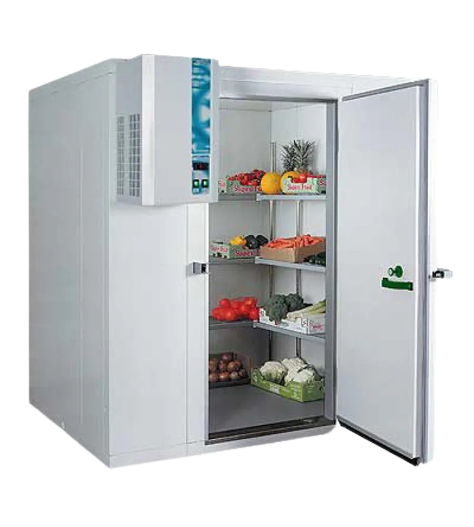
• Butcheries and meat shops: bulk cuts, primal portions, and retail inventory held safely before processing and sale. Smaller shops often start with a compact walk-in freezer sized to their daily volume.
• Supermarkets and hypermarkets — combined chiller and freezer setups for daily meat rotation alongside frozen stock
• Hotels, restaurants, and catering (HORECA) — high-volume storage that can flex for seasonal spikes like Ramadan or festive-season lamb and ham
• Meat processors and abattoirs — pre-cooling chambers, blast freezing, and bulk holding freezers across the full production line
• Distribution centers and cold logistics hubs — large-capacity storage built for pallet racking, forklift traffic, and redundant backup refrigeration


Meat Freezer Room Manufacturers UAE
Meat is one of the least forgiving products to store in the UAE. A few degrees of temperature drift for a few hours is enough to push a batch of beef, poultry, or lamb into unsafe territory — and in a climate where ambient temperatures regularly pass 45°C, a poorly specified cold room fails faster here than almost anywhere else. Coldroom.ae designs, builds, and installs meat freezer rooms across Dubai, Abu Dhabi, Sharjah, Ajman, and the wider UAE, for butcheries, supermarkets, hotels, restaurants, meat processors, and distribution warehouses that can’t afford to get cold storage wrong.

What Is a Meat Freezer Room?
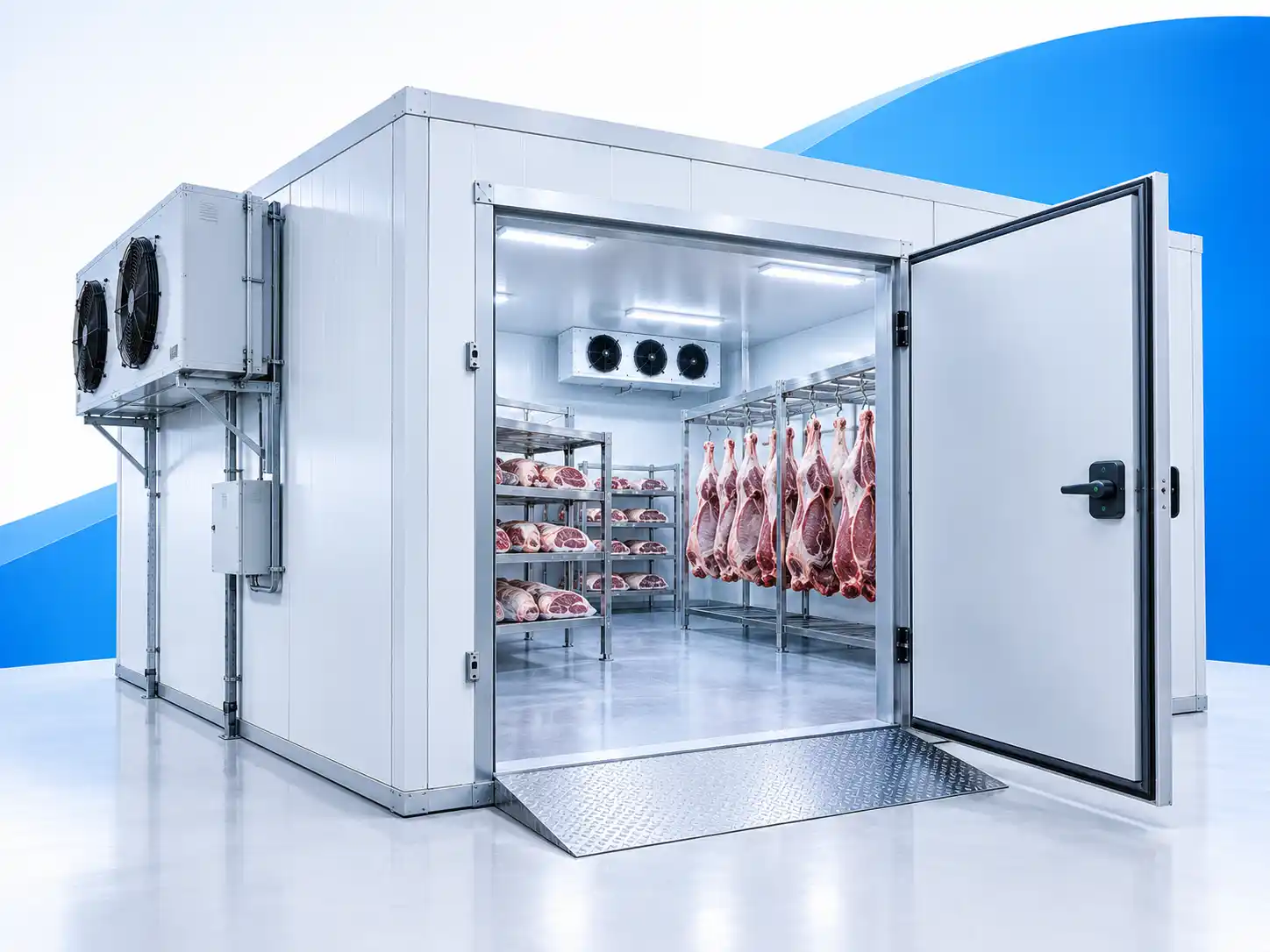
A meat freezer room is exactly what it sounds like: an insulated, refrigerated space built to hold meat at -18°C or colder, cold enough to stop bacteria in their tracks and turn short-term storage into long-term preservation. It’s a specialised version of a general-purpose freezer room, configured for the hygiene, segregation, and temperature requirements of meat. It’s a distinct facility from a meat cold room (sometimes called a meat chiller), which sits just above freezing and handles short-term storage and daily stock rotation. And it’s not the same thing as a blast freezer either. That’s the unit that slams fresh meat down to -30°C or lower within hours, locking in texture before the product moves into long-term frozen storage.
Every meat freezer room shares the same core components: insulated wall, ceiling, and floor panels; a refrigeration system built around a compressor and evaporator; a vapor-sealed door with a hinged or sliding mechanism; and, in the UAE specifically, additional engineering most standard cold room suppliers don’t account for: condenser protection against sand and dust, compressors rated for extreme heat, and floor heating to stop the slab from cracking underneath it.
Why Meat Cold Storage Is Non-Negotiable in the UAE
Food safety regulators call it the danger zone — the 5°C to 60°C range where pathogens like Salmonella, E. coli, and Listeria multiply fast. And meat sits right inside it the moment it’s not being actively chilled. It doesn’t take much in a UAE summer to land meat in that zone — refrigeration on a delivery van that’s quietly given up, a freezer door left open a beat too long mid-rush, a compressor losing the fight against 45°C outside. Minutes matter here, not hours.
Dubai Municipality and the Abu Dhabi Agriculture and Food Safety Authority (ADAFSA) both enforce strict cold chain rules specifically because of this risk, and non-compliance carries real consequences — product write-offs, failed inspections, and in serious cases, business closure. A meat freezer room engineered for local conditions isn’t a nice-to-have; it’s the baseline requirement for legally and safely trading in meat, poultry, or seafood anywhere in the UAE.
Meat Cold Room vs. Meat Freezer Room vs. Blast Freezer: What Sets Them Apart
- Meat cold room (chiller): runs -1°C to +5°C and handles fresh meat, short-term storage, and carcass aging. High humidity control matters here to stop the meat drying out and losing saleable weight — a problem the industry calls shrinkage.
- Meat freezer room: holds -18°C or colder for long-term frozen storage. Here the priority flips — instead of managing humidity, the job is pulling moisture out of the air so the product doesn’t develop freezer burn.
- Blast freezer: drops fast, down to -30°C or -45°C. Freezing meat quickly like this keeps the ice crystals forming inside the muscle small, which protects texture and cell structure. Freeze it slowly in a standard freezer instead, and you get larger ice crystals that tear through cell walls — that’s why slow-frozen meat weeps moisture once it thaws.
Cold Storage Temperatures by Meat Type
Different meats need different handling. Fat content, water content, and pathogen load all affect how cold a product needs to be and how long it holds up once frozen.
| Meat / Product | Chilled Storage | Frozen Storage | Notes |
|---|---|---|---|
| Beef cold storage | 0°C to 4°C | -18°C or below | High saturated fat content gives it strong resistance to oxidation; can hold for up to 12 months frozen |
| Chicken cold storage / poultry | -1°C to 2°C | -18°C or below | Higher pathogen load than red meat; needs a colder chilled range and strict segregation from other products |
| Pork cold storage | -1°C to 4°C | -18°C to -30°C | Unsaturated fat oxidizes faster, limiting frozen shelf life to roughly 6-8 months; UAE regulations require pork to be handled and stored in fully segregated, dedicated non-halal facilities |
| Lamb chops cold storage | 0°C to 4°C | -18°C or below | Chilled shelf life is short, typically 3-5 days; frozen storage extends this to 6-12 months |
| Cold storage sausage / deli meats | 4°C or below | -18°C or below | Casings are humidity-sensitive — poor moisture control causes them to crack, weep, or turn slimy |
| Roast / Cooked Chicken | 4°C or below | -18°C or below | Must be chilled within two hours of cooking; requires separation from raw poultry |
| Christmas ham cold storage | 4°C or below | -18°C or below | Seasonal HORECA demand spikes require flexible bulk capacity ahead of the festive period |
Blast freezing (all meat types): -30°C to -45°C, used to rapidly freeze fresh product and prevent large ice crystal formation.
Engineered for UAE Conditions
Cold storage built to generic international specifications tends to fail fast in the UAE. Standard systems weren’t designed for 45°C-plus ambient heat, coastal humidity, or fine airborne sand — all of which shorten the working life of a badly specified freezer room. The specification points below are what separate a room built for the UAE from one that isn’t.
Insulated panels. Polyurethane (PUF) or polyisocyanurate (PIR) core panels are the standard for meat freezer rooms, chosen for low thermal conductivity and structural rigidity. Panels typically run 100mm to 150mm thick for rooms operating between -18°C and -25°C, rising to 150mm-200mm for blast freezers running down to -40°C or colder. Finishes need to be food-grade and moisture-resistant — coated galvanized steel or stainless steel — to withstand daily chemical washdowns without harboring mold.
Tropicalized refrigeration. UAE summer ambient temperatures routinely exceed 45°C, which is well outside what standard refrigeration equipment is rated for. Manufacturers such as Bitzer and Danfoss produce tropicalized compressors specifically engineered to maintain stable cooling capacity and manage discharge temperatures at ambient conditions up to 55°C — the kind of specification a meat freezer room in Dubai or Abu Dhabi actually needs.
Dust-resistant condensers. Fine desert sand clogs standard condenser coils quickly, insulating the coil and forcing the compressor to run at higher head pressure until it eventually burns out. Condensers built for this climate use wider fin spacing (3.5mm or more, versus the 2.1mm common on standard units) to let particulate matter pass through, along with corrosion-resistant copper tubing and treated aluminum fins to handle coastal humidity.
Frost heave prevention. This is one of the most overlooked failure points in a poorly specified freezer room. When a slab operates at sub-zero temperatures continuously, moisture in the subsoil beneath it can freeze and form an ice lens. As the lens expands, it exerts significant upward pressure, which can crack or lift the concrete floor above it. The standard solution is continuous, low-intensity heating beneath the slab — typically self-regulating electric heating cables laid in a sand bed — to keep the substrate just above freezing without placing meaningful additional load on the main refrigeration system.
Door systems and infiltration control. Door openings are the single biggest source of heat infiltration in any freezer room. Doors need perimeter heating cables to stop the gasket freezing to the frame, plus PVC strip curtains or high-speed roll-up doors on high-traffic openings to cut how much cold air escapes — and how much warm, humid air gets in — during loading.
UAE Regulatory Considerations
Meat cold storage in the UAE falls under Dubai Municipality’s Food Code and the Abu Dhabi Agriculture and Food Safety Authority (ADAFSA), both aligned with HACCP and ISO 22000 principles. Requirements that directly shape how a meat freezer room needs to be built and run include holding frozen product at -18°C or below, controlled thawing at 10°C ambient or under, and strict physical segregation between raw meat, cooked meat, and poultry — with pork requiring entirely separate, dedicated facilities. We design meat freezer rooms with these requirements in mind, from insulation and floor heating to layout and monitoring points.
Maintenance and Energy Efficiency
A meat freezer room running continuously in UAE heat is typically one of the largest ongoing electrical costs in a food business, so the specification choices that affect running cost matter as much as the upfront build. A few of the biggest factors:
- Demand-based defrost — controllers that trigger defrost cycles based on actual ice buildup rather than a fixed timer, cutting unnecessary energy use and avoiding temperature spikes inside the room
- Condenser cleaning — routine high-pressure washing to clear sand and dust buildup, which otherwise forces the compressor to run harder and shortens its lifespan
- Variable frequency drives (VFDs) on compressors and evaporator fans, allowing the system to modulate output to actual demand instead of cycling on and off
- Door gasket inspection and cold-rated LED lighting, both of which reduce parasitic heat load inside the room
Industries We Serve
Frequently Asked Questions
What is the ideal temperature for a meat freezer room in the UAE?
-18°C or below, in line with Dubai Municipality and ADAFSA requirements. Some products, like pork, are often held colder — down to -30°C — to extend frozen shelf life.
What’s the difference between a meat cold room and a meat freezer room?
A meat cold room is for short-term use — fresh meat held just above freezing for daily rotation. A meat freezer room is for long-term storage at -18°C or below, where bacterial activity stops entirely. As a rule of thumb: if the meat is moving within a day or two, a cold room is enough; anything held longer needs a freezer room.
How much does a meat freezer room cost in the UAE?
Compact units typically run AED 10,000 to 22,000, standard walk-in installations AED 25,000 to 70,000, and large industrial builds are custom quoted — starting around AED 68,000, with full-scale facilities exceeding AED 200,000. Get in touch for a site survey and an accurate quote for your space and product mix.
Can raw chicken and beef be stored in the same cold room?
Technically yes, but only with rigorous physical segregation — separate shelving, racking, or zoning to prevent cross-contamination. Given poultry’s higher pathogen load and colder ideal temperature, separate chiller or freezer zones are generally the safer and more practical option.
How do you stop a walk-in freezer floor from cracking?
Frost heave prevention has to be designed in from the start — it’s a sub-slab heating system, not something you can retrofit once a floor has already cracked. If you’re taking over an existing cold storage space without confirmed floor heating, it’s worth having the slab inspected before committing to a long-term freezer installation there.
Why does a freezer compressor overheat or fail in the UAE summer?
Usually sand-clogged condensers or a compressor that isn’t tropicalized. One way to tell which: if performance drops specifically during the hottest hours and recovers overnight, that points to a tropicalization issue; if it’s underperforming regardless of time of day and the coils look visibly dusty, start with a condenser clean before assuming the compressor has failed.
How long can meat be stored frozen before quality drops?
These figures are quality guidelines, not safety limits — meat held continuously at -18°C or below stays safe well beyond them. What actually shortens usable shelf life is inconsistent temperature and poor packaging, both of which accelerate freezer burn regardless of the meat type.
Do you build compact meat freezer rooms for small butcher shops, or only large commercial units?
Both. We build across all three tiers — compact units for small butcheries and kitchens, walk-in rooms for supermarkets and hotels, and full commercial or industrial installations for processors and distribution centers.
Get a Meat Freezer Room Quote
If you’re setting up a butcher shop, upgrading a supermarket’s cold storage, or building out a distribution facility anywhere in Dubai, Abu Dhabi, Sharjah, Ajman, or across the UAE, we’ll design a meat freezer room around your space, your volume, and the specific products you’re storing. Request a site survey and technical consultation, and we’ll put together a specification and quote.