

Restaurant Freezer Room Manufacturers UAE

Coldroom.ae manufactures and supplies cold rooms for commercial and industrial food businesses in Dubai, Abu Dhabi, Sharjah and Ajman. A restaurant freezer room is a walk-in room that holds frozen stock at -18°C or below, usually placed near the kitchen’s receiving door.

The right size depends on how the kitchen works. A room opened twice a day is lightly loaded. The same room opened fifty times during dinner service is not. Summer heat above 45°C adds to that load. Some kitchens need only a freezer, while others also need a chiller for fresh produce, and a combi room can provide both in one footprint.

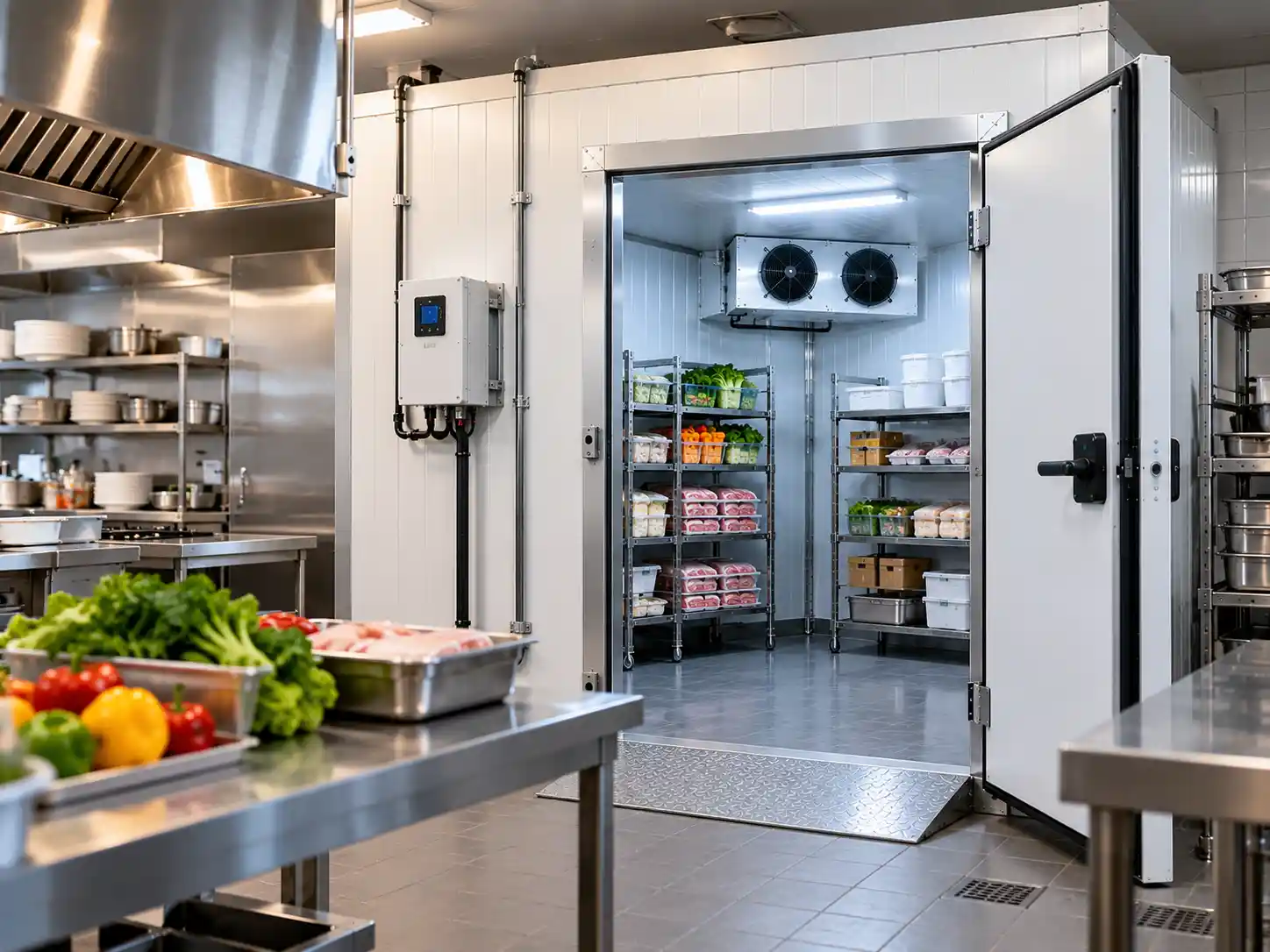
Restaurant freezer room with an open door, ceiling evaporator and stainless steel shelving stocked with frozen food in a commercial kitchen

What Is a Restaurant Freezer Room?

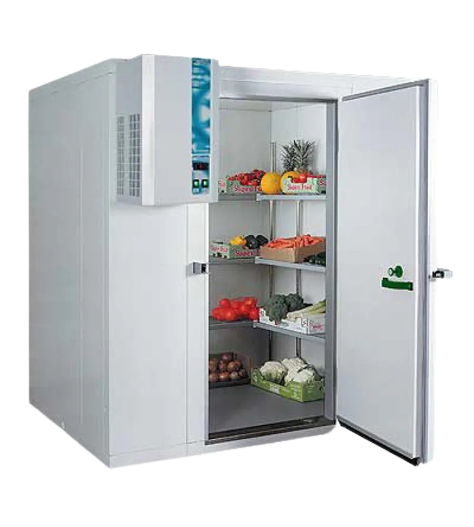
A restaurant freezer room is a walk-in freezer built for a commercial kitchen. It is assembled on site from insulated panels and has its own refrigeration unit. Staff step inside and take what they need from bulk frozen stock like meat, fish, fries and dough, usually still in the supplier’s cartons.

It is easy to mix up with other equipment. Reach-in and chest freezers hold far less, and full master cartons often don’t fit on their shelves. A walk-in chiller, which some kitchens simply call the cold room, runs at 0°C to +5°C for fresh produce and dairy, so nothing in it is frozen. A blast freezer does a different job again: it freezes food quickly, while a freezer room only keeps frozen food frozen. Our blast freezer room manufacturers page covers that.
Why Does a Restaurant Need a Freezer Room?

Kitchens tend to end up here gradually. One upright freezer becomes four, then eight, scattered along prep lines and corridors. Each one pushes its condenser heat into the kitchen, and each one needs its own temperature check.

A single freezer room replaces them. Its condensing unit sits outdoors or in a plant area, so the heat and compressor noise leave the kitchen. The room uses the full ceiling height, and one controller and one data logger take the place of a row of separate cabinets.

Which Kitchens Use Restaurant Freezer Rooms?

ApplicationTypical frozen itemsPlanning point
Restaurants and QSR outletsFries, patties, nuggets, doughQuick access during service rushes
Hotels and banquet kitchensMeat, seafood, pastry, event stockOften built as a combi (chiller and freezer) room
Cloud kitchensPrepared meals, proteinsCompact room for tight footprints
Catering and central kitchensBatch-frozen sauces and mealsWide doors for trolley access
Bakeries and patisseriesDough, butter, fruit compotesADAFSA Guideline 6 places the pastry freezer next to the pastry kitchen
Ice cream and gelato outletsTubs, frozen dessertsLower setpoint of -25°C to -30°C

For businesses that store mainly meat and poultry, see our meat freezer room page.

Types of Restaurant Freezer Room and Cold Storage Solutions

Restaurant cold storage usually combines several rooms rather than one. The main options are:

Modular freezer room. Prefabricated cam-lock panels that can be expanded, reconfigured or relocated to another branch.

Combi (dual-temperature) cold room. One footprint divided into a chiller zone (+1°C to +4°C) and a freezer zone (-18°C to -22°C). The chiller zone works as an entry vestibule, which reduces warm air reaching the freezer.

Corner or L-shaped freezer room. A custom layout for awkward back-of-house spaces.

Industrial and central kitchen freezer room. A larger room with high-bay racking and wide doors for pallet or trolley movement.

Supporting equipment. A walk-in chiller for fresh stock and a blast chiller for hot food. Cooked food should be chilled before it enters the freezer room.

Restaurant Freezer Room Temperature Requirements

What temperature should a restaurant freezer room be? Frozen food must be stored at or below -18°C under Dubai Municipality Food Code 2.0 and ADAFSA guidance. Rooms are usually designed to run at -18°C to -22°C so that defrost cycles and door openings do not push product above the limit.

Storage typeDesign temperature
Walk-in chiller0°C to +5°C
General restaurant freezer room-18°C to -22°C (up to -25°C for extended holding)
Ice cream and gelato-25°C to -30°C

Repeated temperature swings allow ice crystals to grow, which increases drip loss and reduces texture once food is cooked. Stable temperature protects both compliance and food quality.

Technical Specifications

ComponentTypical specificationProject-dependent choice
Insulated panelsPIR or PUR core, commonly 100 mm to 150 mm for freezersSkin material, thickness, fire rating
FloorInsulated floor with anti-slip AISI 304 stainless steel, or reinforced concreteRecessed slab or surface floor with ramp
Frost-heave protectionVapour barrier and sub-slab heating where the room sits on a slabCable or mat system
RefrigerationCeiling evaporator with ECM fans and a remote air-cooled or water-cooled condensing unitSplit or monoblock; single or standby compressors
DefrostElectric or hot-gasTimed or demand-based control
Drain lineCondensate line with heating cableRouting outside the room
DoorSelf-closing, magnetic gasket, anti-sweat heater, PVC strip curtainHinged, sliding or flip-flap
LightingVapour-proof, shatter-shielded LEDFixture layout
ShelvingWashable, non-absorbent, corrosion-resistant3-tier or 4-tier, mobile racking
ControlsDigital controller, data logging, door-ajar alarm, internal safety releaseSMS or email alerts, building management link

Shelves are commonly kept about 15 cm off the floor and 5 cm from the walls so cold air can circulate, and stock should stay below the marked load line. Wood is not permitted in food areas under ADAFSA food service design guidance.

PIR or PUR? Both are rigid closed-cell foam cores. PIR offers better fire performance, which is why it is often specified for freezer rooms. The two look identical once the steel skins are bonded, so ask any supplier for written confirmation of core type, foam density and fire-test approval.

Built for UAE Conditions

Heat. In summer, outdoor temperatures often pass 45°C. A freezer holding -20°C on a 47°C day has to work across a gap of about 65°C to 70°C. Condensing units made for cooler climates tend to trip on high pressure under that load, so a unit rated for high ambient temperatures, with a generously sized coil, is the safer choice.

Humidity. On the coast, the air outside the freezer door carries a lot of moisture. Each time the door opens, some of it gets in and freezes on the gaskets, the panels and the evaporator fins. Over a few weeks that ice builds up and starts to affect airflow. A chiller vestibule, strip or air curtains and heated door frames cut down how much moisture gets in.

The building matters too. A restaurant on the upper floor of a Dubai tower or mall may be barred from running pipework through the facade, which can rule out a standard outdoor condenser. A water-cooled unit or a plant-room location is the usual answer. In Abu Dhabi, kitchens are often kept at slightly negative pressure, so unless the makeup air is conditioned, hot air is pulled in near the receiving area, right where the freezer door is. Sharjah and Ajman are different again, since many catering kitchens there are in industrial sheds with no air conditioning. In those cases, panels of 150 mm or more and a shaded condensing unit are worth considering.

Food Safety and UAE Requirements

The table summarises requirements that commonly apply. Requirements vary by emirate and project, so confirm the current version with your local authority.

Authority or standardRelevance to restaurant freezer rooms
Dubai Municipality Food Code 2.0Frozen food at -18°C or below; monitoring sensors where food is most exposed; annual calibration; limited freeze-thaw cycles
ADAFSA (Abu Dhabi)Frozen food at -18°C or below; documented HACCP-based food safety system
ADAFSA Guideline No. 6 (Food Service Design)Cold storage close to the receiving area; self-closing doors; shielded lighting; no wood in food areas
UAE Fire and Life Safety CodeBuilding materials, including insulated panels, are expected to meet Civil Defence requirements
Sharjah and Ajman municipalitiesConfirm local requirements for each project

Can hot food go into a restaurant freezer room? No. Hot or warm food raises room temperature, creates condensation on packaged stock and overloads the evaporator. Chill or blast-freeze it first, then move it into the freezer room.

Freezer Room vs Commercial Freezer Cabinets

CriterionFreezer roomUpright freezersChest freezersFour or more cabinets
CapacityLarge, holds full cartonsLimited per unitBulk but hard to organiseFragmented
WorkflowWalk-in visibility, easy FIFOQuick at the cooklineBottom stock gets buriedStaff open many doors
Kitchen heatRejected outdoorsReleased into kitchenReleased into kitchenHigh combined load
InstallationSite survey and panel assemblyPlug-and-playPlug-and-playPlug-and-play
ScalabilityModular and relocatableBuy another unitFixedLimited by floor space
Best forMedium to large kitchens, hotels, caterersCafes, cookline backupLow-turnover storageOften a sign the kitchen has outgrown cabinets

How Big Should a Restaurant Freezer Room Be?

No single size suits every kitchen. Two rooms of identical dimensions can carry very different loads if one is opened twice a day and the other fifty times during service.

Two planning rules help:

• Usable volume is typically only 40% to 65% of gross internal volume once aisles, door swing, shelving gaps and evaporator clearance are removed. A 15% to 20% buffer is often added for peak demand.

• Storage density per cubic metre of usable volume is roughly 0.40 t for frozen meat, 0.47 t for frozen fish and 0.55 t for poultry.

What to prepare before requesting a quotation:

1. Meals served per day

2. Peak frozen stock (kg)

3. Product types and target temperature

4. Delivery frequency

5. Available floor area and ceiling height

6. Preferred door location

7. Daily loading and door-opening frequency

8. Future expansion plans

Installation Process

A restaurant freezer room project normally moves through these stages: site survey, heat-load calculation and 3D layout, floor preparation, panel and door installation, refrigeration and electrical connection, temperature testing, and commissioning with calibration of the temperature probes.

Common Restaurant Freezer Room Problems

ProblemUsual cause in a kitchenPrevention
Room not reaching -18°CGrease or dust on the condenser, warm food loaded, door left openRegular coil cleaning, chilling food before loading
Frost on walls and ceilingDamaged strip curtains, failed door closerDoor-open alarm, curtain checks
Torn or frozen gasketsTrolley impact, failed door heaterWeekly gasket checks
Ice on the evaporatorFaulty defrost heater or frozen drainDefrost and drain-heater inspection
Temperature swings at rush hourRepeated single-item tripsBatch-pull ingredients before service

Frequently Asked Questions

What temperature is required for a restaurant freezer room in the UAE?

-18°C or colder. That is the limit for frozen food, and inspectors check the product itself, not just the display on the wall. Because the product warms a little every time the door opens or the coil defrosts, rooms are normally set at -20°C to -22°C. Ice cream needs more, usually -25°C to -30°C.

What is the difference between a restaurant cold room and a freezer room?

Temperature, mainly. “Cold room” is used loosely in kitchens and often means a chiller running at 0°C to +5°C, where fresh produce, dairy and prepped ingredients are kept. A freezer room is built for stock that is already frozen. The panels are thicker, the door frame is heated, and the evaporator has a defrost cycle, since ice forms on it constantly at those temperatures.

How much does a restaurant freezer room cost in the UAE?

A standard prefabricated room is often priced between AED 25,000 and AED 45,000. Larger or more customised projects can go past AED 100,000. The final figure depends on the size, panel thickness, target temperature and how easy the site is to work in.

What size freezer room does a restaurant need?

There is no standard size. It comes down to how many meals the kitchen serves, how much frozen stock it holds, how often deliveries arrive and what space is available. Only 40% to 65% of a freezer room’s volume ends up as usable storage, since aisles, shelving gaps and airflow take the rest, so the gross size should allow for that.

What panel thickness is used for a restaurant freezer room?

Panels of 100 mm to 150 mm, in PIR or PUR, are the usual range. A room in an unconditioned shed, or one running at a very low temperature, may need thicker panels.

When should a restaurant move from freezer cabinets to a freezer room?

Usually when the cabinets start to get in the way. The prep area is crowded, the kitchen is noticeably warmer, and nobody is sure which freezer holds what. If that sounds familiar, one room is easier to manage than six cabinets.

What is a combi cold room?

A combi cold room combines a chiller zone and a freezer zone in one footprint, with the chiller acting as an entry airlock.

Where do you supply restaurant freezer rooms?

Coldroom.ae supplies restaurant freezer rooms in Dubai, Abu Dhabi, Sharjah, Ajman and across the UAE for commercial and industrial kitchens.

Plan Your Restaurant Freezer Room

Share your kitchen location, available footprint, target temperature and main products. Coldroom.ae will help you plan a freezer room or combi cold room suited to your restaurant, hotel, cloud kitchen or catering facility.