
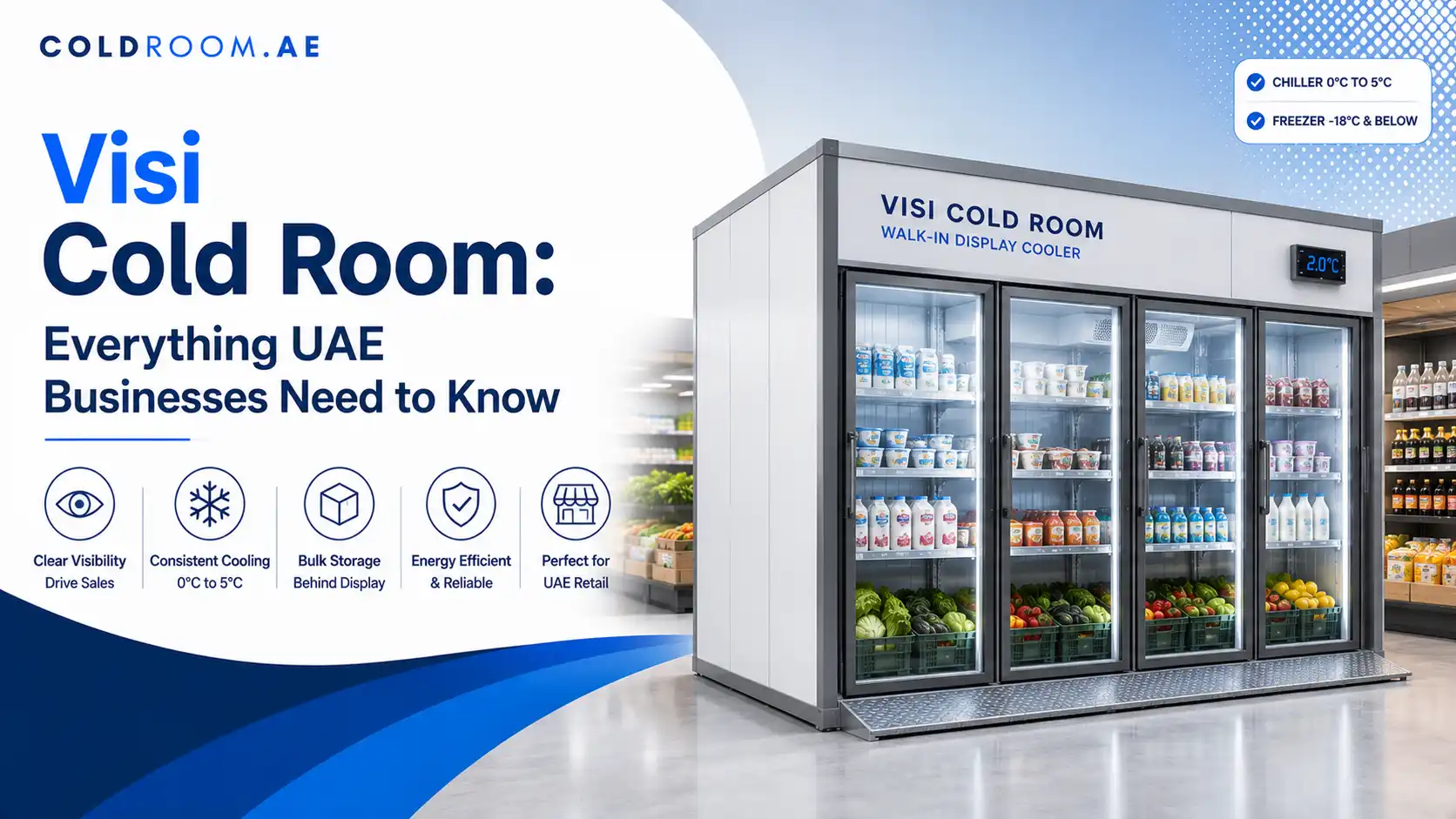
A visi cold room combines bulk cold storage with a retail display face. Here’s how it’s engineered, where it fits in a UAE store, and how it differs from a standard visi cooler.
Quick answer: A visi cold room is a walk-in refrigerated structure fitted with insulated glass display doors instead of solid panels. It’s also called a visible cold room, visibility cold room, or more precisely, a walk-in glass door cooler. It lets customers or staff see and grab stock without opening the whole room. Meanwhile, the bulk of the inventory stays in cold storage right behind the display.
What Does “Visi” Actually Mean?
“Visi” is shorthand for visible, or visibility. That’s the same root behind visible cold room and visibility cold room — terms suppliers use interchangeably with visi cold room. All three describe the same equipment: a walk-in structure that swaps part of the wall for glass. That keeps the stock inside visible from the shop floor.
Refrigeration engineers and standards bodies prefer a more precise name: walk-in display cooler. It’s sometimes written as display cold room or glass-door cold room. Use that term if you need something technically exact for a spec sheet or a formal quote request (RFQ). In everyday conversation and supplier catalogs, though, visi cold room is what you’ll hear most. That’s especially true across India, the Middle East, and parts of Asia.
Visi Cold Room vs. Visi Cooler — Don’t Confuse These
This is where a lot of buyers get tripped up. So let’s be direct: a visi cold room and a visi cooler are not the same product. The names are nearly identical, but the equipment isn’t.
A visi cooler is a small, standalone, reach-in unit — the glass-door fridge holding drinks at a checkout counter. A visi cold room, on the other hand, is a full walk-in structure built like a small room. Glass doors sit in one wall for display, while the rest of the space works as bulk cold storage.
The distinction matters for anything you look up about either product. Power consumption, capacity, and installation needs for a countertop visi cooler are nowhere near what a walk-in room requires. A reach-in fridge and a walk-in structure simply aren’t the same scale of equipment. So figures for one won’t tell you much about the other.
How the Glass Doors Are Engineered
Cold room display doors are the defining part of a visi cold room — and the most technically demanding. Solid insulated panels are relatively simple to seal against heat and moisture. Glass isn’t. It conducts heat far more readily, and it’s exposed to humid air every time a door opens.
So manufacturers build these doors from multi-pane glass with a low-emissivity (Low-E) coating on the inner surface. The coating prevents moisture from collecting on the glass, keeping the contents clearly visible. A low-voltage current runs through the coating, gently warming the outer pane so its surface stays above the dew point. The metal frames get the same treatment. Built-in anti-sweat heaters stop moisture forming on the door frames and keep the gaskets from freezing shut.
The number of glass panes depends on how cold the room behind them runs. A standard glass walk-in cooler at typical chiller temperatures does fine with double glazing, usually filled with an inert gas like argon. A walk-in freezer with glass doors is a different story. At deep-freeze temperatures, it needs triple-pane glass with two gas-filled cavities and stronger heating. Double glazing alone can’t stop ice from forming on the retail-facing side.
Chiller vs. Freezer Versions
Most visi cold rooms on the market are built for chilled display. That means dairy, beverages, packaged foods, and produce that need a consistent 2°C to 8°C. You’ll see this range cited widely in commercial catalogs. Stricter technical sources, though, narrow chiller-side glass door applications closer to 2°C to 5°C for tighter temperature control.
Freezer versions exist too, typically running at -18°C or below — the same standard used for any deep-frozen food. Because the temperature gap is so much greater, freezer versions need the heavier triple-pane glass and stronger anti-fog heating described above. Double glazing alone simply can’t hold the line against condensation and ice at that temperature.
Quick Specs
| Attribute | Value |
|---|---|
| Chiller zone temperature | 2°C to 8°C (commercial range); 2°C to 5°C (precise chiller-only spec) |
| Freezer zone temperature | -18°C or below |
| Glazing — chiller applications | Double-pane, gas-filled (argon or krypton) |
| Glazing — freezer applications | Triple-pane, two gas-filled cavities |
| Door heating | Low-E coated glass + anti-sweat frame heaters |
| Panel construction | Insulated PU/PUR panels, typically 4–6 inches thick |
| Common layouts | L-shape, U-shape, straight run, “beer cave” walk-in |
| Stocking method | Rear/gravity-feed shelving for front-facing FIFO rotation |
| Common applications | Supermarkets, convenience stores, pharmacies, beverage outlets, bakeries, floral shops |
Why Businesses Choose One
The core appeal is simple: it does two jobs at once. It holds real bulk inventory, and it sells that inventory too — no separate backroom storage or front-of-store display fridge required.
The energy case is genuine, not just a sales pitch. Customers can see the product and decide what they want before a door even opens. That means the average door-opening event is shorter than in an opaque room, where staff have to search by feel. Shorter openings let in less warm, humid air, which directly reduces the load on the compressor.
The stocking method reinforces this. Most use angled, gravity-feed shelving loaded from the back. Staff restock from the bulk-storage side while customers pull from the front. Gravity keeps the front row full automatically, creating a natural first-in, first-out rotation. As a result, restocking never has to disrupt the shop floor.
Visi Cold Room vs. Combi Cold Room
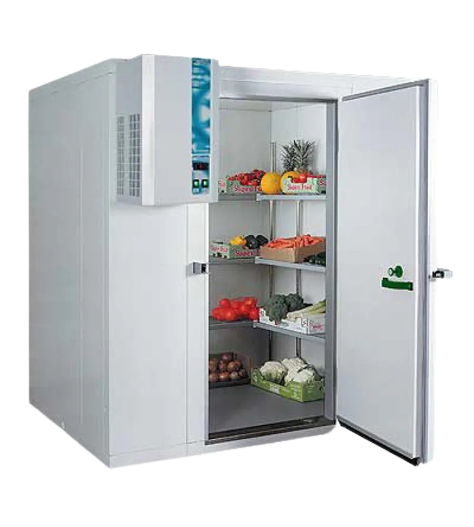
These two terms get mixed up occasionally, so here’s a quick distinction. A combi cold room combines a chiller and a freezer behind solid insulated walls, built purely for storage. A visi cold room is built around glass doors for retail display instead. They solve different problems: one is a backroom storage solution, the other a storefront fixture. Many businesses reasonably need both.
Fact-Check: Common Claims
A few claims come up often enough in supplier marketing that they’re worth checking directly:
“Visi cold rooms use vacuum glass panels.” Not accurate for walk-in structures. Vacuum Insulated Glass (VIG) shows up in small, standalone visi coolers, where the panel size stays manageable. Full-size walk-in display doors overwhelmingly use heated, gas-filled multi-pane glass instead. At that scale, VIG runs into structural and cost problems that make it impractical.
“Glass visibility reduces energy loss.” This one holds up. Letting customers see the product before the door opens genuinely cuts down on how long doors stay open. That’s the single biggest source of unwanted heat and humidity entering the space.
“Rear stocking is a standard feature.” Also accurate. Gravity-feed shelving loaded from behind the display is the standard design for these units, not an upsell option.
Visi Cold Rooms in the UAE
UAE humidity makes the anti-fog engineering in a visi cold room non-negotiable, not a nice-to-have. Ambient moisture stays high for much of the year, and every door opening pushes humid air toward the glass. Without proper heated, multi-pane doors, condensation would fog the display within a single humid afternoon. That defeats the entire point of the unit.
That’s also why sourcing matters. Equipment built for milder, drier climates often skips the stronger anti-sweat heating that UAE conditions require. So before ordering, it’s worth confirming glazing type, heater wattage, and pane count. Don’t assume a standard catalog unit will hold up locally.
On the compliance side, the usual UAE food safety rules still apply: correct holding temperatures, HACCP-aligned monitoring, and regular inspection. Regulators treat its chilled or frozen zone exactly like a solid-walled room’s. The glass doors change the merchandising, not the food safety obligations. For the exact requirements, Dubai Municipality’s Food Safety Department is the reference point.
Who Should Choose One?
Supermarkets, convenience stores, and beverage outlets are the classic fit. Anywhere with high foot traffic and grab-and-go buying, visibility is worth the extra engineering cost. Bakeries and floral shops use smaller versions for the same reason: the product needs to be seen to sell. Pharmacies use them too, for temperature-sensitive stock, since staff can also check inventory at a glance.
It’s a poor fit for pure backroom storage, where nobody but staff ever needs to see what’s inside. A combi cold room or a standard walk-in makes more sense there, since solid panels are easier to build and maintain than glass.
Frequently Asked Questions
A visi cooler is a small, standalone, reach-in glass-door fridge. A visi cold room is a full walk-in structure instead. Glass display doors sit in one wall, with real bulk inventory stored behind the display. They’re different scales of equipment entirely.
Chilled visi cold rooms typically run between 2°C and 8°C. Tighter engineering specs narrow that to 2°C–5°C for precise control. Freezer versions run at -18°C or below and always need triple-pane glass.
Yes, in a real and specific way. Letting customers see the product before opening the door shortens the average door-opening time. That’s the main source of unwanted heat and humidity entering the space.
Yes — display cold room, walk-in display cooler, and visi cold room all describe the same structure. It’s just the more common everyday term; walk-in display cooler is the more precise engineering name.
Yes. UAE humidity means heated, anti-fog multi-pane glass isn’t optional. Standard glazing built for milder, drier climates will fog and ice over far faster here.
Yes, but it needs triple-pane glass with two gas-filled cavities and stronger door heating. Double glazing works for chiller temperatures but can’t hold back condensation and ice at freezer temperatures.
Why Coldroom.ae
With 7+ years of experience and 1000+ successful projects across the UAE, ColdRoom.ae specializes in modular cold rooms and cold storage solutions built for speed, flexibility, and the region’s demanding climate. If you’re not sure whether a visi cold room fits your space and business needs, tell us your temperature range, footprint, and whether the site is leased or owned — we’ll give you a straight answer, not just a quote.
Get a free consultation: Contact US