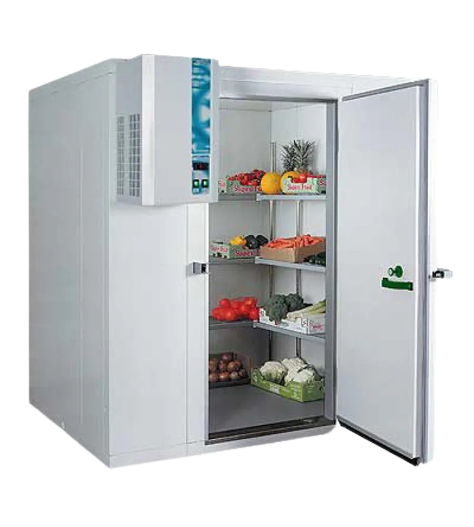

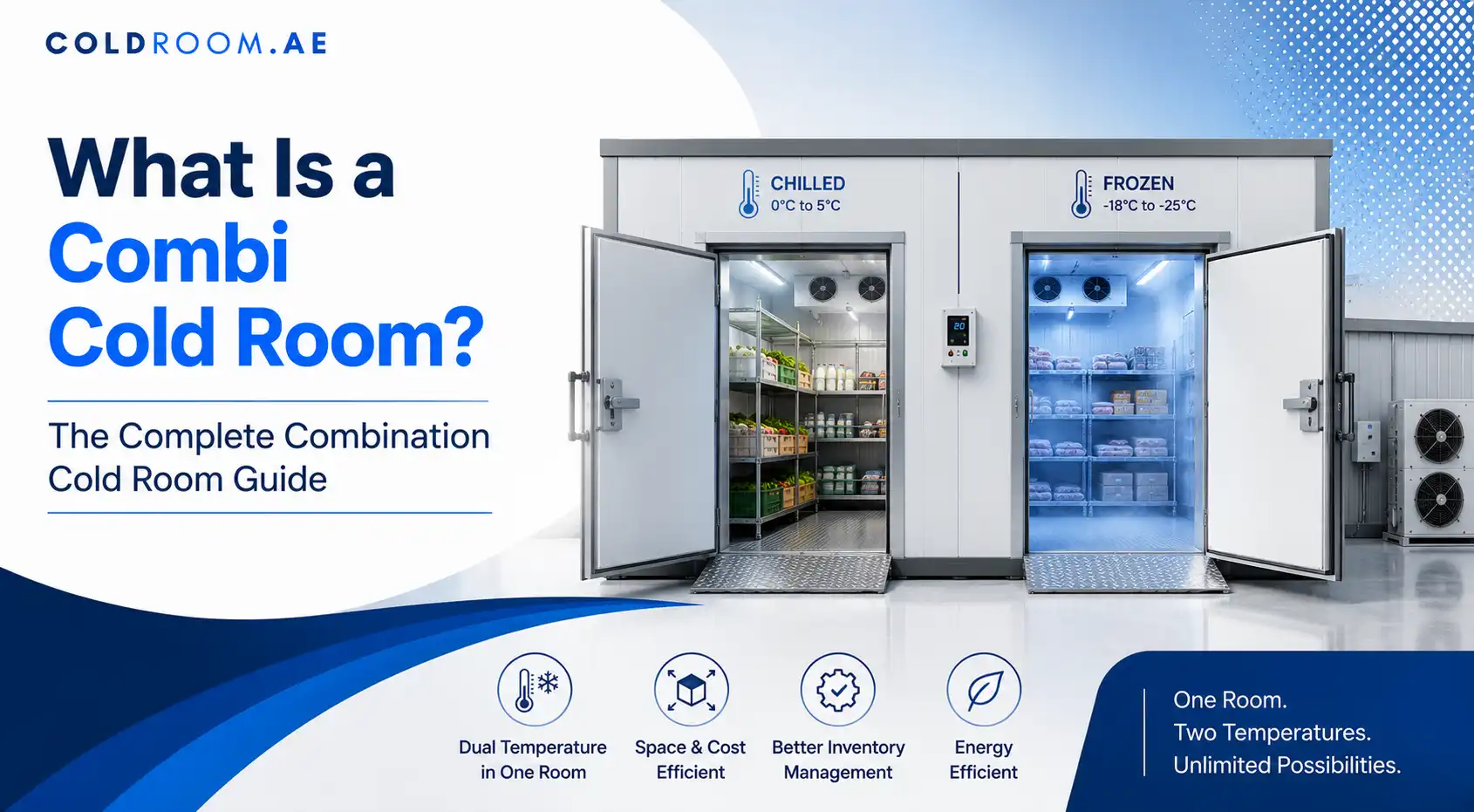
A combi cold room packs chiller and freezer storage into one footprint. Here’s the engineering, UAE compliance rules, and buying guidance you need before choosing one.
Quick answer: A combi cold room — short for combination cold room — is a single insulated structure divided by an internal partition into two independent temperature zones: a chiller (0°C to +5°C) and a freezer (-18°C to -25°C). It lets a business store fresh and frozen stock in one shared footprint instead of building two separate rooms.
What Does “Combi” Actually Mean?
“Combi” is simply shorthand for combination. A combi cold room and a combination cold room are the same piece of equipment — manufacturers use both terms interchangeably across spec sheets, engineering drawings, and supplier catalogs, not just in marketing copy. So if you’re comparing quotes and see both terms for the same product, that’s expected.
What sets it apart from an ordinary walk-in is the internal split: one shared external shell, one insulated partition wall down the middle, and two climate zones that operate independently of each other on either side of it.
How a Combi Cold Room Is Built
The outer envelope uses factory-made insulated panels — typically a polyurethane (PUR) or polyisocyanurate (PIR) foam core sandwiched between metal facing sheets. Builders size each wall’s panel to match its own zone, and because the freezer side is almost always the tougher job, freezer-facing walls usually end up thicker than the chiller walls next to them.
The partition wall itself needs the most care. Because the freezer side sits at a much lower vapor pressure than the chiller side, moisture constantly moves from the warmer zone toward the colder one — a phenomenon refrigeration engineers call vapor drive. If installers don’t fully seal the vapor barrier on the warm face of the partition, that moisture works its way into the panel core, freezes, expands, and eventually peels the panel apart. The junctions where the partition meets the ceiling and floor need the same attention, too, since a poorly sealed joint acts as a thermal bridge and lets cold “track” into the chiller, causing frost and condensation where you don’t want it.
Finally, flooring adds one more variable: under a freezer zone, the floor slab needs enough insulation to stop frost heave, where sustained cold freezes ground moisture below the slab, which then expands and pushes the floor upward over time.
Why Chiller and Freezer Need Separate Refrigeration
It’s technically possible to run both zones off one compressor, but installers rarely do this in practice, and for good reason. A freezer’s evaporator needs to run at a much lower suction pressure than a chiller’s evaporator. So if both zones share a compressor, the chiller evaporator gets dragged down to near-freezer pressure too — unless installers fit a device called an EPR valve (evaporator pressure regulator) to hold the chiller side back.
That fix works, but it comes with a cost: the EPR valve forces the compressor to run at a less efficient pressure for the whole system, and the artificial pressure drop tends to block oil from returning to the compressor — a common cause of early compressor failure in mixed-load setups.
As a result, standard practice — and what most manufacturers install by default — is two fully independent refrigeration systems, one condensing unit per zone. It costs a little more upfront, but it gives tighter temperature control, simpler defrost scheduling, and a useful safety net: if the freezer’s unit goes down, the chiller keeps running, and vice versa.
Combi Cold Room Specs at a Glance
| Attribute | Value |
|---|---|
| Chiller zone temperature | 0°C to +5°C |
| Freezer zone temperature | -18°C to -25°C |
| Insulation material | PUR / PIR sandwich panel |
| Freezer wall thickness (UAE climate) | ~150mm |
| Chiller wall thickness (UAE climate) | ~100mm |
| Refrigeration setup | Independent systems per zone (standard) |
| Partition risk | Vapor drive — moisture pulled into the panel, where it can freeze and cause damage |
| Typical layouts | Walk-through or side-by-side |
| Common applications | Central kitchens, hotels, butcheries, catering |
| UAE regulator | Dubai Municipality / ADAFSA |
The Ante-Room Effect: Why Pass-Through Design Cuts Frost
Many combi cold rooms use a walk-through layout, where you enter the chiller first and reach the freezer through an internal door. This has a genuine side benefit: as warm, humid air enters through the main door, the chiller’s evaporator cools it and strips out much of its moisture before anyone opens the inner door to the freezer. As a result, less humidity reaches the freezer, which means less frost build-up on its evaporator and fewer defrost cycles.
The catch: however, this only holds up under light-to-moderate foot traffic. In a busy kitchen with constant door openings, the chiller evaporator absorbs so much incoming humidity that it starts icing over instead — so the frost problem doesn’t disappear, it just moves to the other zone.
Combi Cold Room vs. Other Cold Storage Options
| Format | Footprint | Flexibility | Best fit |
|---|---|---|---|
| Combi cold room | Shared shell, smaller than two rooms | Fixed zone ratio once built | Central kitchens, hotels, butcheries |
| Two standalone rooms | Larger — duplicated walls + service gap | Each room independently expandable | High-turnover supermarkets |
| Reach-in units | Smallest | Easy to add/replace individually | Cafes, food trucks, line-prep storage |
| Separate rooms + shared ante-room | Largest | High — rooms operate independently | Distribution centers, pharma storage |
Does a Combi Cold Room Really Save 20% Space?
Suppliers often present the “up to 20%” figure as a fixed number, but it’s only roughly true. The saving comes from two things: sharing one wall instead of building two, and removing the maintenance gap normally required between two separate structures. On a small room, that adds up to a real, noticeable percentage. However, as the total room size grows, that one shared wall becomes a smaller slice of the overall footprint, so the percentage saved shrinks. In short, treat 20% as a best-case number for compact installations, not a guarantee.
Combi Cold Rooms in the UAE
UAE conditions push combi cold room engineering harder than most markets. Because summer ambient temperatures routinely climb toward 45–50°C, condensing units need oversized condenser coils and fans built to handle extreme heat — standard equipment sized for milder climates won’t hold up. Coastal humidity in Dubai and Sharjah adds another layer of urgency to the partition’s vapor barrier, since a bigger indoor/outdoor moisture gap means faster panel damage if that seal fails. In addition, regular condenser coil cleaning matters more here, since airborne sand and dust foul coils faster than in most regions.
On the compliance side, Dubai Municipality and ADAFSA set firm limits: chilled perishables generally need to sit between +1°C and +5°C, and frozen goods at -18°C or below, with zero tolerance for drift. HACCP protocols typically require digital temperature logging and automated alarms rather than manual spot checks.
This is exactly where the combi format earns its keep in the UAE. Because commercial real estate in dense hospitality districts is expensive and kitchens are often tight on space, a combi cold room lets a restaurant, hotel, or catering kitchen keep chilled and frozen stock properly separated — satisfying the regulator — without needing the floor area two standalone rooms would demand.
Who Should Choose a Combi Cold Room?
It’s a strong fit for central kitchens, hotels, catering operations, and butcheries that need real bulk storage in both zones but are working with a constrained footprint. On the other hand, high-turnover supermarkets usually need constant independent access to each zone more than they need the space saved, and large-scale logistics operators need multi-temperature warehouse partitioning instead of a single split room.
Frequently Asked Questions
It shares one external shell and uses a single insulated partition to separate the chiller and freezer zones. Two standalone rooms, by contrast, each have their own full set of exterior walls plus a required gap between them — that uses more panel material and more floor space, but it keeps the zones fully independent.
A freezer evaporator needs much lower suction pressure than a chiller evaporator. Running both off one compressor requires an EPR valve to protect the chiller side, which reduces efficiency and can interfere with oil return to the compressor. Independent condensing units per zone avoid that trade-off and add a built-in backup, since each zone keeps running if the other’s unit fails.
No. It combines a chiller and freezer behind solid insulated walls. A “visi cold room” — more accurately a walk-in display cooler — is a retail-facing structure with glass doors for product visibility. In other words, they solve different problems and aren’t interchangeable terms.
Dubai Municipality and ADAFSA generally require chilled perishables to be held between +1°C and +5°C and frozen goods at -18°C or below, with HACCP-compliant digital monitoring and no tolerance for sustained deviation.
Technically yes, using an EPR valve to manage the pressure difference, but it’s an efficiency and reliability compromise most installers avoid. Independent systems per zone are the standard, more dependable configuration.
It saves the most in smaller installations, where removing one shared wall and the service gap between two separate rooms has a bigger relative impact. In larger facilities, however, that saving becomes a smaller percentage of the total footprint.
Looking for a combi cold room in the UAE?
Get in touch with ColdRoom.ae to talk through your space, storage needs, and compliance requirements. Connect with US.