
Garbage Cold Room Solutions for UAE Businesses
Custom-built garbage cold rooms, waste chillers, waste disposal coolers, and waste storage chiller rooms for hotels, restaurants, malls, hospitals, supermarkets, and industrial facilities across Dubai, Abu Dhabi, and Sharjah.
Coldroom.ae engineers refrigerated waste storage that holds up to UAE heat, aggressive daily washdowns, and constant bin traffic — so your garbage room stops being an odor and hygiene liability.

What Is a Garbage Cold Room?
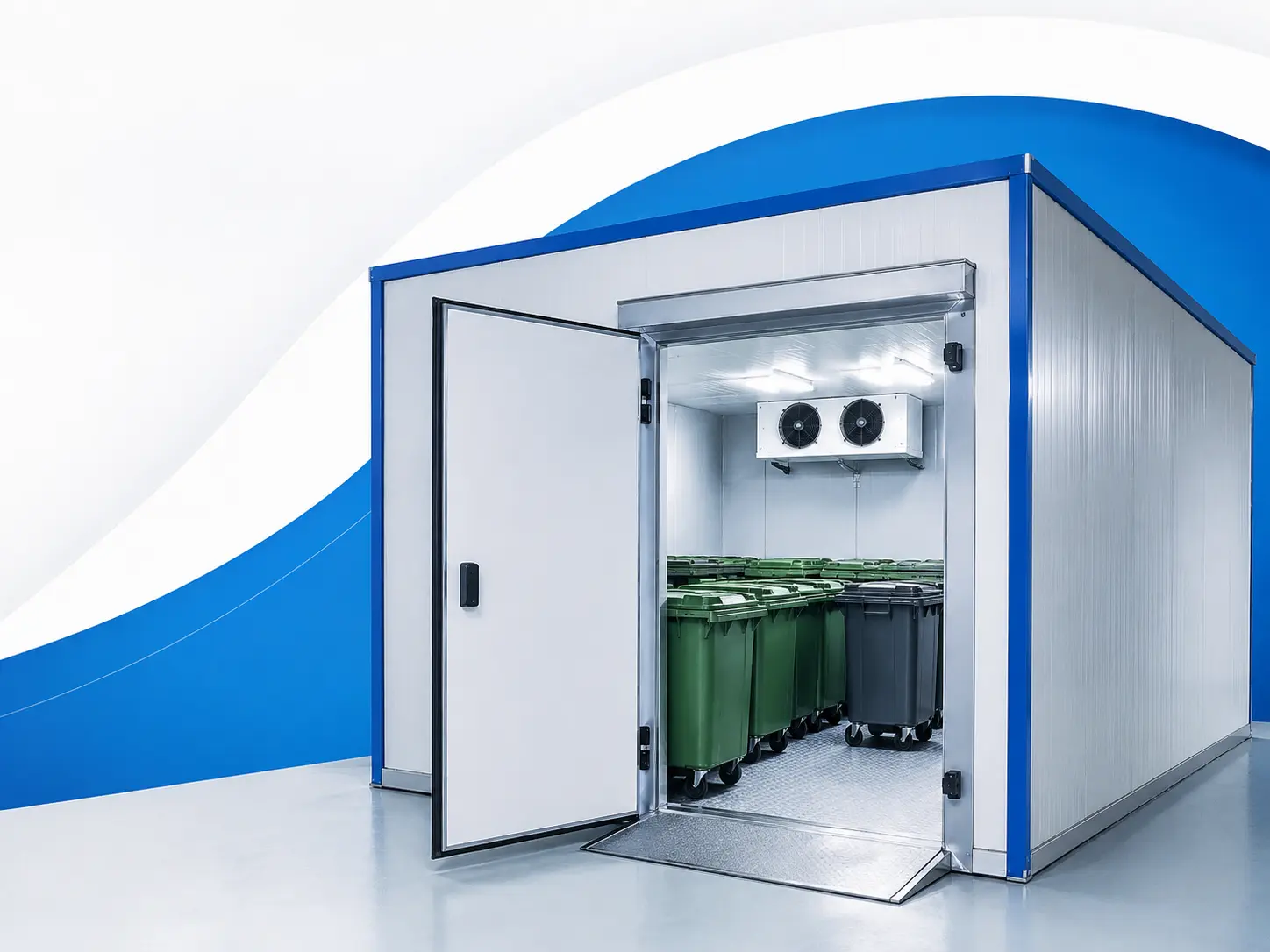
A garbage cold room — sometimes called a cold room for garbage — is a refrigerated, insulated space built to hold food waste, wet waste, and general commercial garbage at a controlled low temperature before collection.
It’s not a repurposed food cold room. It’s a dedicated cold room for waste — engineered around corrosion resistance, drainage, and odor control rather than product preservation. You may also know it as a waste cold room, cold room for waste storage, garbage chiller, waste disposal cold room, waste storage chiller room, or kitchen garbage cold room. Same core function, different name depending on the site and industry.
Why UAE Businesses Need One
UAE summers aren’t mild. Ambient temperatures sit at 45°C to 50°C for weeks on end, and waste left in an uncooled garbage room doesn’t cope well with that. It starts smelling within hours, draws pests fast, and by the time collection day rolls around, you’ve usually got a hygiene problem too. A comfort AC unit won’t fix any of this. It’s built to keep people comfortable in an office, not to handle the heat, humidity, and corrosive gases that come off decomposing waste.
A properly engineered garbage cold room slows decomposition, cutting odor development compared to an uncooled room and keeping the space manageable for staff, guests, and inspectors alike. It also supports the hygiene standards most UAE food businesses already operate under: the Dubai Municipality Food Code requires solid waste disposal to be handled hygienically and kept from exposing food premises or products to contamination, alongside the clean/dirty workflow separation most food safety programs already follow, and the widely used microbiological “danger zone” (5°C–63°C) that governs how fast waste-borne bacteria multiply.
Our Garbage Cold Room Solutions
| Solution | Best For |
| Walk-in garbage chiller room | Hotels, malls, large kitchens, supermarkets, residential towers |
| Waste disposal cooler (compact) | Small restaurants, cafés, cloud kitchens |
| Custom waste cold room | Project-specific volume, layout, and temperature needs |
| Container waste chiller room | Outdoor, remote, or industrial site-based waste holding |
| Portable waste cooling unit | Events, renovations, seasonal peaks, backup capacity |
| Existing garbage room conversion | Retrofitting an existing room with insulation, refrigeration, drainage |
Every installation starts with your bin count, bin size (120L, 240L, or 1,100L municipal bins are common), waste type, and collection schedule — not a generic template.
Garbage Cold Room vs Standard Cold Room
| Feature | Uncooled Garbage Room | Product Cold Room | ColdRoom.ae Garbage Cold Room |
| Purpose | Room-temp waste holding | Preserving food/flowers/pharma | Slowing waste breakdown before collection |
| Temperature | Ambient, up to 40°C+ in summer | Product-specific set point | Controlled cold range, sized per project |
| Interior | Basic finish | Food-safe panels | Corrosion-resistant, washdown-rated finish |
| Drainage | Minimal | Not required | Sloped floor, trapped floor drains |
| Odor control | None | N/A | Low temp + negative-pressure ventilation on larger sites |
| UAE summer performance | Degrades fast | Rated for UAE heat, but not waste-specific corrosion | Engineered for 45–50°C ambient heat |
A food cold room and a waste cold room face different demands — leaking liquids, cleaning chemicals, and corrosive gases from decomposition — so copying one design for the other usually means premature corrosion and drainage problems down the line, even if the room performs fine on day one.
Typical Specifications
The figures below reflect common UAE industry practice for waste holding — not a fixed spec. Your actual temperature set point, materials, and insulation thickness are confirmed during a site assessment based on waste type, volume, and collection schedule.
Indicative temperature ranges
| Waste Type | Commonly Used Range | Holding Interval |
| General food/organic waste | 0°C to 10°C | 1–3 days between collections |
| Odor-sensitive / high-moisture waste | 0°C–2°C, or a +4°C–6°C design target | Daily emptying |
| Non-infectious hospital food & general waste | 0°C to 5°C | Daily emptying |
| Mixed commercial garbage (hotels, malls) | +4°C to +6°C | Per collection schedule |
Clinical, hazardous, and controlled waste always require separate authority review — a standard garbage cold room isn’t designed for those streams.
Typical build approach
- Insulated panels sized for UAE ambient heat (45–50°C design conditions), with thickness confirmed per project
- Corrosion-resistant interior finish — stainless steel or food-safe coated panels, graded to the waste stream’s chemical exposure
- Sealed, insulated doors with bumper rails and kick plates, wide enough for bin/trolley access
- Anti-slip, sloped flooring to trapped floor drains
- Hygienic coving at floor-to-wall junctions for washdown durability
- Negative-pressure exhaust ventilation on larger sites, to contain odor at the door
Sensor Garbage Cold Rooms
Need a sensor garbage cold room that flags problems before they turn into complaints? For hotels, hospitals, and multi-tenant buildings, we can fit temperature sensors with data logging, high-temperature and door-open alarms, and remote alerting — so facility teams catch a fault before it becomes an odor complaint or a failed inspection.
Who Uses a Garbage Cold Room
Garbage cold rooms earn their keep wherever waste sits on-site for hours before a scheduled pickup, and food or organic waste is part of the mix.
Hospitality and F&B tends to produce the highest and most odor-sensitive volumes. Hotel banquets, room service, restaurant kitchens, cloud kitchens, and catering operations all generate steady wet waste that can’t wait for evening collection without becoming a guest-facing problem.
Malls, food courts, and supermarkets deal with a different kind of challenge than a single restaurant does. Multiple tenants or departments all feed into one shared garbage room, so both the volume and the risk go up if odor ever escapes into a public walkway.
Residential and labour accommodation buildings are more of a volume problem than an odor-sensitivity one. A single tower or labour camp can produce as much daily food waste as several restaurants combined, all funnelled into one back-of-house room.
Healthcare facilities need refrigerated holding specifically for food and general waste. Clinical and hazardous waste streams go through entirely separate, authority-regulated handling and aren’t part of a standard garbage cold room setup.
Factories, processors, and central production kitchens sit at the other end of the scale. Their organic by-product waste comes in bulk, and the operation looks a lot more like a warehouse than a kitchen back-of-house.
Serving Dubai, Abu Dhabi, Sharjah, and across the UAE for both commercial and industrial sites.
Built for UAE Conditions
- Insulation and condenser sizing rated for 45–50°C ambient summer heat
- Condensing units specified to handle dust and sand exposure without efficiency loss
- Refrigeration capacity sized for frequent door openings, not just steady-state holding
- Design considerations aligned with Dubai Municipality Food Code hygiene requirements and standard HACCP practice already in place at most food businesses
Frequently Asked Questions
What temperature should a garbage cold room be set to?
Somewhere between 0°C and 10°C is the norm for commercial food and wet waste rooms here, though plenty of projects settle closer to +4°C–6°C when odor control really matters. There’s no single “right” number for this — it comes down to your waste type and how often it’s collected, which is exactly what we work out during the site visit rather than quoting a fixed figure upfront.
Can I just add a normal AC to my garbage room?
No. Comfort AC just isn’t built for it. It can’t handle the heat and humidity that decomposing waste throws off, and it won’t get anywhere near the temperature you actually need to keep odor and bacteria under control.
Can an existing garbage room be converted?
In most cases, yes. We can usually retrofit an existing room with insulated panels, refrigeration, door sealing, and drainage upgrades, so you’re not looking at a full new-build.
Is a garbage cold room legally required in the UAE?
Not named explicitly in every regulation, but the hygiene requirements in the Dubai Municipality Food Code and standard HACCP practice make refrigerated waste storage a practical necessity for most food businesses.
What size do I need?
Sizing depends on daily waste volume, bin count and size, and collection frequency. We size every project from a site assessment rather than a fixed template.
Get a Garbage Cold Room Built for Your Site
ColdRoom.ae designs and installs garbage cold rooms, waste disposal coolers, and walk-in waste chiller rooms for commercial and industrial facilities across Dubai, Abu Dhabi, and Sharjah — backed by 7+ years of experience and 1,000+ completed cold storage projects across the UAE.