
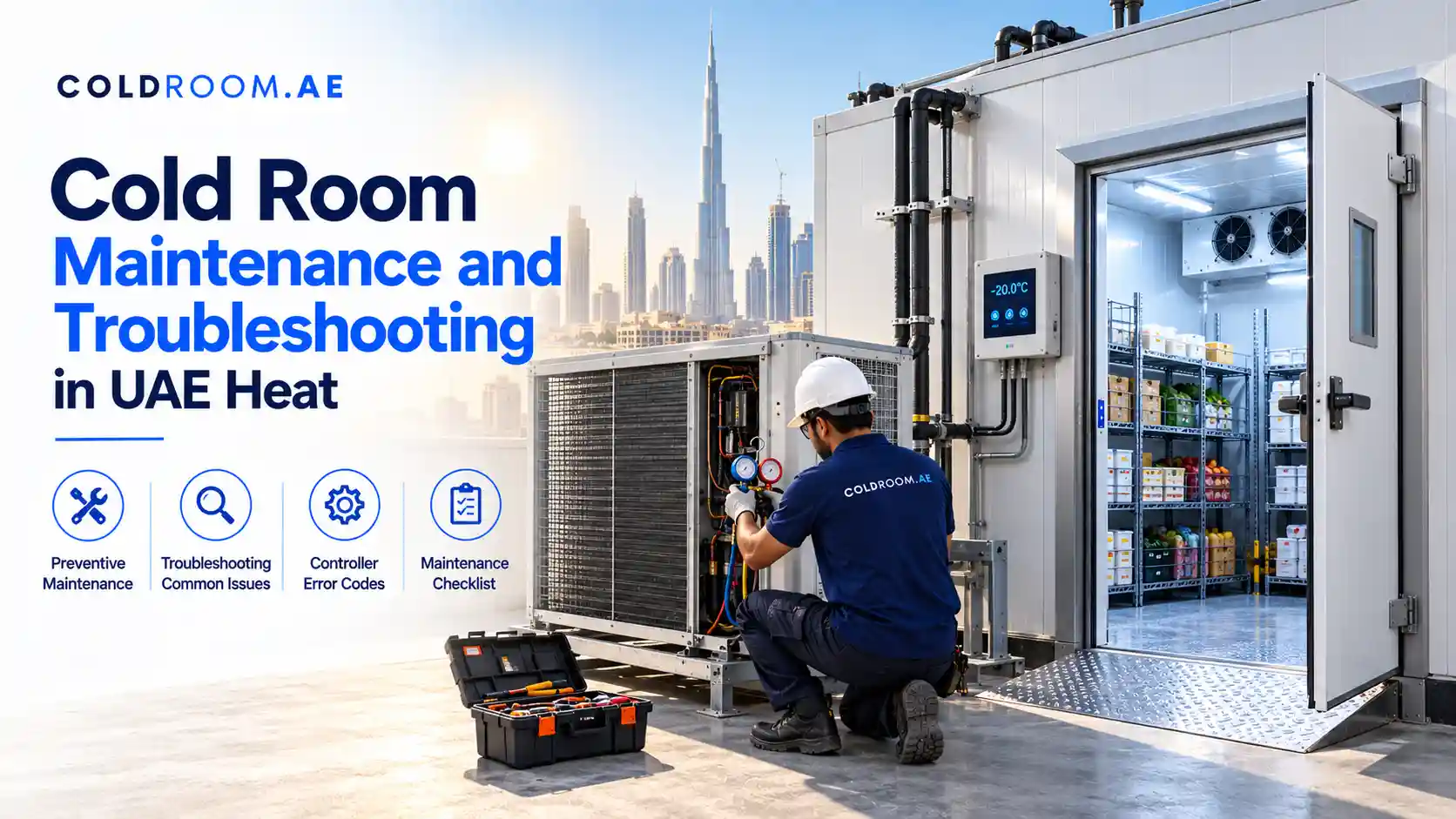
Cold room maintenance covers four things: the refrigeration system, the insulated panels, the doors and the temperature controls. Each needs regular inspection, cleaning and servicing so that stored goods stay at the temperature they need. The UAE makes this harder. In summer, Dubai, Abu Dhabi, Sharjah and Ajman often pass 45°C, and the air can approach 50°C. At that point compressors, condensers and door seals are all working near their limits.
We wrote this guide for restaurant and supermarket operators, facility managers and industrial cold storage teams across the UAE. It starts with the cold room problems that come up most often and their usual causes. Cold room troubleshooting comes next, step by step. It also shows where site staff should stop and call a qualified refrigeration technician.
Coldroom.ae designs, builds and maintains cold room solutions for businesses across the UAE, so the advice below comes from work on rooms that run through the summer.
Quick answers
- Four faults explain many cooling failures: a dirty condenser, ice on the evaporator, worn door seals and refrigerant loss.
- In UAE conditions, dust on the condenser coil is a frequent reason a system runs hot and trips on high pressure.
- Staff can log temperatures, check seals and spot ice. Refrigerant, electrical and heater work belongs to a qualified technician.
- Freezer rooms need extra checks: the heated pressure relief vent, drain line heaters and defrost heater current.
What is cold room maintenance?
Cold room operation and maintenance covers three kinds of work.
Preventive maintenance is scheduled: cleaning coils, checking seals, testing alarms and recording temperatures.
Corrective work starts after something fails. This is cold room repair or cold storage repair, and it is usually done in a hurry because stock is already at risk.
Predictive maintenance relies on records. Logs and alarm history can show a room changing before it fails, such as slow recovery after a door opening. See our guide to data loggers for cold rooms.
The parts of a cold room depend on each other, so a fault rarely stays where it starts. A failed evaporator probe stops the controller knowing when defrost is complete, so it ends the cycle on a timer. A worn door gasket lets in humid air, which freezes on the evaporator, and the room warms even though the plant itself is fine.
Why does UAE heat make cold storage maintenance harder?
The UAE falls in ASHRAE Climate Zone 0, the category for extremely hot climates. Heat and humidity drive most problems, and dust adds to them (see condenser overheating below).
Heat raises the compressor’s workload. A freezer holding -25°C in 45°C air has a 70°C temperature difference across its walls. A room designed around a 35°C day only has to handle 60°C, so at 45°C the same room carries about 17% more heat through its panels. The compressor meets this extra load at the worst moment. On a hot afternoon, condensing temperature and head pressure climb, and the compressor loses efficiency as it works harder. Energy use shows the effect. In one display-case test, compressor energy rose about 13% when condensing temperature went from 40°C to 45°C. A cold room will not match that figure, but the direction is the same.
Humidity matters most at the door. In coastal cities every opening lets in moist air that ends up as ice on the evaporator.
What temperatures must a UAE cold room maintain?
Maintenance exists to hold these ranges. For a breakdown by product, see our guide to cold room temperature in the UAE.
| Entity | Attribute | Value |
|---|---|---|
| Chiller room | Maximum for high-risk food | 5°C (range 0°C to 5°C; many operators target 2°C to 4°C) |
| Freezer room | Product temperature | -18°C or colder (room typically -18°C to -22°C) |
| Blast freezer | Typical room range | -30°C to -40°C |
| Pharmaceutical cold room | Required range | 2°C to 8°C |
| UAE summer ambient | Peak temperature | Above 45°C, near 50°C |
Dubai Municipality and ADAFSA are the food safety authorities in Dubai and Abu Dhabi, and the chilled and frozen limits above match those in our HACCP guide for UAE cold rooms. Pharmaceutical storage follows WHO Annex 9 and the rules of MoHAP, DHA and DoH. Missing the limits can bring enforcement action, so a cooling fault is a compliance risk as well as a quality risk.
What are the most common cold room problems?
| Symptom | Common causes | Operator can check | Call a technician when |
|---|---|---|---|
| Room not reaching setpoint | Dirty condenser, iced evaporator, worn seals, bulk warm loading, low refrigerant | Alarms, door closure, ice, airflow | Refrigerant loss is suspected, the compressor is not running, or checks change nothing |
| Heavy ice on evaporator | Seal or air curtain failure, blocked fans, defrost heater or probe fault | Door closure, stock clearance | A defrost heater, probe or control fault is suspected |
| Compressor runs continuously or short-cycles | Iced coil, refrigerant loss, valve fault, tripping safety switch | Ice, condenser cleanliness, alarms | Always |
| High-pressure trip | Fouled condenser, failed condenser fan, overcharge, air in the system | Whether the condenser fan runs; visible blockage (power isolated by an authorised person) | The trip repeats, or no blockage was found and cleared |
| Foaming sight glass, red lockout code or oil spots on pipework | Liquid refrigerant at the compressor, protection lockout, leak | Record what you see | Immediately |
Cold room refrigeration system troubleshooting: root causes explained
Evaporator icing and defrost failure
Each time the door opens, humid air enters the room. The moisture settles on the evaporator and freezes as frost. A thin layer is normal. A thick one is a fault. Ice that bridges the fins blocks airflow, and the room then stops reaching its setpoint.
Freezers add two defrost failures. If the termination probe fails, the heaters can run on after the coil is clear, and the room warms. If a heater element burns out, the coil is never cleared and ice keeps building. Fans also have a delay after defrost. They stay off until the coil has cooled, commonly to around -5°C, so that they do not throw water droplets onto stored product.
Condenser overheating and high discharge pressure
Condenser faults come up often in UAE summers. The gap between outdoor air and condensing temperature is small to begin with, so a coil that cannot reject heat has little margin. Fine sand lodges between the fins and acts as insulation. Condensing temperature then settles several degrees above where it should be, and discharge pressure and discharge gas temperature rise with it.
Every compressor has a discharge temperature limit. For one Copeland scroll model it is 130°C, and protection devices act once it is passed. As the temperature nears that point, the oil starts to degrade, discharge valves take damage and high-pressure cutouts begin to trip. The first warning is often a higher power bill rather than an alarm. Regular condenser cleaning remains the main defence.
Refrigerant leaks and blended refrigerants
Many newer UAE installations use R448A or R449A, and older systems may still run R404A. Confirm which refrigerant is in the system before any recharge. R448A and R449A are zeotropic blends, meaning their components boil at different temperatures. In a slow leak, the more volatile components escape first. What remains no longer matches the design mix, so capacity falls and pressures drift.
For this reason, many technicians recover the charge, repair the leak and recharge by weight rather than topping up. The manufacturer’s guidance for the refrigerant and compressor should decide the method. Leaks leave evidence. Escaping gas carries oil with it, so dark, oily marks at a joint or valve usually show where to look.
Expansion valve problems
A thermostatic expansion valve (TXV) can hunt. It swings between feeding too much refrigerant and too little. Common causes are an oversized valve, a sensing bulb that is not insulated, or a poor superheat setting. Overfeeding can send liquid refrigerant to the compressor. Underfeeding cuts capacity. An electronic expansion valve (EEV) holds superheat more steadily.
Door seals, air curtains and insulation panels
The paper strip test is the quickest gasket check. Close the door on a strip of paper and pull it. If it slides out without resistance, the seal is worn. PVC strip curtains should overlap fully, with no gaps between strips.
Air curtains should be sized for the door height and run whenever the door is open. A stronger jet is not necessarily better, since efficiency falls once the airflow is stronger than the door needs.
Insulation panels rely on their vapor barriers and joint seals. If moisture gets in, it displaces the insulating gas in the foam. The panel then insulates less, and its outer surface starts to sweat. An infrared camera can show damp areas before the panel fails.
Pressure relief vents
Warm air that enters a cold room cools and contracts, and the room is left under a partial vacuum. The effect is stronger in a freezer. A pressure difference of only about 0.04 PSI puts more than 100 pounds of force on a freezer door of about 3 x 6 ft. During defrost the effect reverses: the air expands and builds positive pressure. A relief vent evens out both conditions.
Vents are not limited to freezers. Some positive-temperature rooms have them too, depending on the panel design. In a freezer, moisture can freeze the vent flaps shut, so freezer vents carry a built-in heater. One manufacturer’s spec sheet says that heater should not be connected on positive-temperature rooms.
How to fix a cold room that is not cooling
These checks run from the quickest and safest to those that point toward a technician. Stop at the first fault you cannot safely handle yourself.
- Read the controller. Note the temperature and any alarm code, such as P1, P2 or HA, before touching anything.
- Check the basics. Is the setpoint right? Does the door close fully? Was warm stock loaded recently?
- Inspect the seals and strip curtains with the paper strip test above.
- Look at the evaporator. Check for heavy ice and make sure the fans turn freely. Move stock within 30 cm of the fans or walls.
- Check the condenser. Have an authorised person isolate the power first, then look for dust packed between the fins. With power back on, stand clear and confirm the condenser fan starts with the compressor.
- Observe the compressor. Does it run continuously, short-cycle or fail to start? Note any hissing, knocking or vibration.
- Escalate. If the cause is still unclear, call a technician with your notes from steps 1 and 6. Call at once for oil on the pipework or a lockout code on a protection module.
What do cold room temperature controller error codes mean?
The cold room temperature controller is the control centre of the room. Dixell (now part of Copeland) and Carel controllers are widely used, and the Dixell XR series is a common example. Codes differ by brand and model, so check your unit’s manual.
| Code | Meaning | Effect | What to do |
|---|---|---|---|
| P1 | Room probe failure | Safety duty cycle | Check wiring, test the probe, replace it if faulty |
| P2 | Evaporator probe failure | Defrost ends on a time limit | Replace promptly, since defrost can be incomplete or overheat the coil |
| HA | High temperature alarm | Alarm only | Check doors, warm loading, the condenser and evaporator ice |
| LA | Low temperature alarm | Alarm only | Check the setpoint, then look for a stuck contactor or solenoid keeping the compressor on |
| PoF | Keypad locked | Buttons do not respond | Hold UP and DOWN for about 3 seconds until PoN appears |
If the displayed temperature differs from a calibrated thermometer, a technician can correct it with the probe calibration offset, labelled “ot” on many Dixell models.
How to set a cold room temperature: on many controllers, hold SET for a few seconds until the setpoint blinks, change it with the arrow keys and press SET to save. Then keep the door closed and watch the logged temperature settle before loading product.
Protection modules such as Copeland CoreSense or Bitzer SE-B2 show lockout codes on LEDs. Record any red code and call a technician.
Cold storage maintenance checklist for UAE conditions
Cold rooms involve high-pressure refrigerant, 415V three-phase power and, in some plants, flammable or toxic refrigerants. Operators handle visual checks and logs.
| Frequency | Action | Who | Purpose |
|---|---|---|---|
| Daily | Log temperature, check alarms, inspect gaskets and strip curtains | Operator | Compliance and early fault detection |
| Weekly | Check the oil sight glass, evaporator ice and fans; listen for knocking or hissing | Operator observes, technician acts | Catch lubrication and airflow problems |
| Monthly | Condenser: brush loose dust off the fins with power isolated by an authorised person. Never hose live electrics | Operator for light cleaning, technician for a deep wash | Keep discharge pressure down |
| Monthly | Drain lines and pans; superheat against the valve target (commonly 5 to 8 K) | Operator (drains), technician (superheat) | Prevent overflow and liquid slugging |
| Quarterly | Electrical panel thermal scan; manual defrost with a heater current check; freezer vent faceplate slightly warm | Technician | Catch loose terminals, confirm heaters work |
| Pre-summer | Filter drier and sight glass; thermographic scan of panels | Technician | Keep the system dry and locate vapor barrier breaches |
| Annually | Full audit, pressure test, controller calibration | Technician | Plan repairs before peak season |
Technician-only work includes electrical diagnosis, attaching gauges, handling refrigerant, replacing defrost heaters and leak tracing. A tripped breaker points to a deeper fault, such as a shorted winding, so a technician should run an insulation resistance (megger) test before it is reset.
Avoid some old habits. Never place a jumper across a tripping safety switch, and never use mineral oil with HFC refrigerants, since polyolester oil is the standard pairing. Do not trust the room air probe alone either: food safety depends on product core temperature, so add a second probe in a glycol bottle.
Freezer room maintenance vs chiller room maintenance
The refrigeration cycle is the same, but water behaves differently at 4°C and at -20°C.
| Area | Chiller room (0°C to 5°C) | Freezer room (-18°C or colder) |
|---|---|---|
| Defrost | Often off-cycle, room air melts frost | Electric heaters or hot gas |
| Drain lines | Check pans for algae and slime | Heater trace must work, or the pipe freezes |
| Relief vent | Fitted where the panel design calls for it; no heater | Heated vent required |
| Floor | Standard checks | Large rooms may need underfloor heating against frost heave |
What should UAE facilities consider across Dubai, Abu Dhabi, Sharjah and Ajman?
Schedule the full service a few weeks before summer heat starts, not during it. That leaves time to repair whatever it finds. Then set the cleaning schedule by site: a condenser beside a dusty road or construction area clogs faster than one in a clean plant room, and monthly cleaning may not be enough there.
Inspectors can ask for temperature records, so keep the log complete. Rules differ between emirates. Facilities in Sharjah, Ajman and the other emirates should confirm the requirements with the authority that licenses their premises.
How does maintenance differ for commercial and industrial cold rooms?
| Factor | Commercial cold rooms | Industrial cold rooms |
|---|---|---|
| Typical users | Restaurants, hotels, supermarkets, central kitchens | Food processors, cold storage warehouses, 3PL hubs, pharmaceutical distributors |
| Main focus | Door discipline, condenser cleaning, controller logs | Defrost scheduling, frost heave protection, redundancy, panel inspection |
Read more about walk-in freezers for UAE food supply chains.
How do you choose a cold room manufacturer or supplier with maintenance in mind?
A cold room solution that is easy to maintain is decided at the specification stage, so put these questions to cold room manufacturers and suppliers in the UAE before you order.
| Ask about | Why it matters | A good answer |
|---|---|---|
| Condenser rating | UAE summer air above 45°C overloads equipment chosen for milder climates | A condensing unit rated for high ambient temperatures |
| Brands | Established brands, for example Bitzer, Copeland or Danfoss compressors and Dixell or Carel controllers, are easier to service | Named brands and a manufacturer test certificate for the compressor |
| Spare parts | A part that takes weeks to arrive turns a small fault into a long outage | Common parts held locally, with a stated lead time for the rest |
| Monitoring and handover | Alarms catch a failing room overnight, and the next technician needs the setup details | A data logger with alarms, plus setpoints, parameters and wiring diagrams in writing |
If a supplier cannot answer two or three of these clearly, treat that as a warning about post-installation support.
Frequently asked questions
Check the compressor first. If it is running and the room is still warm then the heat has nowhere to go. The cause is usually ice on the evaporator or blocked fans. A dirty condenser or worn door seals can do the same. If the compressor is not running read the controller for an alarm or lockout code. Then see whether a protection device has tripped.
Staff check the room daily and weekly. The condenser is cleaned monthly. A technician visits every quarter. A full inspection comes before summer and an audit once a year. Treat that as a common schedule and not a fixed rule. Dusty sites may need cleaning more often. A stricter manufacturer interval takes priority.
The controller runs the room. It switches the compressor, defrost and fans to hold the setpoint. The data logger only records. It keeps a temperature history for audits and sounds an alarm when a limit is exceeded. Most facilities want both. A logger with its own probe can also show when the controller’s probe has drifted.
A vacuum is holding the door shut. Warm air that got in has cooled and contracted. Forcing the door can damage it. If anyone is inside use the internal emergency release and get help immediately. If the room is empty wait a few minutes for the pressure to equalise. Then check the relief vent. Frost on the vent points to a heater or flap fault. Tell a technician and never block the vent.
Talk to Coldroom.ae about your cold room
If your cold room is struggling in the summer heat, or you are planning an installation or upgrade, speak with the Coldroom.ae team. Coldroom.ae has more than 7 years of experience in UAE cold storage and offers ongoing maintenance and repair services. Share the symptoms and room details, and the team will help identify the likely cause and next step.